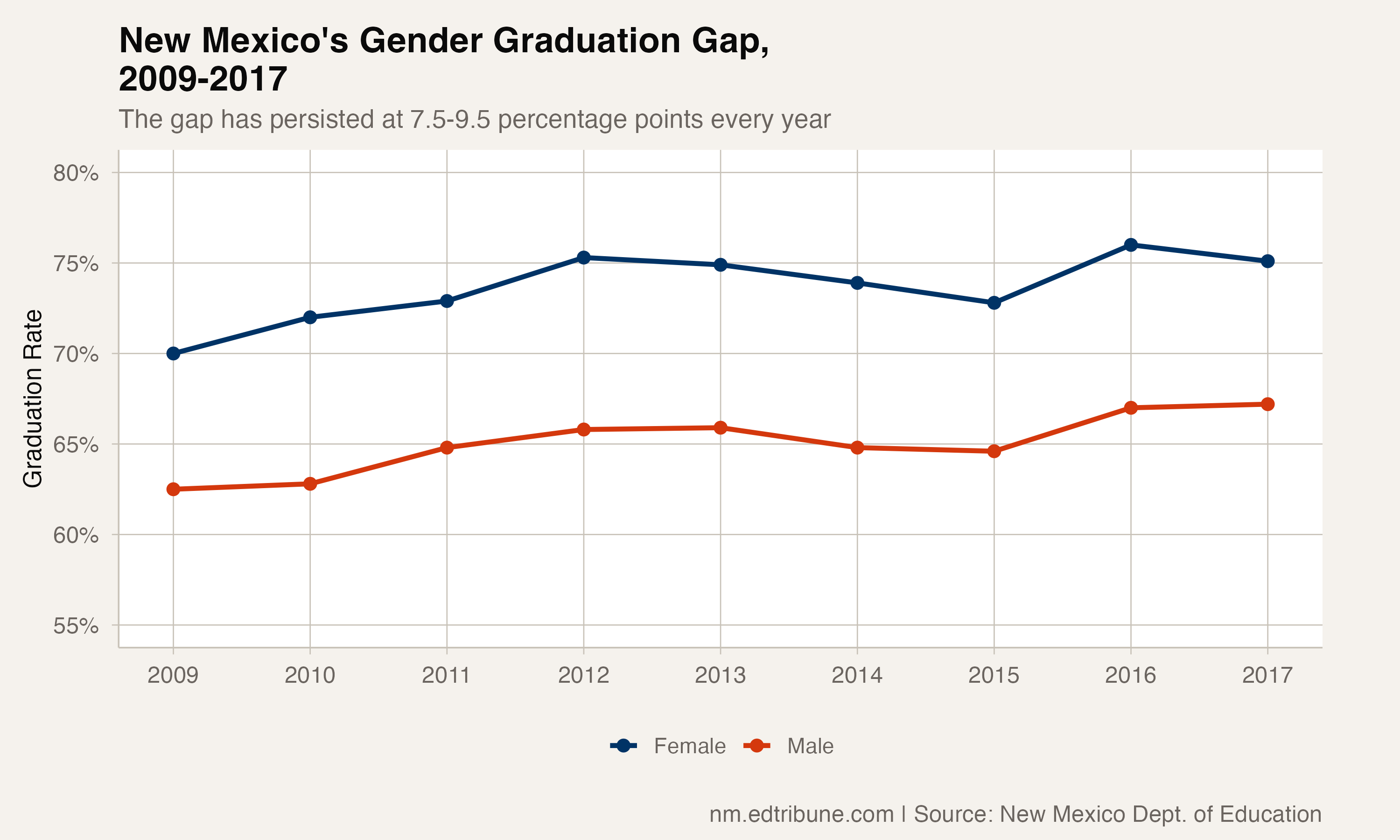
In every year since New Mexico started measuring four-year graduation rates, girls have outpaced boys by at least seven and a half percentage points. In most years, the gap has been closer to nine.
For the Class of 2017, 75.1% of female students graduated on time. For male students, 67.2%. That 7.9-point gap is roughly three points wider than the national average gender gap of approximately five points.
A gap that refuses to narrow
The consistency of the gap is its most striking feature. From 2009 to 2017, the female-male graduation gap never dropped below 7.5 points (in 2009) and peaked at 9.5 points (in 2012). Both genders improved over the period -- girls by 5.1 points, boys by 4.7 -- but the improvement was almost perfectly parallel, leaving the gap functionally unchanged.
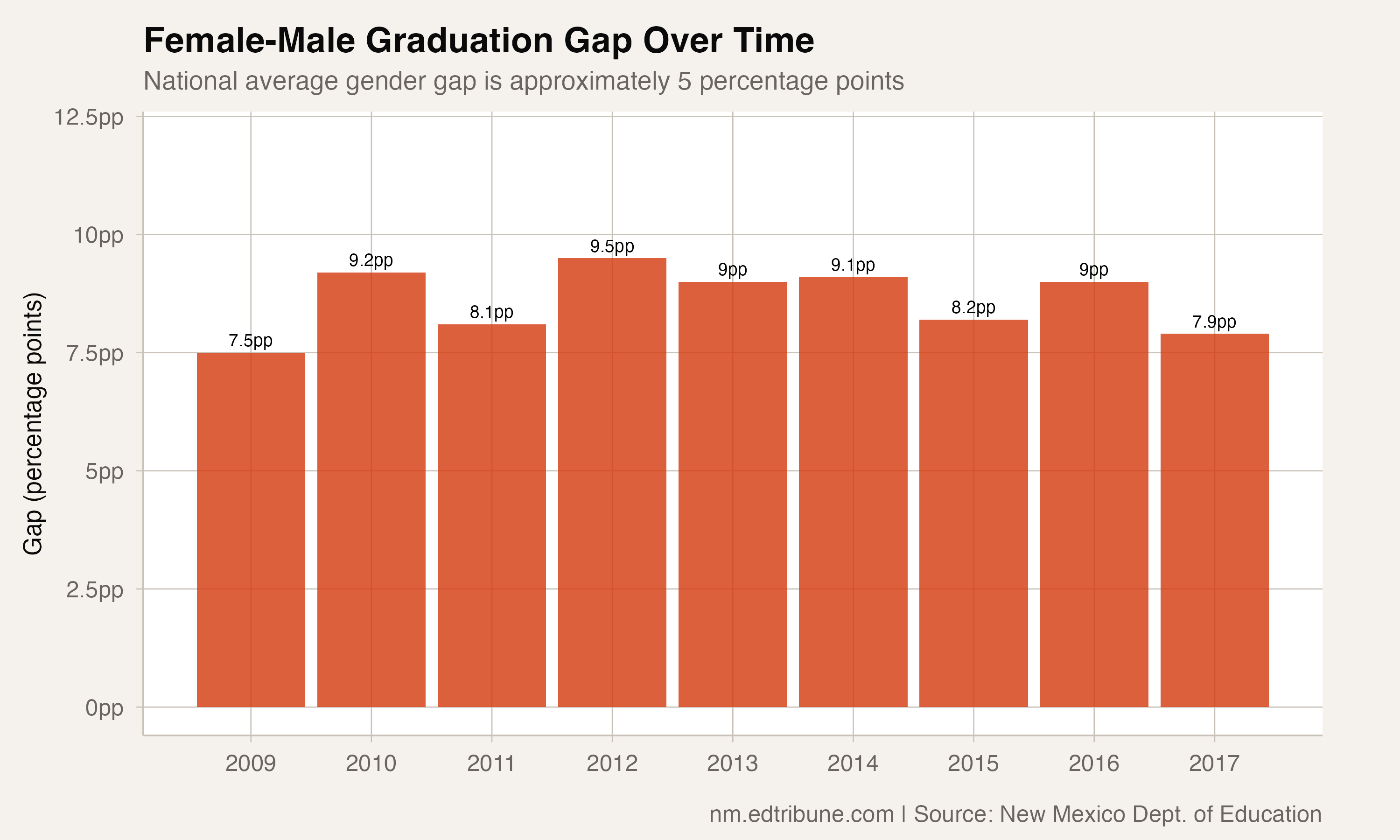
The gap narrowed slightly at the bookends: 7.5 points in 2009 and 7.9 in 2017. But the years between tell a different story. In 2012, girls reached 75.3% while boys sat at 65.8%, a 9.5-point gap that was the widest of the ACGR era. The mid-decade decline in overall rates hit both genders, but boys bottomed out lower (64.6% in 2015) than girls (72.8%).
Where boys fall in the ranking
The 67.2% male graduation rate is not just below the female rate. It falls below nearly every other subgroup in the state.
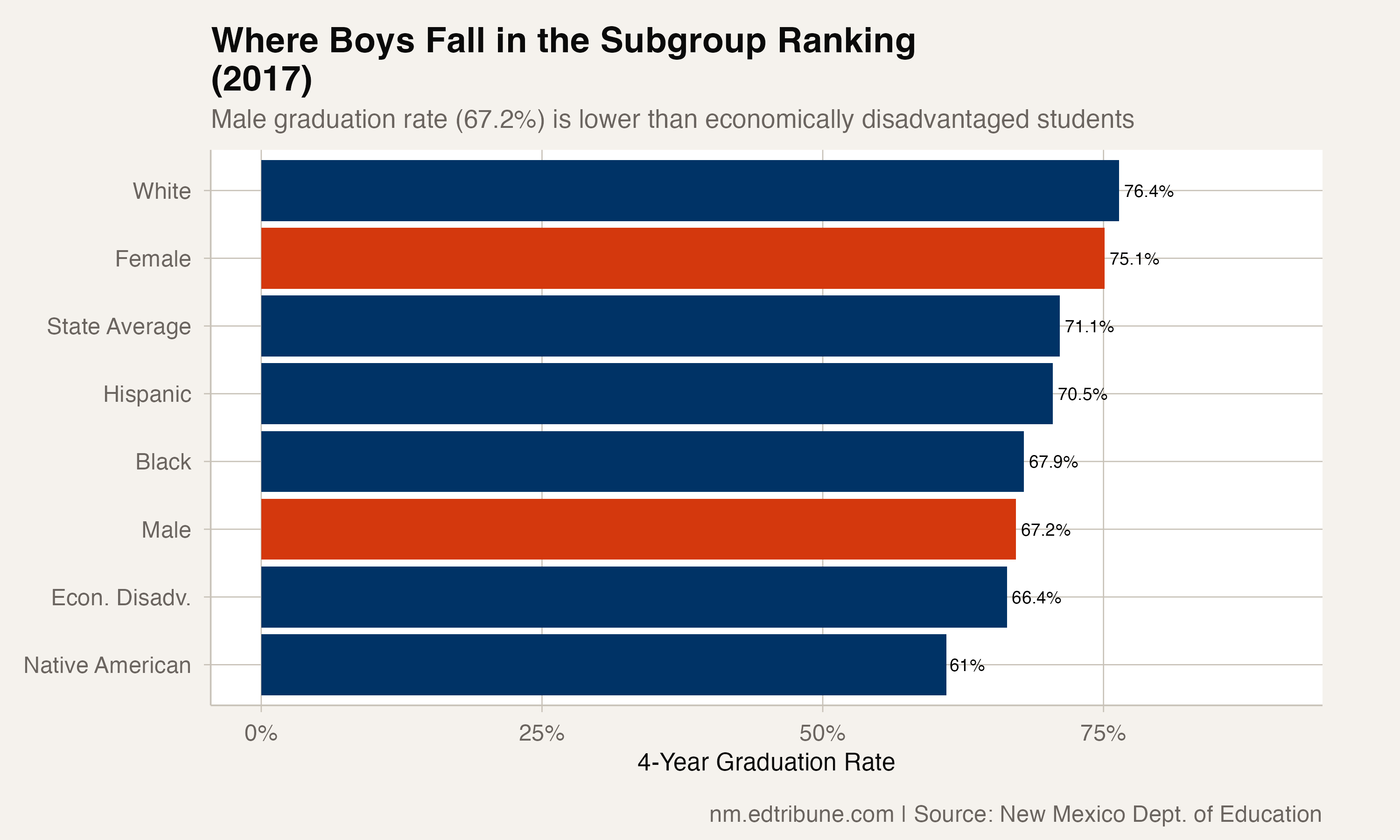
Economically disadvantaged students graduated at 66.4% in 2017, barely below male students at 67.2%. Black students graduated at 67.9%, just above. Only Native American students (61.0%) and students with disabilities (61.5%) ranked lower than boys as a group.
Put another way: being male in New Mexico is associated with a lower graduation rate than being economically disadvantaged. That comparison is imprecise -- many male students are also economically disadvantaged -- but it illustrates how large the gender effect is relative to other factors.
The district picture
At the district level, gender gaps range from negligible to enormous.
In 2017, Jemez Valley Public Schools reported a 32.1-point gender gap (77.1% for girls, 45.0% for boys). Cuba Independent Schools had a 29.0-point gap. In both cases, small cohort sizes mean individual students can shift the numbers substantially. But the pattern repeats across enough districts to suggest something beyond statistical noise.
Among larger districts, Albuquerque Public Schools (10.0 points) and Santa Fe Public Schools (10.5 points) sit just above the 7.9-point statewide gap. Las Cruces Public Schools runs counter to the pattern at 5.6 points, with both boys (82.8%) and girls (88.4%) graduating at well above the state average.
The improvement that was not enough
Boys did improve. The 4.7-point gain from 62.5% (2009) to 67.2% (2017) represents real progress. In absolute terms, more boys graduated in 2017 than in any previous year measured.
But girls improved faster. And the national average for boys, while also below the national average for girls, sits somewhere in the low 80s -- more than 15 points above where New Mexico's boys are. The state's gender gap is not just a reflection of a national pattern amplified; it exists on top of an already-low base rate.
The 67.2% rate means roughly one in three boys in New Mexico does not earn a diploma within four years. For girls, it is one in four. Both numbers are too high, but the gap between them has proven remarkably resistant to eight years of statewide graduation improvement.
Data from the New Mexico Public Education Department. Graduation rates are 4-year Adjusted Cohort Graduation Rates (ACGR) for cohorts 2009-2017. National gender gap estimate from NCES.
Detailed code that reproduces the analysis and figures in this article is available exclusively to EdTribune subscribers.
Discussion
Sign in to join the discussion.
Loading comments...