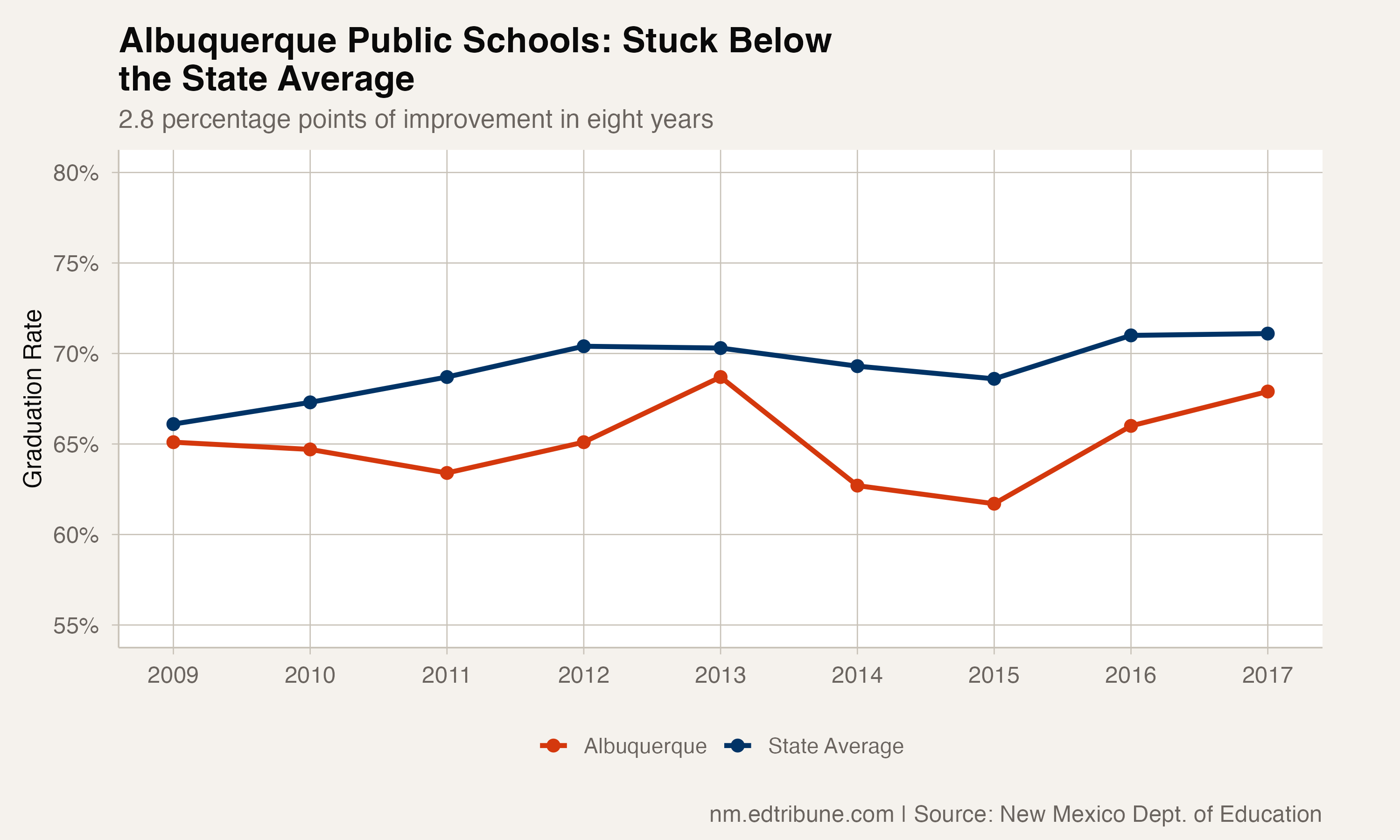
Albuquerque Public Schools↗ET educates more than a quarter of New Mexico's students -- about 27% of the statewide total. In 2017, the district graduated 67.9% of them on time.
That rate is 3.2 points below the state average and 18 points below what Las Cruces↗ET achieved the same year. Over eight years of ACGR measurement, Albuquerque gained just 2.8 percentage points -- barely more than a third of a point per year -- while the state gained five.
In this series: the state's 16-point gap with the nationET and the gender chasm between New Mexico boys and girlsET.
Stuck in a band
The most telling feature of Albuquerque's graduation data is how narrow the range has been. From 2009 to 2017, the rate bounced between 61.7% and 68.7%. The swings were sharp -- a 7.0-point drop from 2013 to 2015, a 6.2-point gain from 2015 to 2017 -- but they largely cancelled each other out.
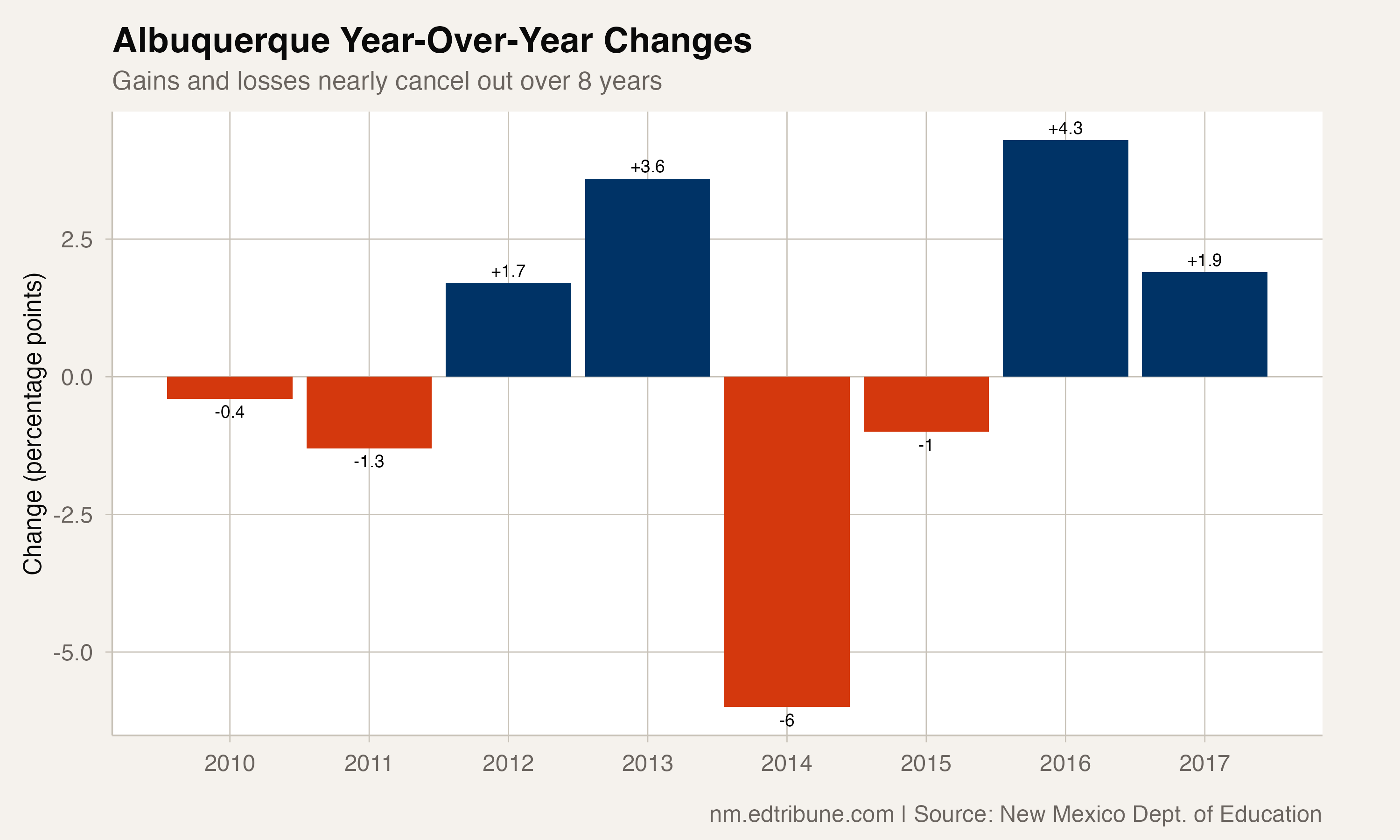
The district hit its lowest point in 2015 at 61.7%, a level that would be alarming in any context but particularly in the state's largest school system. The recovery to 67.9% by 2017 brought the rate back to approximately where it had started in 2009 (65.1%) -- progress, but of the most frustrating kind, recapturing ground that had already been covered.
The subgroup gaps inside APS
Within Albuquerque, the disparities follow the statewide pattern but are sharper in some cases.
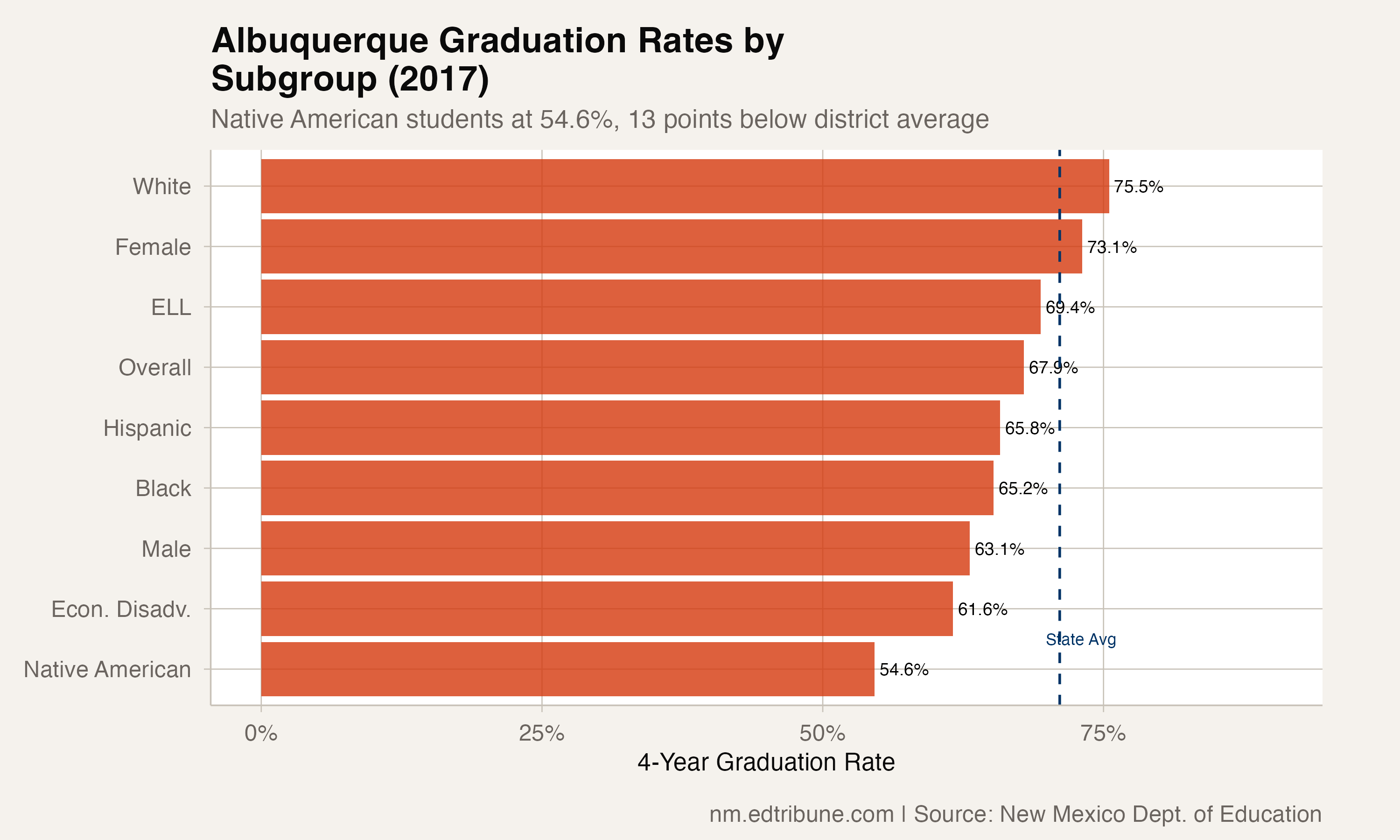
Native American students in APS graduated at 54.6%, 13.3 points below the district average and 6.4 points below the statewide Native American average. Students who are economically disadvantaged graduated at 61.6%. Male students at 63.1%.
Across the major race and gender subgroups, APS sat below the statewide rate for that group. White students at APS (75.5%) trailed the statewide white rate (76.4%) by nearly a point. Asian students at APS (83.3%) trailed the statewide Asian rate (85.4%) by two. Hispanic students in APS (65.8%) were nearly five points below the statewide Hispanic average of 70.5%.
The one notable exception was the district's English learners. At 69.4%, APS students learning English exceeded the statewide rate for that subgroup (68.1%) and even exceeded the district's Hispanic rate. The district's dual-language programs and newcomer supports appear to be producing results for this specific population.
The weight on the state average
When a district this large underperforms, it affects everything above it. Albuquerque's 67.9% rate, applied to more than a quarter of the state's students, acts as an anchor on the statewide number. A back-of-the-envelope calculation suggests that if APS had matched the state average of 71.1%, the state average itself would have been perhaps a point higher.
The comparison with Las Cruces is instructive. Both districts started the ACGR era in the mid-60s. Both serve majority-Hispanic student populations with significant low-income enrollment. Las Cruces ended at 85.5%. Albuquerque ended at 67.9%. The starting conditions were similar; the outcomes were not.
Recent context
Reporting from Albuquerque Public Schools shows the district reached 75.9% for the Class of 2024, a substantial improvement beyond the data window. That improvement, if sustained, would represent the kind of movement that the 2009-2017 data never managed to produce.
But even 75.9% would leave APS below where Las Cruces and Hobbs↗ET were in 2017. The district's challenge is not just improving but closing the gap with its peers -- a gap that grew wider during the very years the data covers.
Data from the New Mexico Public Education Department. Graduation rates are 4-year Adjusted Cohort Graduation Rates (ACGR) for cohorts 2009-2017.
Detailed code that reproduces the analysis and figures in this article is available exclusively to EdTribune subscribers.
Discussion
Sign in to join the discussion.
Loading comments...