Correction (May 29, 2026): An earlier version of this article overstated one comparison and several figures. Espanola's 21.5% rate was the lowest Native American graduation rate of any New Mexico district in 2017, not the lowest of any subgroup in any district. The rate was about 35% of the statewide figure for Native American students (not "less than a third"), the nine-year district average for Native American students was roughly 50% (not 46%), and Bernalillo's equity gap was 11.2 points (not 10.9). The displayed numbers have been corrected.
In 2017, Espanola Public Schools↗ET graduated 65.5% of its students on time, the highest overall rate the district had posted since New Mexico began publishing four-year cohort figures. The rate had climbed from the mid-50s, part of a three-year upward slope that the district carried into the end of the available data.
That progress did not reach everyone. Among Espanola's Native American students, the four-year graduation rate that year was 21.5%, the lowest Native American graduation rate of any district in New Mexico in 2017. It sat 44 percentage points below the district's overall rate, which itself trailed the state average by nearly six points. Statewide, about six in ten Native American students graduated on time in 2017; in Espanola, the figure was about 35% of that statewide rate for their demographic group.
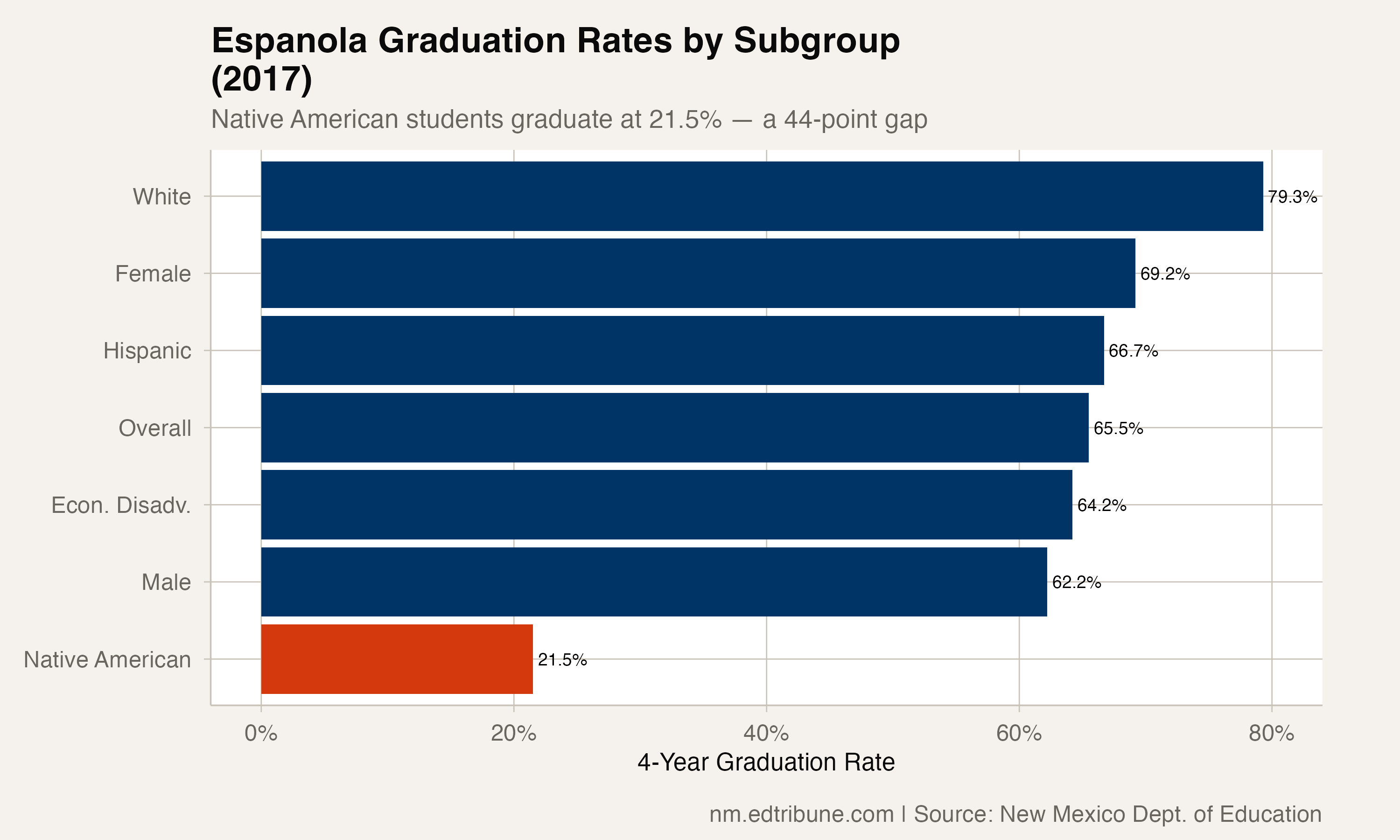
The volatility beneath
The 2017 figure is stark, but it did not come from nowhere. Native American graduation rates in Espanola have been volatile for as long as the state has measured them.
The rate has swung between a low of 21.5% in 2017 and a high of 69.5% in 2014. In between, it has moved by double digits in a single year more than once. The rate jumped from 47.5% (2013) to 69.5% (2014), then fell to 57.1% (2015), 48.0% (2016), and dropped sharply to 21.5% (2017).
These swings likely reflect small cohort sizes. When a graduating class has only a handful of Native American students, the graduation or non-graduation of two or three individuals can move the rate by 20 points. But the long-term average tells the same story as the extremes: across nine years, the rate never exceeded 70% and averaged roughly 50%.
A district that has struggled broadly
Espanola's problems are not limited to its Native American students. The district's overall graduation rate has been among the lowest of any mid-size district in the state.
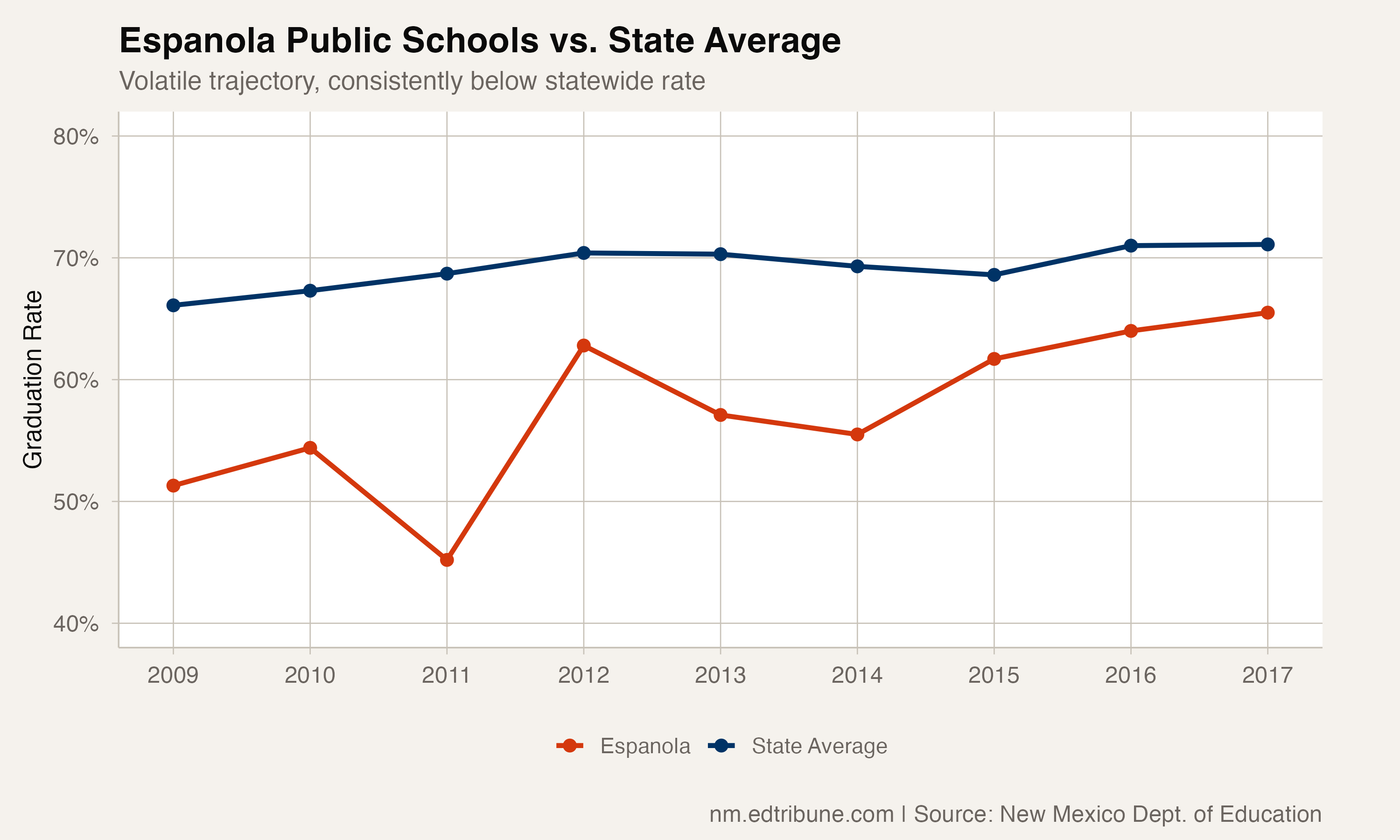
From 2009 to 2017, the overall rate ranged from a low of 45.2% (2011) to a high of 65.5% (2017). The trajectory shows improvement, with the rate climbing from the mid-50s to the mid-60s over the period, but the gains have been unsteady. A jump to 62.8% in 2012 was followed by declines in 2013 and 2014. The rate did not surpass its 2012 level again until 2016.
The district ended the data window on an upward slope, posting 64.0% in 2016 and 65.5% in 2017. Whether that trajectory continued into subsequent years is beyond what this data can show.
The widest gap in the state
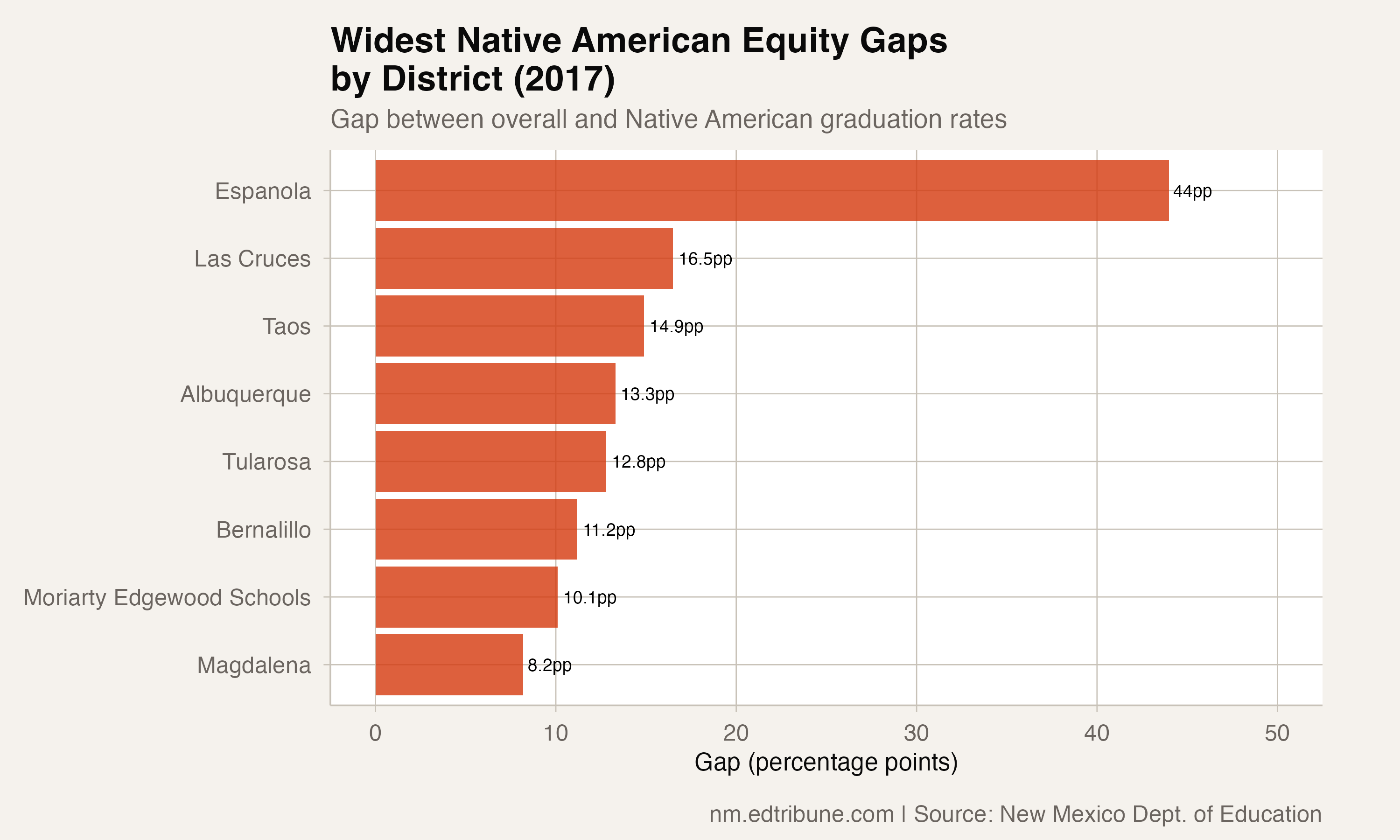
Espanola's 44-point gap between its overall and Native American graduation rates was the widest in the state in 2017. For comparison, Albuquerque Public Schools had a 13.3-point gap, Bernalillo had an 11.2-point gap, and Gallup-McKinley had a 2.1-point gap.
The districts with the narrowest gaps tend to be those where Native American students are the majority and the overall rate is itself low. In Gallup-McKinley and Central Consolidated, for instance, the Native American rate is close to the overall rate because most students are Native American. In Espanola, Native American students are a significant but not majority presence, and the gap reflects different outcomes for different groups within the same schools.
The valley's other crisis
Espanola sits in the Rio Grande Valley between the Ohkay Owingeh and Santa Clara Pueblos. Its student body includes children from both pueblos, from surrounding rural areas, and from the town itself. The dynamics of a school district that serves tribal communities without being a tribal school system create particular tensions around culture, curriculum, and governance that enrollment and graduation numbers cannot measure.
The district has also been affected by the opioid epidemic, which hit the Espanola Valley harder than nearly anywhere else in the country. Research from the New Mexico Department of Health has documented some of the highest overdose death rates in the nation in Rio Arriba County, where Espanola is located. The relationship between community health crises and educational outcomes is difficult to quantify but impossible to ignore.
The 21.5% figure demands context, and some of that context (cohort sizes, specific interventions, tribal education partnerships) is not available in the state graduation data. But the scale of the gap and its persistence are beyond dispute. Across nearly a decade, Espanola has graduated its Native American students at rates far below its other students, far below the state average, and far below what the Yazzie/Martinez ruling found constitutionally adequate.
Data from the New Mexico Public Education Department. Graduation rates are 4-year Adjusted Cohort Graduation Rates (ACGR) for cohorts 2009-2017.
Detailed code that reproduces the analysis and figures in this article is available exclusively to EdTribune subscribers.
Discussion
Sign in to join the discussion.
Loading comments...