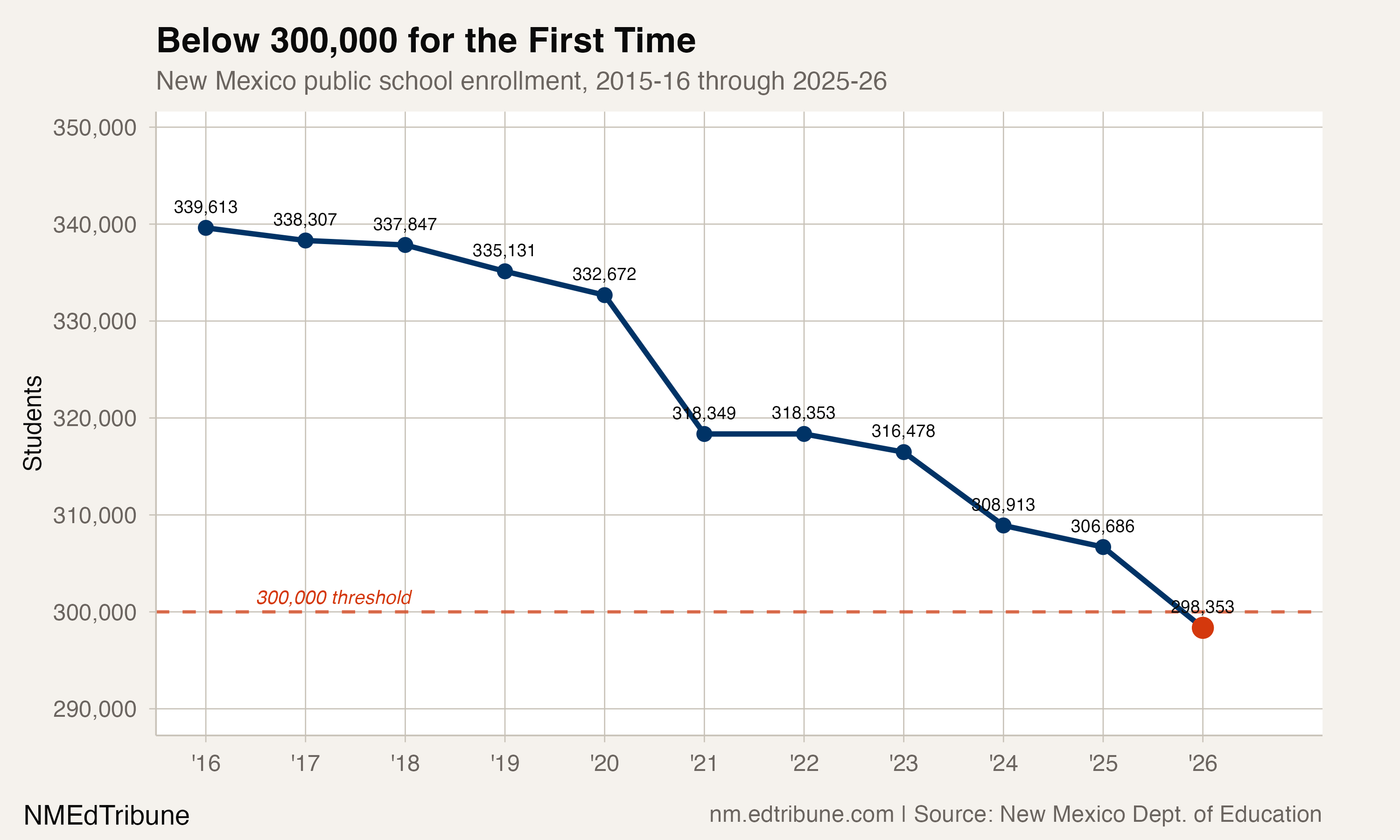
In 10 years of enrollment data, New Mexico has had exactly one year without a decline: 2021-22, when the state gained four students. Four. Every other year, the count dropped. In 2025-26, it dropped below 300,000 for the first time.
The state enrolled 298,353 public school students in 2025-26, down 8,333 from 2024-25 and 41,260 from its 2015-16 peak of 339,613. That is a 12.1% loss over a decade, concentrated in the state's largest districts and accelerating in ways that suggest the bottom is not close.
A decline that keeps getting faster
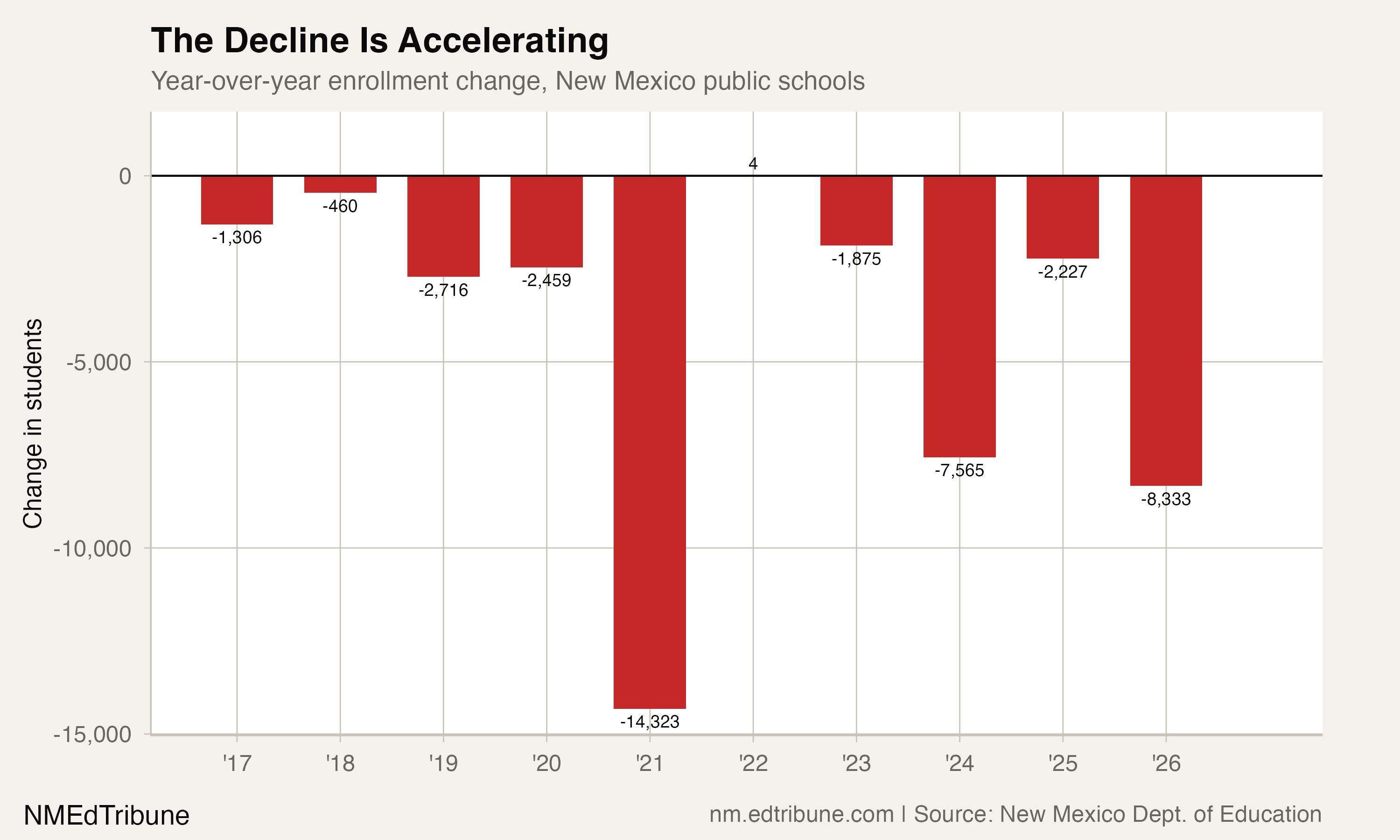
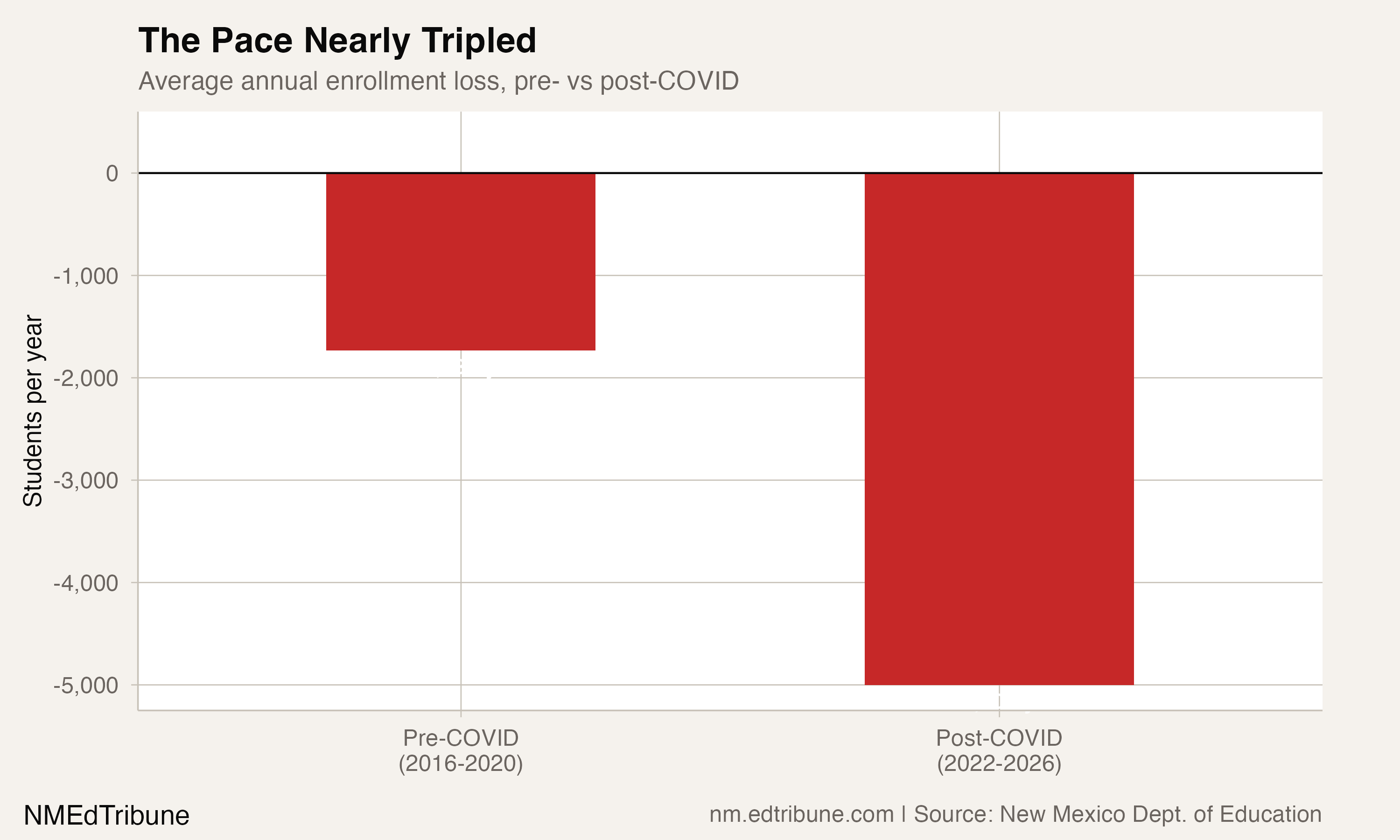
Before COVID, New Mexico was losing students at a pace of roughly 1,735 per year. The pandemic blew a hole in the trendline: 14,323 students vanished in a single year, 2020-21. The state briefly stabilized in 2021-22. It has not stabilized since.
The post-COVID pace, from 2022-23 through 2025-26, averages 5,000 students lost per year. That is 2.9 times the pre-pandemic rate. The two worst years outside of COVID itself were 5,581 lost in 2023-24 and 8,333 in 2025-26. The 2025-26 drop is the largest non-pandemic annual loss in the dataset.
Part of the 2025-26 figure reflects a one-time distortion. Gallup-McKinley County Schools↗ET canceled its virtual education contract with Stride Inc. in mid-2025, displacing approximately 3,000 online students who transferred to other districts. Because New Mexico's funding formula pays districts based on prior-year enrollment, Gallup continued drawing state funds for students it no longer served, creating a $40 million shortfall that prompted emergency legislation in January 2026. Strip Gallup's 3,342-student loss from the statewide figure and the state still lost 4,991 students, a figure worse than any pre-COVID year.
Five districts account for nearly three-quarters of the loss
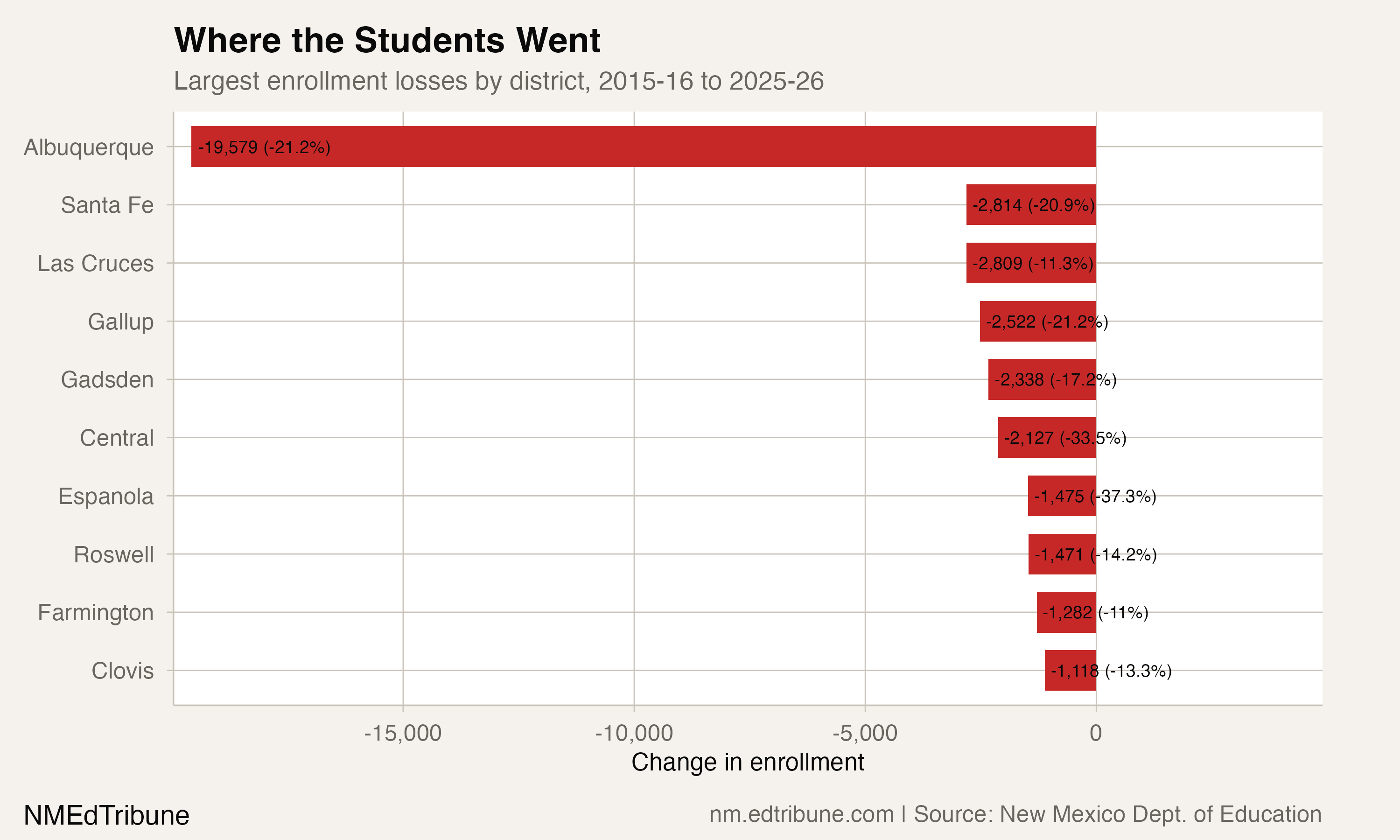
The decline is not evenly distributed. Five districts, Albuquerque↗ET, Santa Fe↗ET, Las Cruces↗ET, Gallup-McKinley, and Gadsden↗ET, account for 30,062 of the state's 41,260-student loss since 2015-16. That is 72.9% of the total.
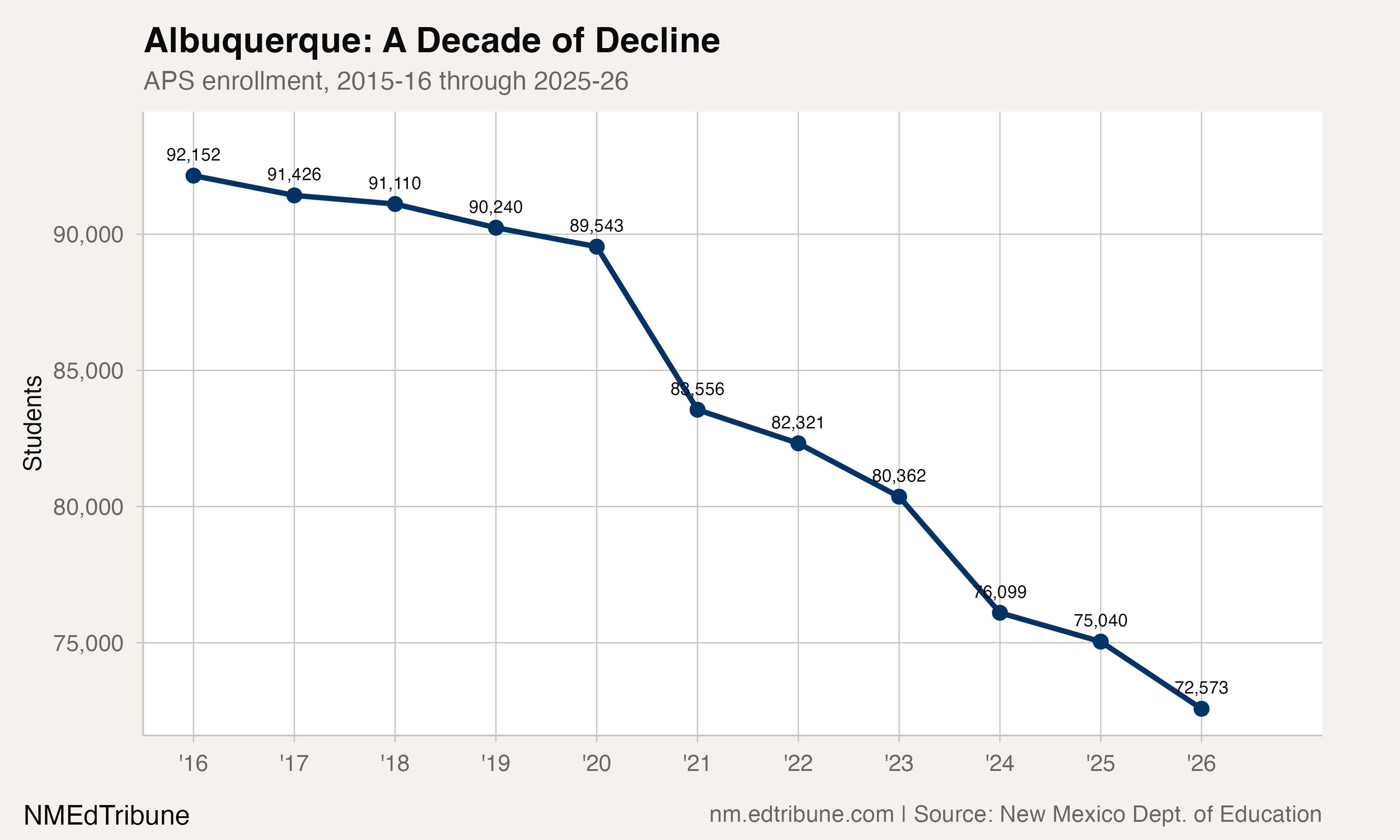
Albuquerque alone accounts for 47.5% of the statewide decline. The district has lost students every year for 10 consecutive years, falling from 92,152 to 72,573, a 21.2% contraction. Its share of statewide enrollment has slipped from 27.1% to 24.3%, meaning the state's largest district is shrinking faster than the state itself.
The fiscal consequences are mounting. APS budgeted for a 2% enrollment decline in 2023-24 and got 5%, costing $2.5 million in State Equalization Guarantee funding the district had already planned to spend. The district's nearly $2.2 billion budget now exceeds the City of Albuquerque's.
Smaller districts face steeper percentage declines. Central Consolidated↗ET has lost 33.5% of its enrollment since 2015-16. Espanola↗ET has lost 37.3%. Three districts, Albuquerque, Socorro↗ET, and Taos↗ET, have declined every single year for a decade straight.
What is driving the acceleration
The most likely structural driver is a sustained decline in births. New Mexico's fertility rate has been falling since 2007, and UNM population researchers project the state's 0-to-24 population will drop by 20% between 2020 and 2040. Births in the state have been in steady decline since 2008, and those smaller cohorts are now working their way through elementary grades and into middle school.
Outmigration compounds the problem. UNM's Geospatial and Population Studies office projects the state's total population will peak around 2.16 million in 2035 and then begin a sustained decline. For a state that is already shrinking its school-age population, every family that leaves accelerates the math.
The growth of alternatives to traditional public schools also plays a role. Johns Hopkins researchers estimate that about 7% of New Mexico's K-12 students were homeschooled in 2022-23, nearly triple the 2.5% rate in 2019-20. Charter school enrollment has also grown, with over 30,000 students now attending charters statewide. These shifts redistribute students rather than remove them from the state, but they pull enrollment from the traditional districts that dominate the loss totals.
More money, fewer students
The enrollment decline is happening against a backdrop of historic investment. The New Mexico Legislature appropriated $4.76 billion for K-12 education in FY2025, with $4.2 billion flowing through the State Equalization Guarantee formula. Per-pupil spending has risen by roughly $4,100 over five years. In a funding formula that follows students, fewer students means fewer dollars flowing to districts, even as fixed costs for facilities, transportation, and staffing remain.
That tension is sharpest in the context of the Yazzie/Martinez court case. A state court found in 2025 that New Mexico remains out of compliance with its 2018 obligation to adequately fund education for at-risk students, including English learners, Native American students, students with disabilities, and students from low-income families. A Legislative Education Study Committee report found that while total education spending rose from $2.8 billion to $4.4 billion between FY2019 and FY2025, the share of funds spent on at-risk student services fell from 75.4% to 23% between FY2020 and FY2023.
"The State's submission is not a true remedial plan, but a collection of existing programs and broad aspirations that fails to explain what changes will be made, how much they will cost, when they will happen, or who will be responsible if students continue to be left behind." — New Mexico Poverty Law Center, February 2026
Fifty-nine of 156 districts are at their all-time enrollment low in 2025-26. Only 35.3% of districts have recovered to their pre-COVID enrollment levels. Ninety-eight districts declined in 2025-26; 49 grew.
Where the trendline points
At the three-year average pace of roughly 6,000 students lost per year, New Mexico would fall below 275,000 by 2030 and below 250,000 by 2035. Those projections assume the current pace holds, which it may not. The Gallup virtual school disruption inflated the 2025-26 loss, and future years may be smaller if that effect does not recur. But the underlying birth-rate trajectory and outmigration pattern offer no obvious mechanism for reversal.
The 2027 count day will arrive in October. If it shows another 5,000 to 7,000 students gone without a comparable one-time event, the acceleration is structural, not a Gallup aftershock. And a state that crossed below 300,000 in 2025-26 would be on pace to cross below 250,000 within a decade, a level that would force the legislature to reckon with a school system built for a population that no longer exists.
Detailed code that reproduces the analysis and figures in this article is available exclusively to EdTribune subscribers.
Discussion
Sign in to join the discussion.
Loading comments...