New Mexico has never been a majority-white state. But it has now crossed a threshold that would have seemed improbable even a decade ago: white students represent just 19.6% of public school enrollment, the first time the share has fallen below one in five. The 58,393 white students enrolled in 2025-26 are 20,424 fewer than the 78,817 enrolled in 2018-19, a 25.9% decline. Over the same period, total enrollment fell 11.0%. White families are leaving New Mexico's public schools at more than twice the overall rate.
This is not a single-year anomaly. White enrollment has declined in every year of available data, dropping from 23.5% in 2019 to 19.6% in 2026. The decline continued through COVID, through a brief enrollment plateau in 2021-22, and through the introduction of a new multiracial category that reclassified some previously white-counted students. Even controlling for that reclassification, the trajectory is unambiguous.
A 3.9-point slide in seven years
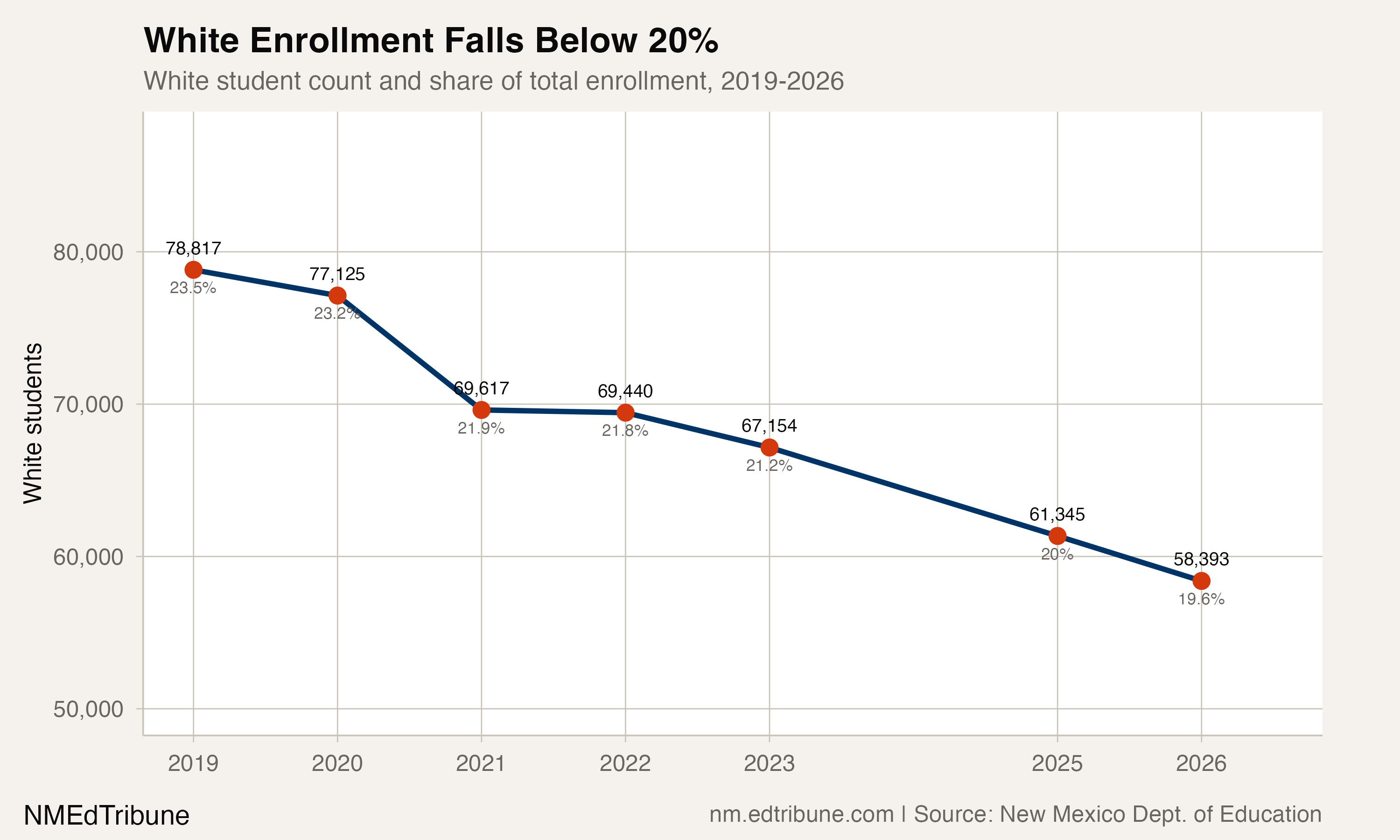
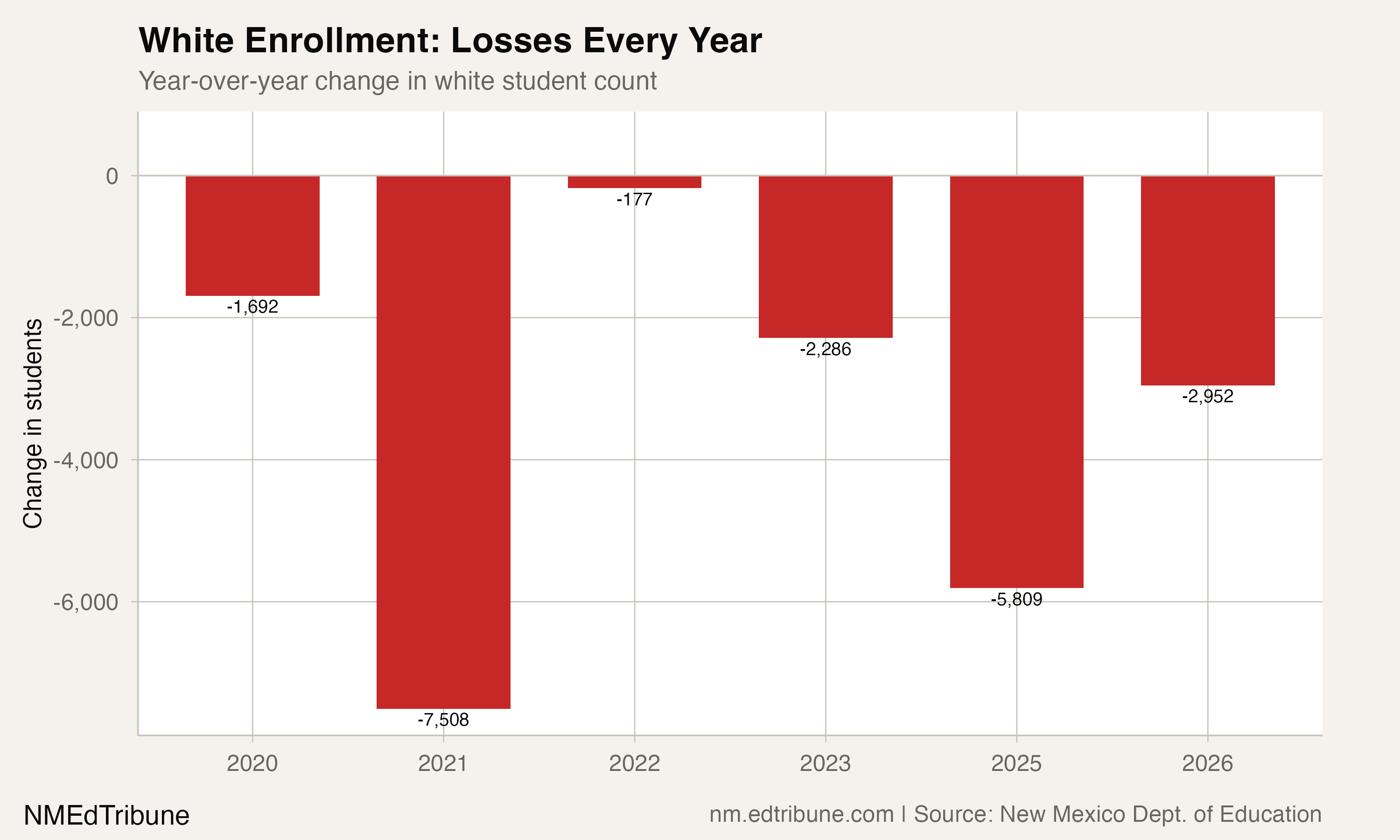
White enrollment fell every year from 2019 to 2026. The steepest single-year drop came during COVID: 7,508 white students vanished between 2019-20 and 2020-21, a 9.7% loss in a single year. That year alone erased a decade's worth of typical attrition. The count stabilized briefly in 2021-22 (losing just 177 students) before resuming losses of 2,000 to 6,000 per year.
The share decline, from 23.5% to 19.6%, amounts to 3.9 percentage points. To put that in context: Hispanic students, who make up nearly two-thirds of enrollment, saw their share rise 2.8 points over the same period (61.8% to 64.6%) despite also losing students in absolute terms. Hispanic enrollment fell by 14,172 students, a 6.8% decline. Native American enrollment fell by 5,432 students, a 15.6% decline, dropping from 10.4% to 9.9% of the total.
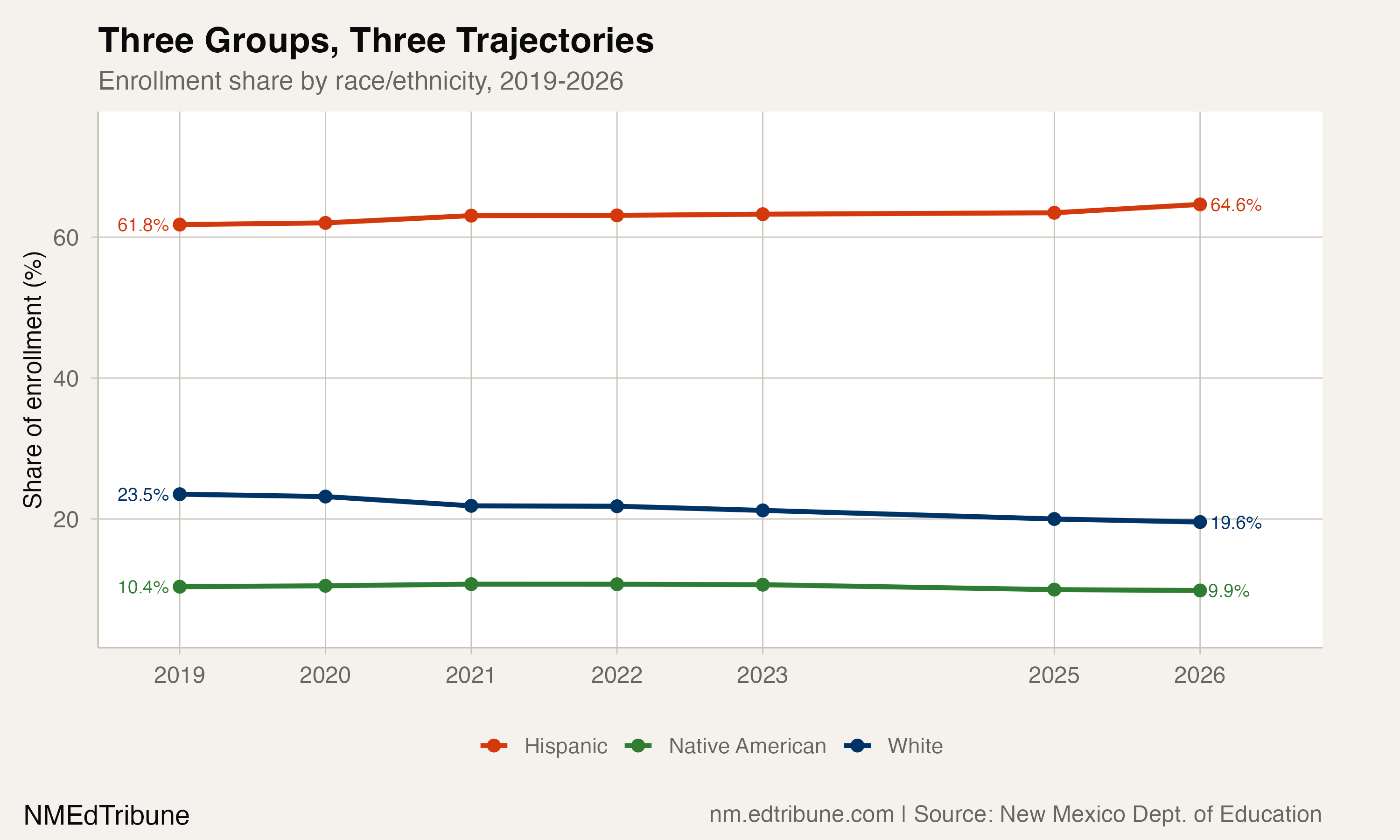
In short, every major racial group is shrinking in absolute numbers. White enrollment is shrinking fastest.
The 55% problem
White students made up 19.6% of enrollment in 2026 but accounted for 55.5% of total enrollment losses since 2019. That ratio, nearly three to one, means white attrition is the single largest driver of New Mexico's overall enrollment decline even though white students are a relatively small share of the student body.
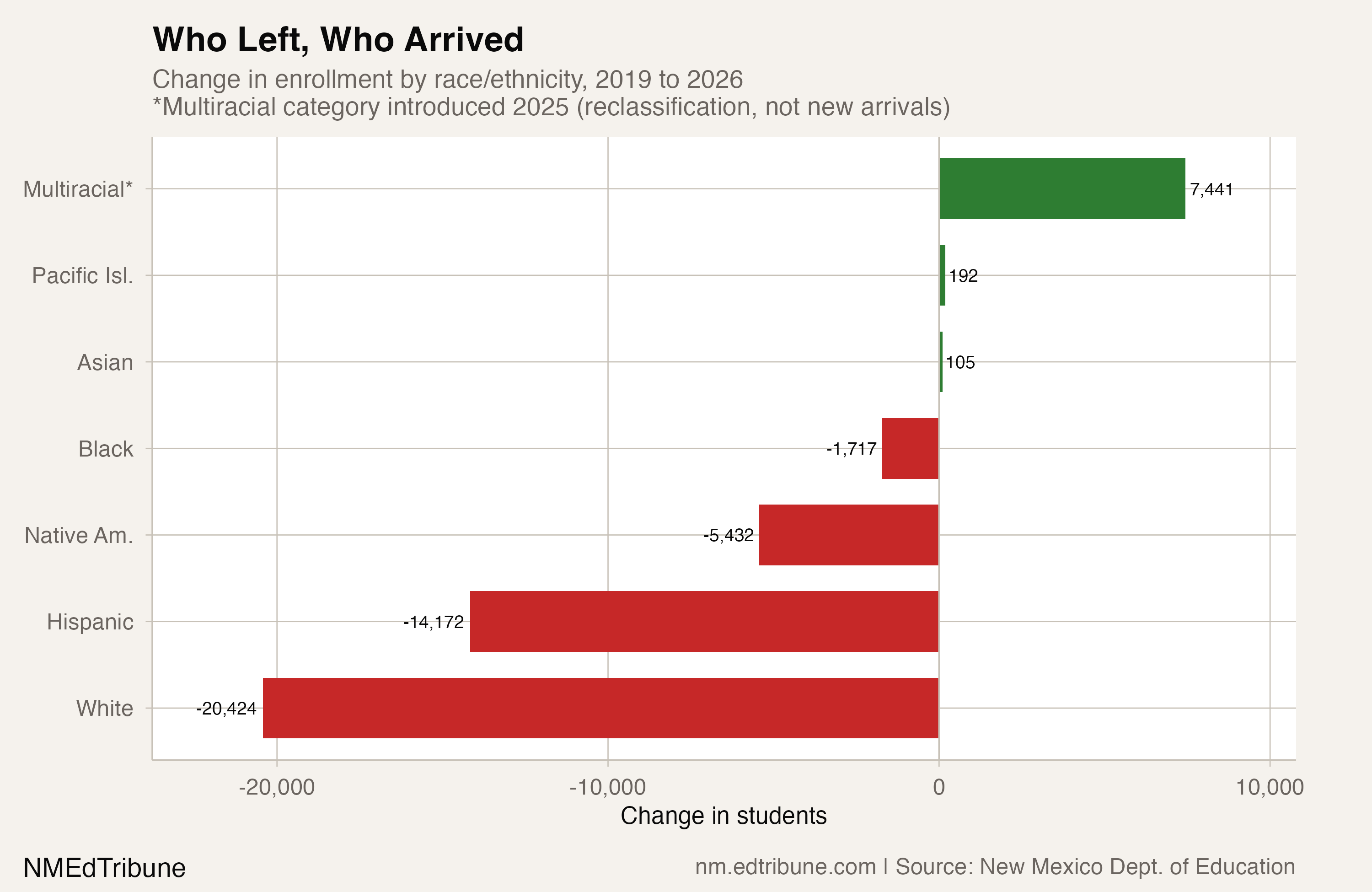
One caveat matters here. In 2025, New Mexico's Public Education Department began reporting a multiracial category for the first time, and 7,221 students appeared in it immediately. By 2026, the count was 7,441. Prior to 2025, the multiracial category did not exist in the data, meaning these students were previously counted under other race categories, likely including white. Some portion of the apparent 2023-to-2025 white decline (5,809 students) reflects reclassification rather than actual departures.
The pre-reclassification period tells a cleaner story. From 2019 to 2023, before the multiracial category existed, white enrollment fell from 78,817 to 67,154, a loss of 11,663 students (14.8%). That decline cannot be attributed to a reporting change.
Where the losses concentrate
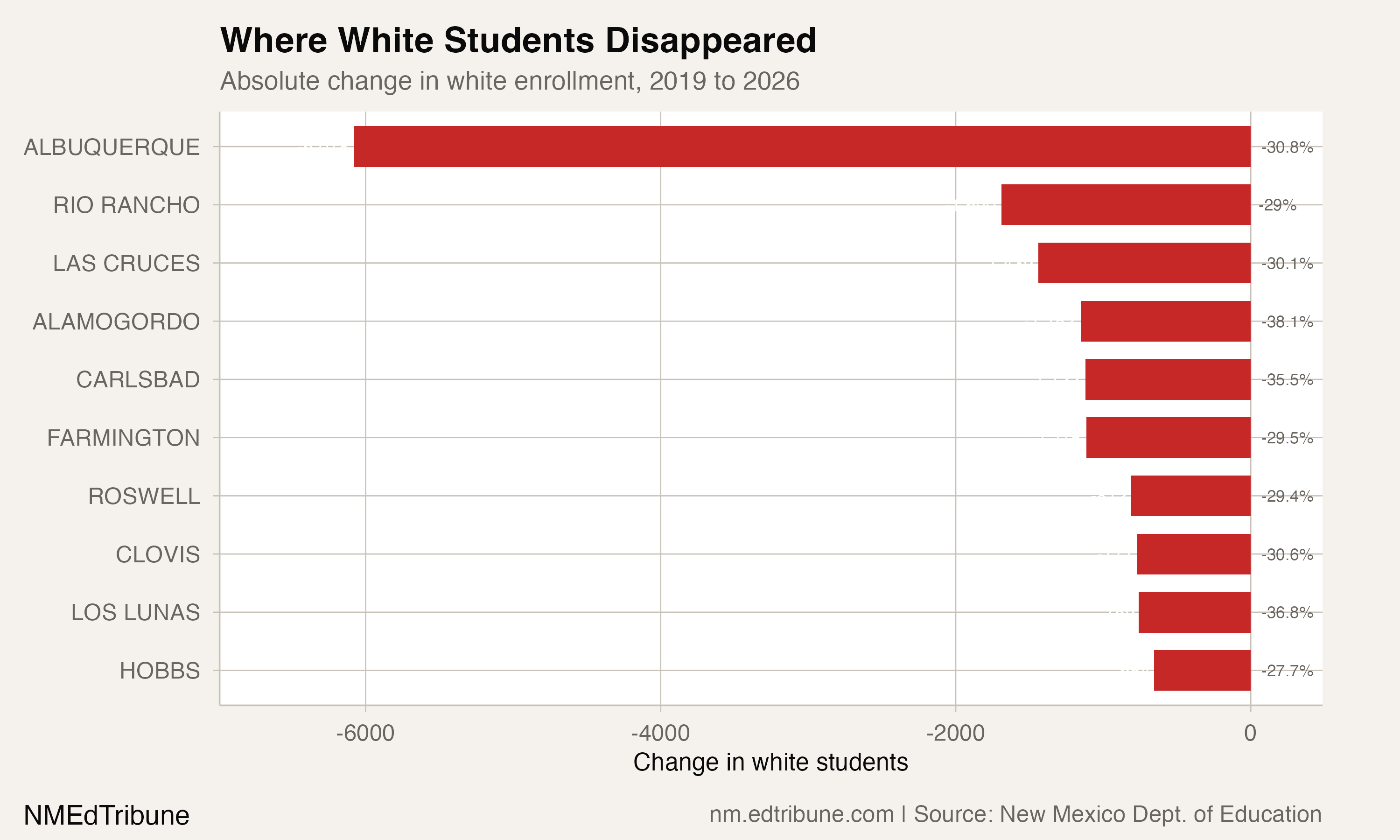
Albuquerque↗ET Public Schools alone lost 6,078 white students since 2019, accounting for 29.8% of the statewide white loss. APS white enrollment fell from 19,723 to 13,645, a 30.8% decline. The district's white share dropped from 21.9% to 18.8%.
Rio Rancho↗ET, the state's second-largest suburban district, lost 1,690 white students (29.0%), with its white share falling from 33.2% to 25.5%. Las Cruces↗ET lost 1,439 (30.1%). Alamogordo↗ET, a military-adjacent district, lost 1,152 white students, a 38.1% decline that dropped its white share from 47.3% to 36.3%.
The pattern is uniform: among districts with more than 2,000 students, every single one lost white enrollment. The percentage declines range from 6.8% (Gadsden, where white students were already a small fraction) to 38.1% (Alamogordo). No large district bucked the trend.
The charter gap
Charter schools in New Mexico are substantially whiter than traditional districts. In 2026, charters enrolled students who were 24.3% white, compared with 19.2% in traditional districts, a 5.1 percentage-point gap. In 2019 the gap was wider: 31.3% versus 23.2%.
Both sectors lost white share, but charters held on to a larger proportion of their white students. Charter white enrollment grew from 4,231 to 5,292 between 2019 and 2026, even as traditional district white enrollment fell from 74,586 to 53,062. White families moving into the charter sector partially offset what would otherwise be an even steeper traditional-district decline.
What is driving this
Three forces are plausibly at work, and the data cannot cleanly separate them.
The strongest evidence points to demographics. New Mexico's births have been declining steadily since 2007, when the state's total fertility rate was 2,308 per 1,000 women of reproductive age. By 2024, that rate had fallen to 1,562. White births represent a smaller share of the state's births (25.8%, per March of Dimes PeriStats data for 2021-2023) than white students represent of current enrollment (19.6%). That 6.2 percentage-point gap between the birth share and the enrollment share suggests that the pipeline of white kindergarteners entering public schools is smaller than the pipeline of white 12th graders leaving, but also that white families are more likely to opt out of public schools altogether.
Outmigration adds a second layer. New Mexico has run a negative domestic migration balance every year since 2012, meaning more residents leave for other states than arrive from them. Robert Rhatigan, the state demographer at the University of New Mexico, told the Santa Fe New Mexican that the state is now dependent on migration for growth because "New Mexico now sees more deaths than births each year." Census estimates show 2,267 residents left the state on net in the most recent year. The Census Bureau does not publish outmigration by race at the state level, so the degree to which white families are overrepresented among those leaving is unknown.
"Births have been in a slow steady decline since 2008 with women having fewer children each year. This trend should continue not only because women are having less children, but also because we have less women of childbearing age every year." -- Dr. Jacqueline Miller, UNM Geospatial and Population Studies
A third factor is school choice. White students are overrepresented in New Mexico's charter sector (24.3% white versus 19.2% in traditional districts). No statewide data tracks enrollment in private schools by race, so the full scope of white families choosing alternatives to traditional public schools remains unquantifiable. The Rio Grande Foundation has argued that New Mexico's enrollment decline reflects broader dissatisfaction with the state's education system, though this argument applies to all racial groups, not specifically white families.
The 20 holdouts
Only 20 districts in New Mexico had a white-majority student body in 2026. The largest was Los Alamos↗ET, the scientific laboratory community, at 51.8% white with 1,826 white students. The next largest was 21st Century Public Academy, a charter school with 339 students (92.6% white). After that, every white-majority district enrolled fewer than 300 students. Cloudcroft↗ET (66.7% white, 254 students), Melrose (70.6%, 192 students), Dora (73.2%, 150 students): these are small rural communities, not population centers.
In districts enrolling more than 2,000 students, the aggregate white share was 18.8%, even lower than the statewide figure. The white student population in New Mexico is increasingly dispersed across districts where it is a small and shrinking minority.
Below 15% by 2035
UNM population researchers project that New Mexico's youth population (ages 0-24) will decline 20% over the next 20 years, driven by falling fertility and persistent domestic outmigration. The white share of that declining youth population will almost certainly continue to fall, given the gap between white births (25.8% of all births) and white enrollment (19.6%). At the current pace of share decline, roughly 0.6 percentage points per year, white enrollment would drop below 15% before 2035.
Charter white enrollment grew by 1,061 students since 2019 while traditional districts lost 21,524. That means roughly 95% of white attrition is not showing up anywhere in the public system. Some of those families moved to Texas or Colorado. Some switched to private school or homeschooling. Some aged out without younger siblings to replace them. The enrollment data tracks departure, not destination. What it does show is a public school system that will look, within a decade, almost nothing like the one that existed when most of its buildings were built.
Detailed code that reproduces the analysis and figures in this article is available exclusively to EdTribune subscribers.
Discussion
Sign in to join the discussion.
Loading comments...