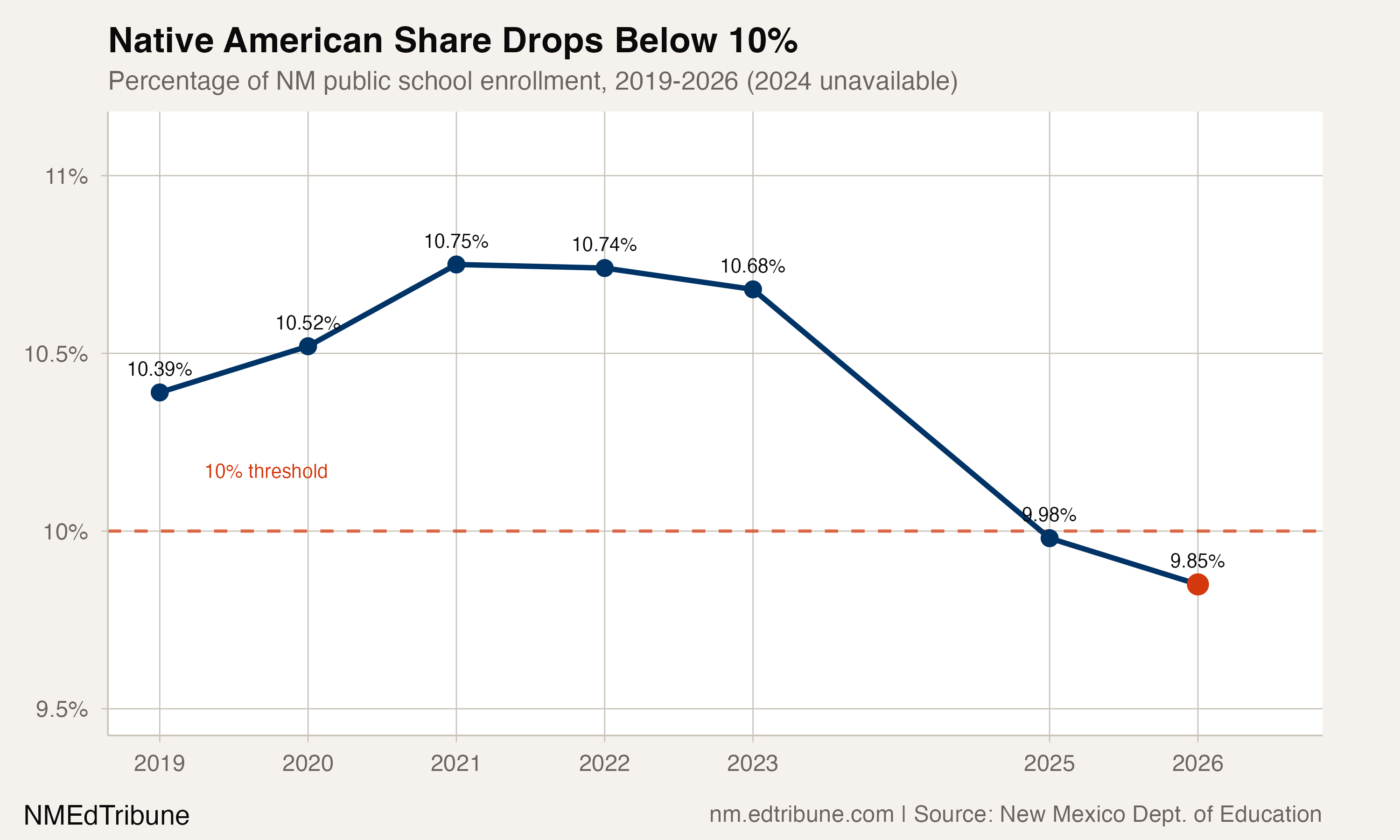
New Mexico is one of three states where Native American children make up at least 10% of public school enrollment. Or it was. In 2025-26, Native American students slipped to 9.9% of enrollment, the first time their share has fallen below that threshold in available state data. The milestone arrived not through a single catastrophic year but through a six-year erosion that accelerated sharply when a contract dispute in the state's largest Navajo-serving district displaced thousands of students.
The 29,401 Native American students enrolled in 2025-26 represent a loss of 5,602 from the 2019-20 peak of 35,003, a 16.0% decline. That rate of loss is half again as steep as the state's overall 10.3% enrollment drop over the same period. In a state whose education system is under court order to improve outcomes for Native students, the shrinking count raises a paradox: the population most directly covered by the Yazzie/Martinez ruling is getting smaller even as the mandate to serve them grows.
A Steady Slide, Then a Cliff
The decline did not begin suddenly. Native American enrollment peaked at 35,003 in 2019-20, ticked down modestly through 2022-23 (to 33,790, a loss of 1,213 over three years), then fell by 3,188 in a single two-year span from 2022-23 to 2024-25. The 2025-26 count of 29,401 represents another 1,201 lost in one year.
The share trajectory tells a related but distinct story. During the COVID years of 2020-21 and 2021-22, Native American students actually gained share (rising to 10.75%) even as their absolute count declined. Total enrollment was falling faster. That cushion evaporated by 2024-25, when the share dipped to 9.98%, and it fell further to 9.85% in 2025-26.
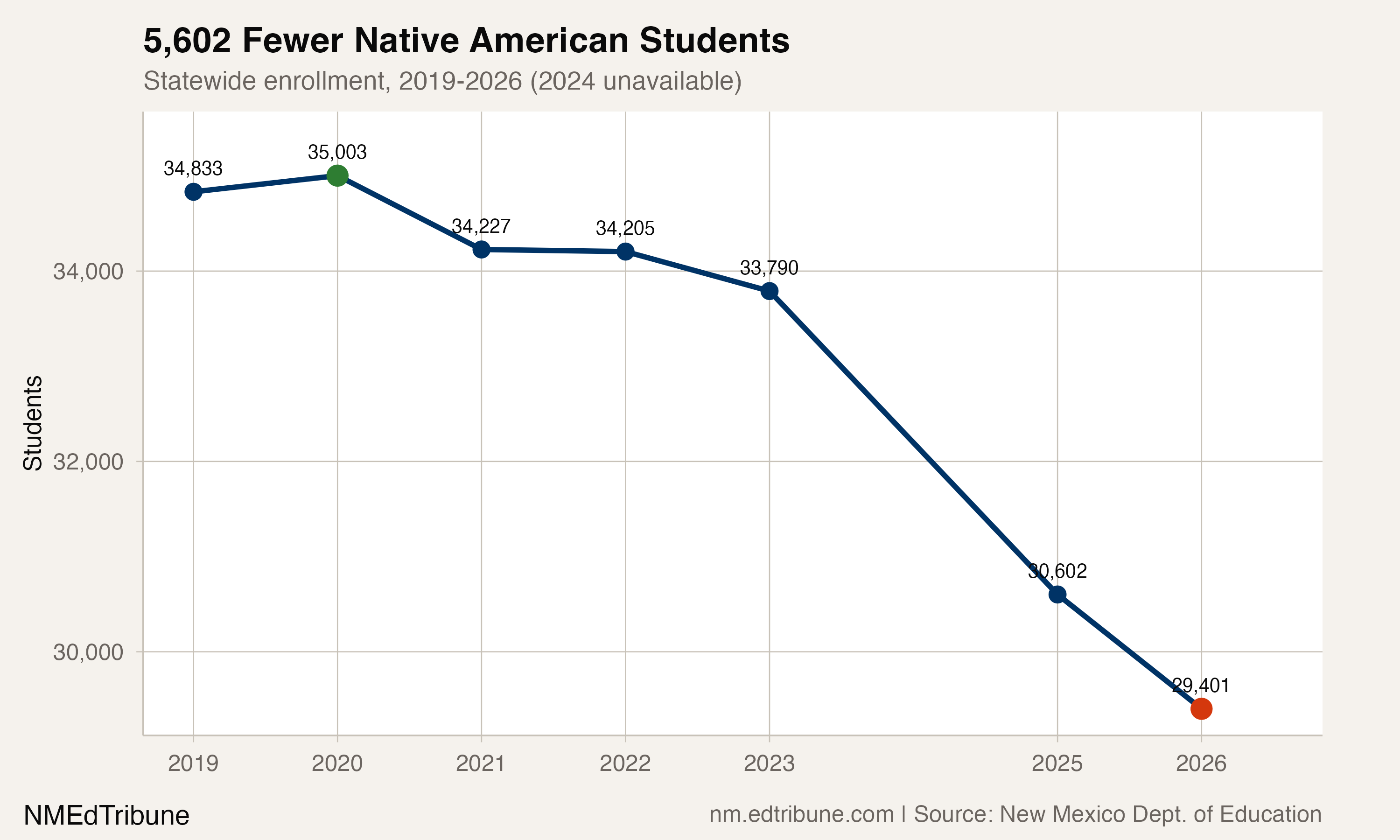
The gap between Native American enrollment losses and statewide losses is substantial. Since 2019-20, the state lost 34,319 students total. Native American students account for 5,602 of that loss, or 16.3%, despite representing only about 10% of the student body. Every other major racial group also declined in absolute terms (white enrollment fell 25.9%, Hispanic fell 6.8%), but Native American students are declining faster than the overall rate while already being a far smaller group.
The Gallup Rupture
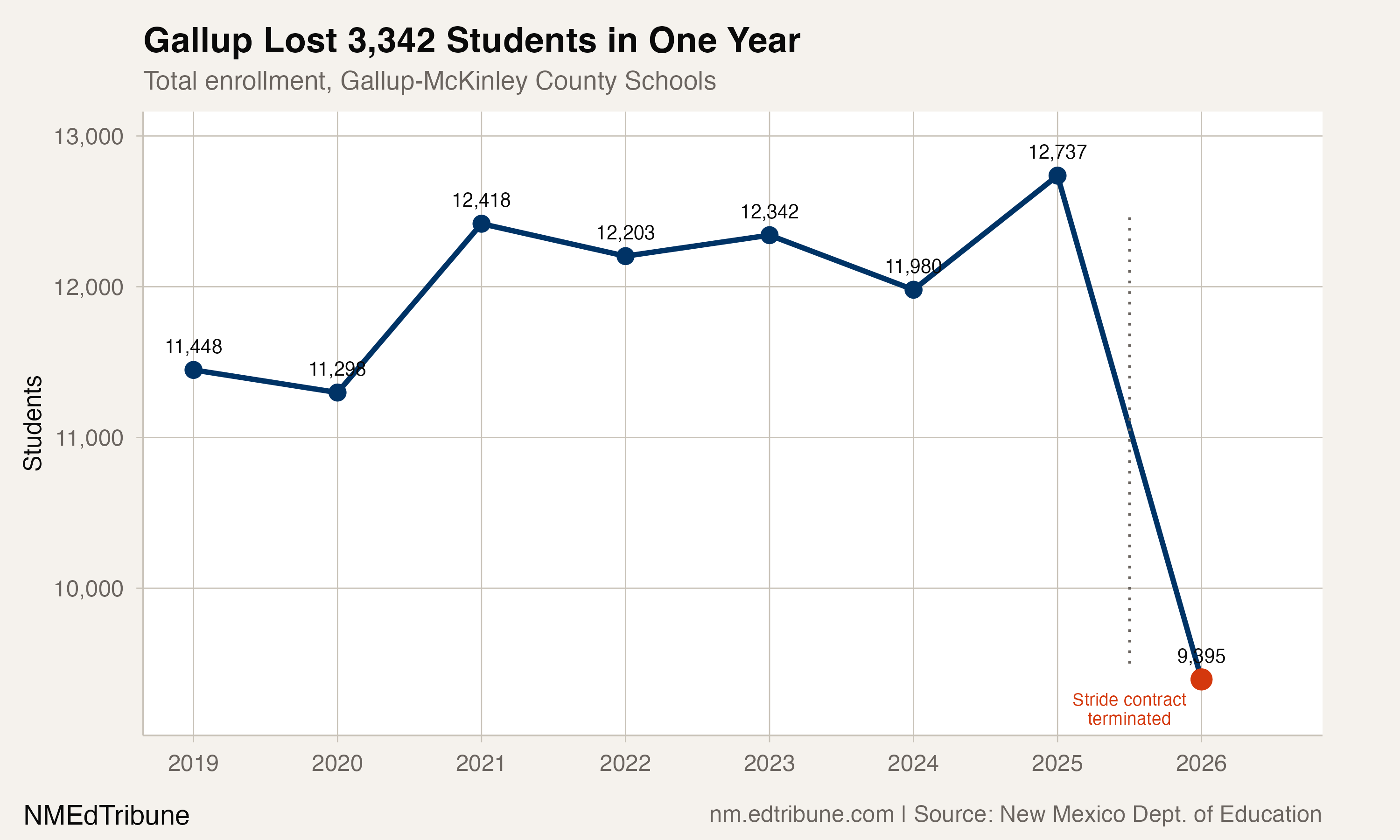
No district explains this story more than Gallup-McKinley County Schools↗ET. In 2025-26, Gallup lost 3,342 students in a single year, dropping from 12,737 to 9,395, a 26.2% decline. Of the 1,201 Native American students lost statewide between 2024-25 and 2025-26, Gallup accounted for 673, or 56%.
The cause is specific and documented. In May 2025, the Gallup school board voted to terminate its contract with Stride Inc. (formerly K12), a virtual education provider that had enrolled roughly 4,000 students statewide through the district. The termination, effective June 30, 2025, followed allegations of academic and legal violations, including graduation rates that plunged from 55.8% in 2022 to 27.7% in 2024 and math proficiency scores of just 5.6% for Stride students.
The displacement was swift. Many families continued with Stride through new contracts that Santa Rosa and Chama Valley school districts signed in July 2025, which explains why those two small districts show sudden gains in Native American enrollment (Santa Rosa went from zero to 164 Native American students; Chama Valley from 21 to 160). Gallup's loss was partly redistributed, not purely lost to the system.
"It was our students that were taken advantage of... that just makes me sick inside that a company did this on our watch." — Superintendent Mike Hyatt, NBC News, February 2026
But the Stride saga is layered over a deeper problem. Even before the contract termination, Gallup's Native American enrollment was falling: from 9,067 in 2019-20 to 8,027 in 2024-25, a loss of 1,040 that had nothing to do with virtual school reshuffling. The district, which has the highest rate of Navajo enrollment in the country with half its 32 schools on tribal land, has faced persistent criticism over equity. A Navajo Nation Human Rights Commission report found that schools on the reservation received fewer resources than those off tribal land, with some students lacking basic utilities.
"Historically, education's been a tool to civilize, to assimilate, to acculturate Navajo people." — Commission Chair Wendy Greyeyes, Searchlight New Mexico
Beyond Gallup: A Geography of Loss
Strip Gallup from the data and the statewide decline still amounts to 3,889 students since the 2019-20 peak, a 15.0% loss. The pattern is broad. Of 70 districts that enrolled Native American students in both 2019-20 and 2025-26, 36 lost students and 33 gained them, but the losers are far larger. The top five districts by Native American enrollment (Gallup, Albuquerque↗ET, Farmington↗ET, Central Consolidated, and Grants↗ET) hold 69% of all Native American students statewide. The top 10 hold 83%.
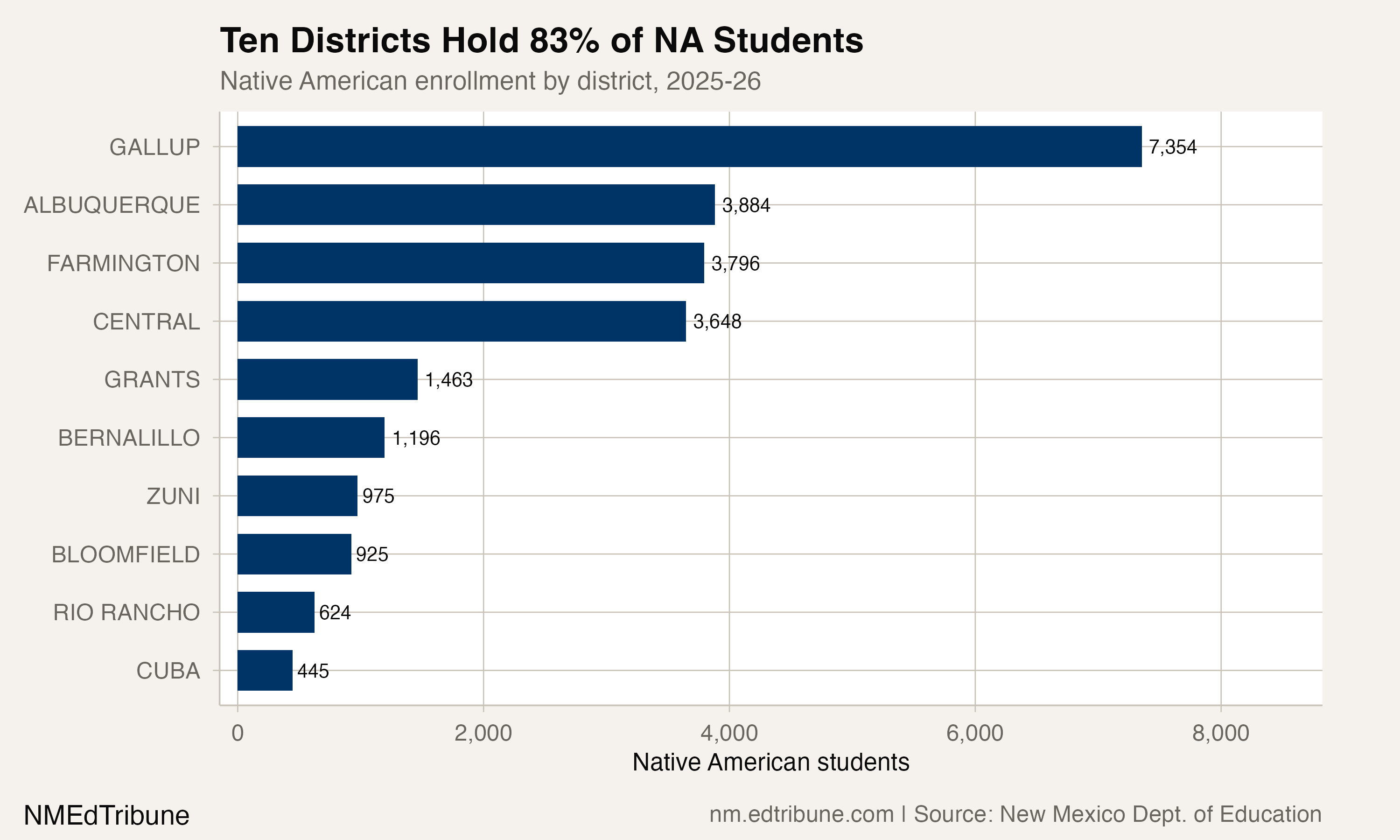
Central Consolidated↗ET, headquartered in Shiprock on the Navajo Nation, has lost 1,422 Native American students since 2019-20 (a 28.0% decline) and its total enrollment has fallen from 5,653 to 4,219. Zuni Public Schools↗ET, where 96% of students are Native American, dropped from 1,299 to 975, a 24.9% loss. Albuquerque, the state's largest district, lost 1,201 Native American students (23.6%), reflecting both the statewide trend and urban migration patterns.
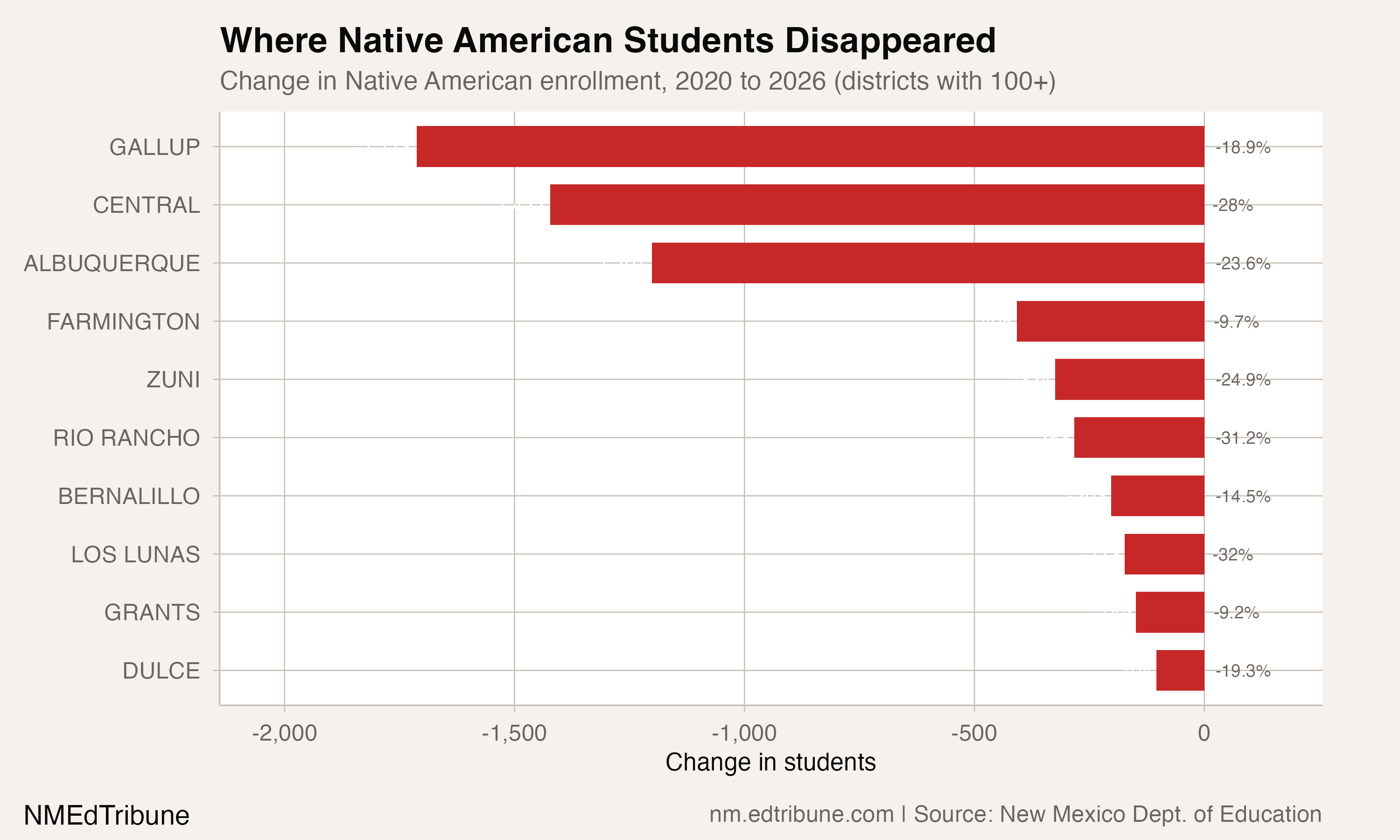
Even districts farther from reservation communities show losses. Rio Rancho↗ET lost 31.2% of its Native American students. Los Lunas↗ET lost 32.0%. These are smaller absolute numbers (283 and 173, respectively) but steep proportional declines that suggest the trend extends beyond reservation-adjacent districts.
What Shrinking Enrollment Does Not Tell You
The enrollment data cannot distinguish between families who left public schools and families whose children aged out or were never born. Nationally, the American Indian and Alaska Native child population declined by nearly 134,000 between 2000 and 2023, according to the Annie E. Casey Foundation, with the largest losses among children under age five. New Mexico, where Native American children represent roughly 10% of the child population, is one of three states with the highest such concentration, alongside Alaska and South Dakota.
A shrinking base population means some enrollment decline is demographic gravity, not a policy failure or a sign of dissatisfaction. But the rate matters. Native American enrollment in New Mexico fell 16.0% from 2019-20 to 2025-26, while overall enrollment fell 10.3%. If the decline were purely demographic, both rates would track more closely. The gap suggests additional factors at work: families choosing alternatives to public school, pandemic-era disengagement that never reversed, or structural issues in the districts that serve the largest Native populations.
The multiracial reclassification that New Mexico introduced in 2022 complicates the picture further. The state went from reporting zero multiracial students to 7,221 in 2024-25. Some portion of students previously counted as Native American may now be classified as multiracial, making the apparent decline partly a measurement artifact. The magnitude is unknowable from enrollment data alone.
Fewer students, bigger mandate
New Mexico's public education system operates under a 2018 court ruling in the consolidated Yazzie/Martinez case, which found the state in violation of its constitution for failing to adequately educate Native American students, English learners, students with disabilities, and economically disadvantaged students. In April 2025, a judge found the state still out of compliance and ordered a new action plan.
The plan the Public Education Department produced drew objections from nearly all 23 tribes in the state. The All Pueblo Council of Governors wrote that the agency had not consulted them. As of February 2026, plaintiffs and tribal leaders were asking the judge to reject the plan entirely.
The enrollment decline sharpens this tension. The Yazzie mandate requires the state to invest specifically in programs for Native students: culturally relevant curricula, Native language instruction, community-based support. Those programs depend on enrollment-driven funding. As the number of Native American students shrinks, the per-student cost of maintaining specialized services rises, creating pressure to consolidate programs precisely when the court says they should expand. Dulce Independent Schools↗ET, which serves the Jicarilla Apache Nation and lost 104 Native American students (19.3%) since 2019-20, enrolls just 434 Native American students in a remote community with no nearby alternatives.
What to Watch
The Gallup situation remains unresolved. In March 2026, the district announced it had settled with Stride and reinstated a modified contract through June 2026. Whether the thousands of students who transferred to Santa Rosa and Chama Valley return to Gallup in 2026-27 will determine whether the 2025-26 3,342-student loss was a one-time redistribution or a permanent fracture in how virtual education is delivered across the Navajo Nation.
The deeper question is structural. Six majority-Native American districts (Gallup, Central, Zuni, Cuba↗ET, Dulce, and Jemez Valley↗ET) enrolled 13,077 Native American students in 2025-26. That number was 16,929 in 2018-19. These districts serve communities where the school is often the largest employer and the primary institution connecting children to their language and culture. Losing nearly a quarter of their enrollment in seven years does not just change a budget line. It changes what a school can be.
Detailed code that reproduces the analysis and figures in this article is available exclusively to EdTribune subscribers.
Discussion
Sign in to join the discussion.
Loading comments...