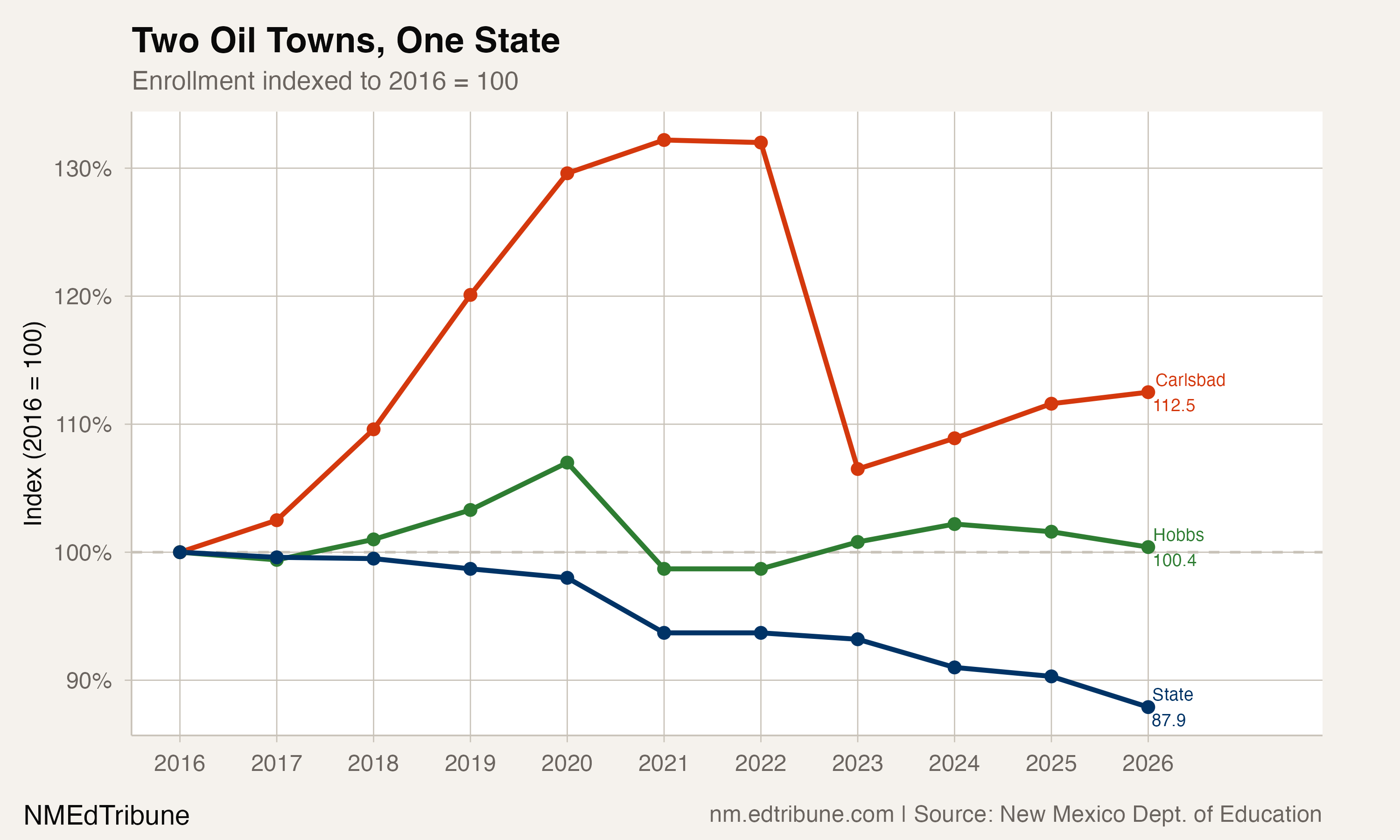
In a state where 87 of 132 districts lost enrollment over the past decade, Carlsbad↗ET stands alone among large traditional school districts. It gained 836 students between 2016 and 2026, a 12.5% increase, while the state as a whole shed 41,260 students (12.1%). The only other large traditional district in New Mexico that can claim any net gain at all is Hobbs↗ET, 90 miles to the east, which added 41 students over the same period. That is not a typo.
But Carlsbad's 11-year trajectory is anything but a steady climb. It is a roller coaster powered by Permian Basin crude, and the ride has left the district building schools it may not fill, recruiting teachers it cannot house, and serving a student body that looks nothing like the one that entered the boom.
Five years up, two years down
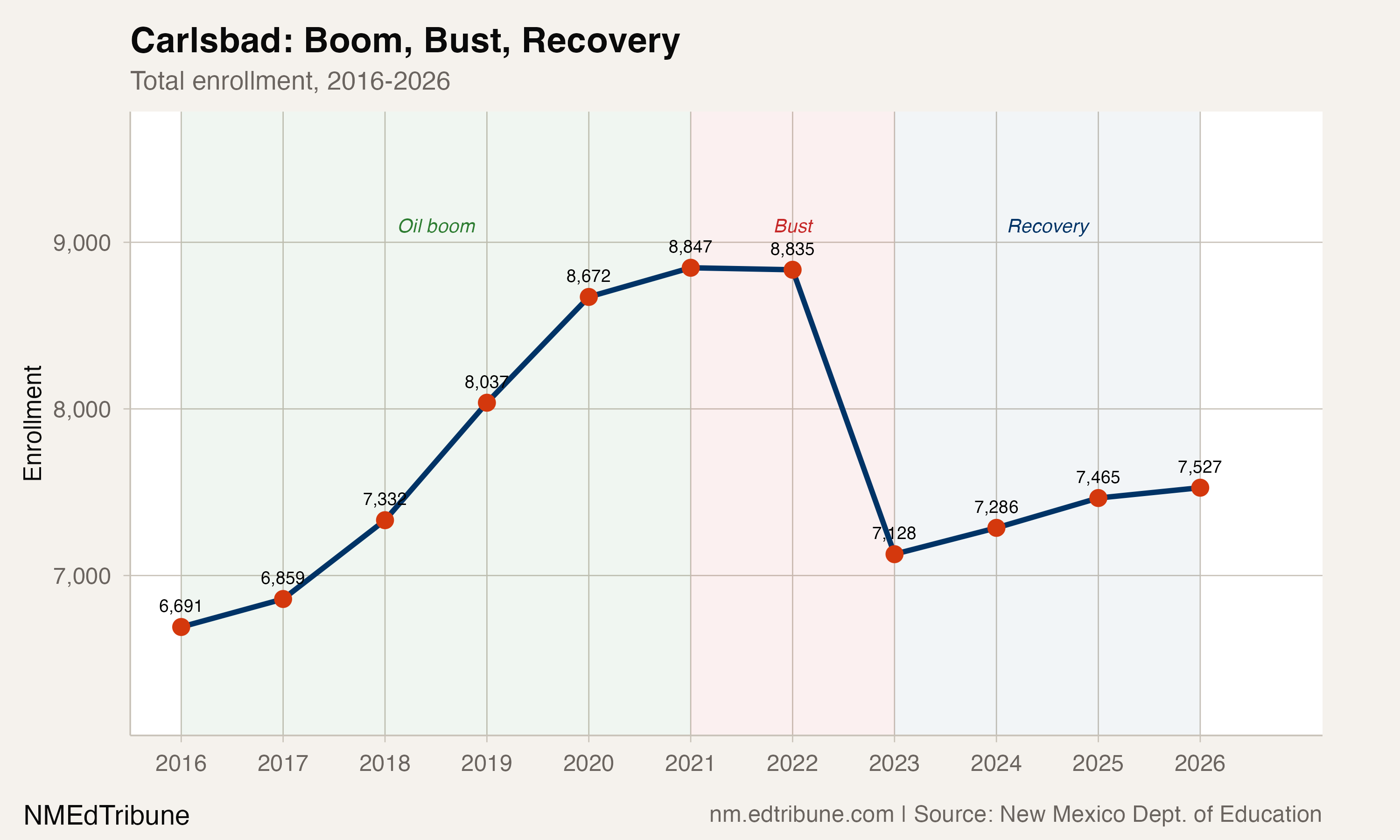
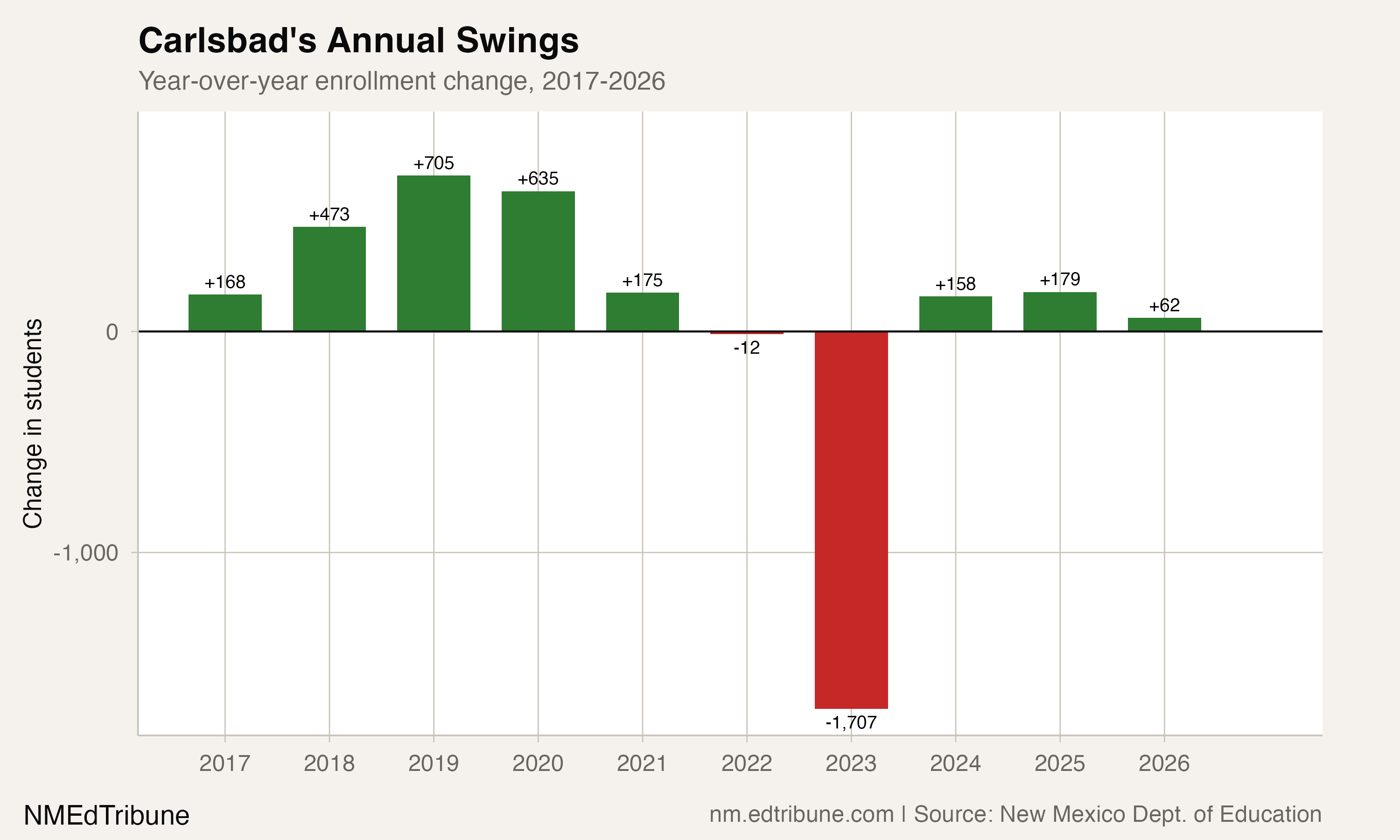
The acceleration was swift. Carlsbad added 168 students in 2017, then 473, then 705, then 635. At its 2019 peak growth rate of 9.6% in a single year, the district was gaining students faster than most New Mexico districts have ever grown. By 2021, enrollment had reached 8,847, up 32.2% from 6,691 just five years earlier.
The gains tracked the oil. Between 2019 and 2024, Eddy and Lea counties accounted for 52% of all U.S. oil production growth, producing nearly 1 million additional barrels per day. Workers flooded into Carlsbad. The city's population ballooned past 52,000, straining housing, roads, and classrooms.
Then it reversed. Carlsbad lost 12 students in 2022, a tremor. In 2023, it lost 1,707, a 19.3% collapse in a single year. That single-year drop was larger than the entire decade-long enrollment loss at many mid-size New Mexico districts.
What oil gives, oil takes
The 2023 crash lines up with a familiar pattern in resource-extraction communities: the transient workforce that inflated the boom departed when the economics shifted. During the oil surge, many workers lived in RV parks and corporate housing. Monthly rents in Carlsbad climbed to $2,000 to $3,000, pricing out teachers and other public-sector workers.
The Santa Fe New Mexican reported that the district started the 2019-20 year short 15 teachers and resorted to hiring 24 international educators on work visas:
"We still probably have half of those needing to show up and we don't have housing for them." — Superintendent Gerry Washburn, Santa Fe New Mexican
When the bust hit, the district faced a different problem: the infrastructure it had built for 8,800 students now served 7,100. Carlsbad voters approved an $80 million bond in 2019 to expand capacity. That construction program, including the reopening of Riverside Elementary and expansions at Ocotillo and Desert Willow, was designed for a district that no longer exists at that size.
Three years into recovery, the district has clawed back 399 of the 1,719 students it lost, roughly 23%. Growth has slowed each year: 158 students in 2024, 179 in 2025, 62 in 2026. Whether this is a plateau or a pause depends on where oil prices and drilling activity go next.
A different kind of oil town
Carlsbad's experience diverges sharply from Hobbs↗ET, the state's other major Permian Basin school district. Hobbs sits in Lea County, adjacent to Eddy County, and draws from the same oil economy. But Hobbs never boomed the same way. It peaked at 10,661 in 2020, lost 831 during COVID, and has since recovered to essentially flat. Over 11 years, Hobbs gained 41 students, a 0.4% change.
Carlsbad sits directly above the most active drilling zone in the New Mexico Permian. In 2022, Eddy County led the nation with 53 active drilling rigs. Hobbs, while also oil-dependent, has a more diversified employment base and did not experience the same in-migration surge.
Smaller Eddy County districts tell a grimmer version of the same story. Artesia↗ET peaked in 2016 at 3,961 and has declined steadily to 3,703, a loss of 258 students. Lovington↗ET fell from 3,832 to 3,300. The oil boom concentrated its enrollment gains in one district while leaving its neighbors flat or declining.
The students who stayed are different
The boom brought workers. The bust took many of them back. But the demographic composition of Carlsbad's student body shifted permanently in between.
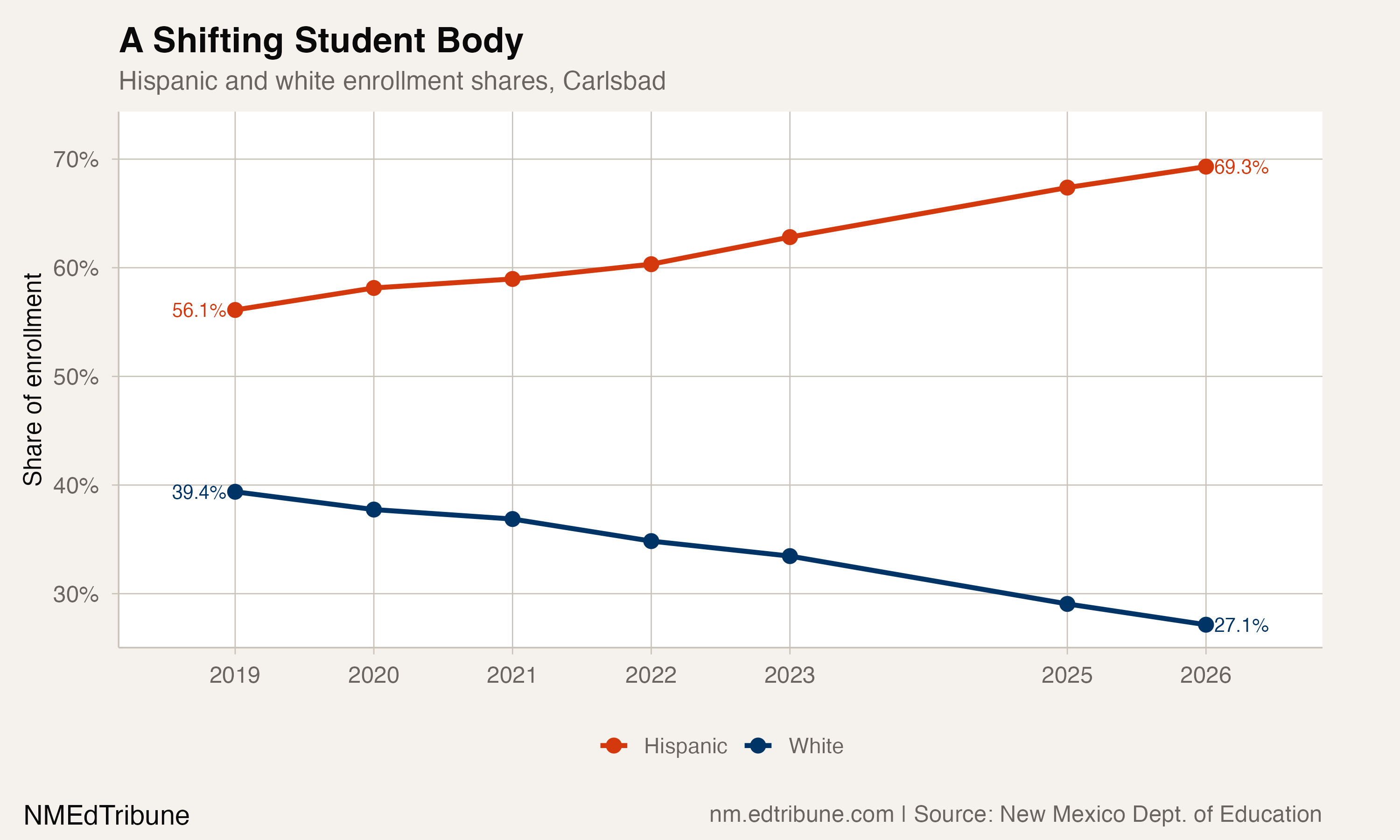
In 2019, Hispanic students made up 56.1% of Carlsbad's enrollment. By 2026, that share had risen to 69.3%. White enrollment fell from 39.4% to 27.1% over the same period, a drop of 1,122 students in absolute terms even as Hispanic enrollment grew by 707.
The shift is visible in another metric. In 2019, 595 Carlsbad students were classified as English learners, 7.4% of the student body. By 2026, that number had reached 1,337, or 17.8%. Nearly one in five Carlsbad students now receives English language services, more than double the share seven years ago.
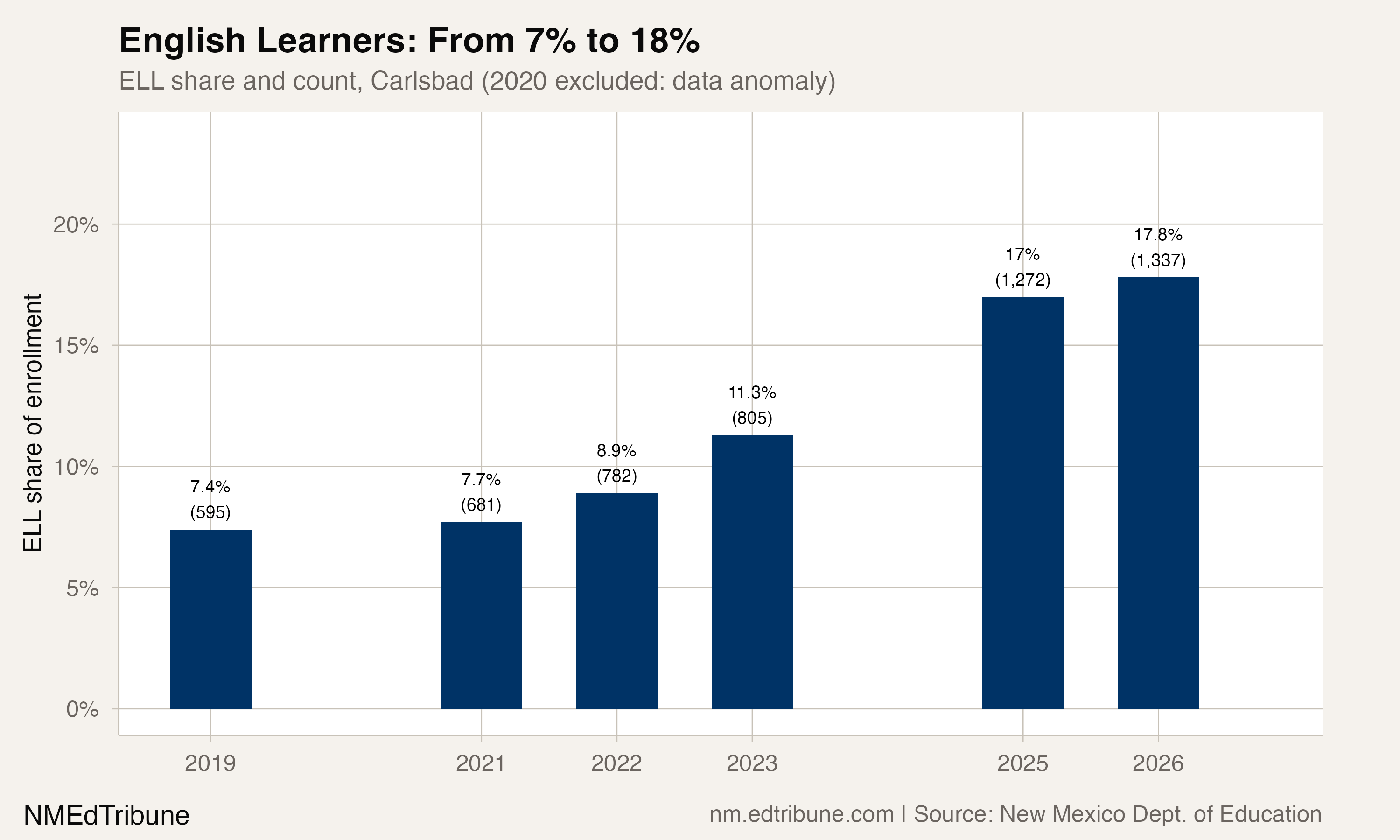
Whether the ELL surge reflects new arrivals drawn by oil-field work or expanded identification of students already in the district is not possible to determine from enrollment data alone. The Permian Basin has long attracted Spanish-speaking workers from both sides of the border. What is clear is that the instructional profile of the district has changed substantially: programs serving English learners carry higher per-pupil costs for staffing, materials, and compliance, and Carlsbad's ELL population more than doubled while the district was simultaneously navigating a 19% enrollment crash.
Rich county, struggling schools
Carlsbad's fiscal position is unusual for a district this volatile. New Mexico's oil and gas tax receipts totaled $11.3 billion in the 12 months ending June 2024, and a substantial share flows to public schools through the state's Land Grant Permanent Fund, which distributes over $1.3 billion annually to K-12 and higher education. The district that produces the oil also benefits from the revenue it generates statewide.
But per-pupil funding follows students. When Carlsbad lost 1,719 students in two years, the revenue dropped with them, even as the fixed costs of newly built facilities did not. The district is now operating schools designed for its 2021 peak while serving 15% fewer students.
Waiting for the next barrel
Carlsbad is adapting. It launched an Energy and Natural Resources Pathway at Carlsbad High School in 2023 with 54 students in its inaugural class, tying the curriculum directly to the industry that drives the local economy. It has invested in teacher housing to buffer against the rental spikes that accompany each oil cycle.
The 62 students Carlsbad added in 2026 suggest the recovery is decelerating. The $80 million in new schools will stay, whether the rigs do or not. So will the ELL programs that did not exist five years ago and the 1,337 English learners who need them. The boom reshaped Carlsbad's schools in ways the bust cannot undo.
Detailed code that reproduces the analysis and figures in this article is available exclusively to EdTribune subscribers.
Discussion
Sign in to join the discussion.
Loading comments...