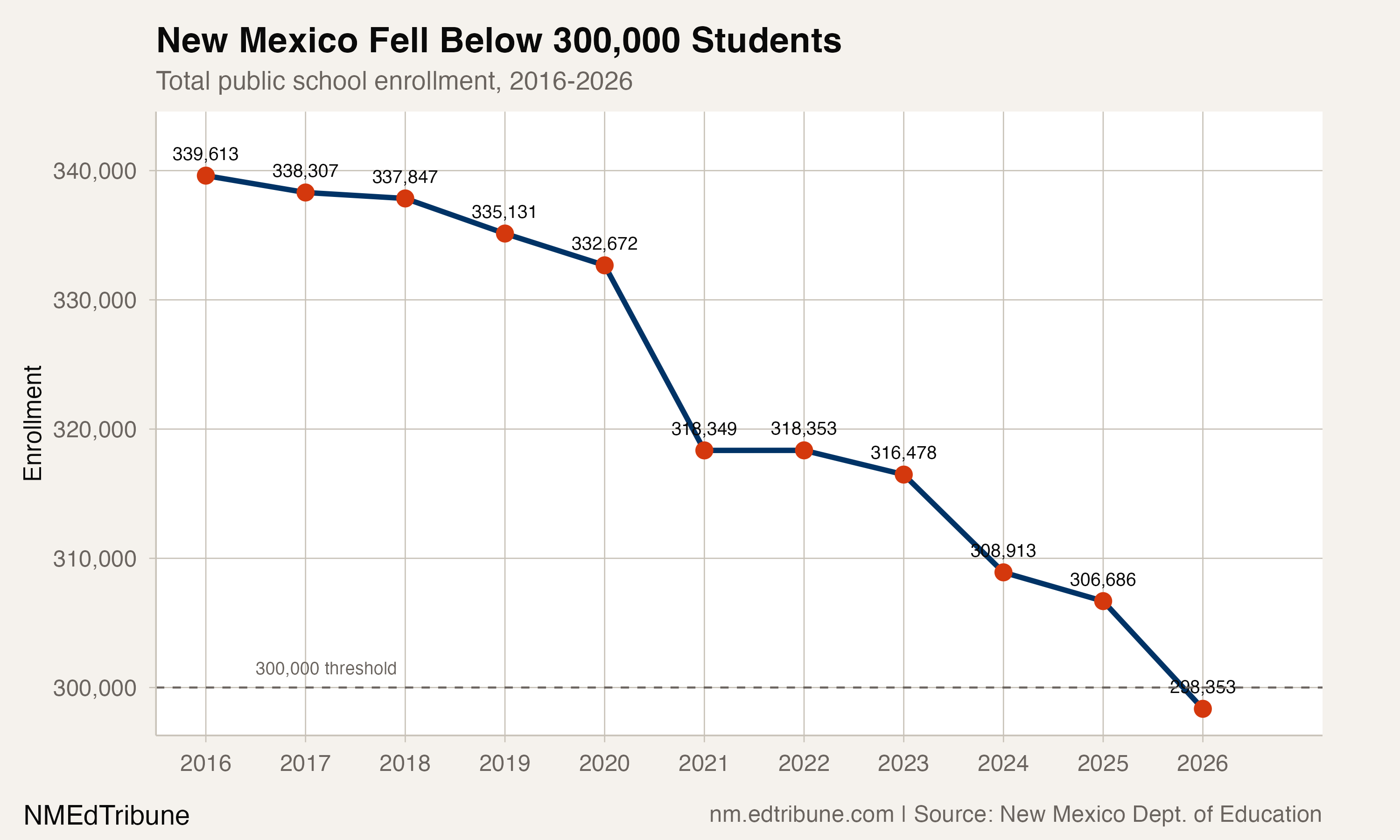
Last year, New Mexico's enrollment appeared to be stabilizing. The state lost 4,211 students in 2024-25, a fraction of the COVID-era crash, and superintendents could reasonably hope the worst had passed. It had not. In 2025-26, the state lost 8,333 students, about twice the prior year's decline, dropping total public school enrollment to 298,353. New Mexico has fallen below 300,000 students for the first time in at least a decade.
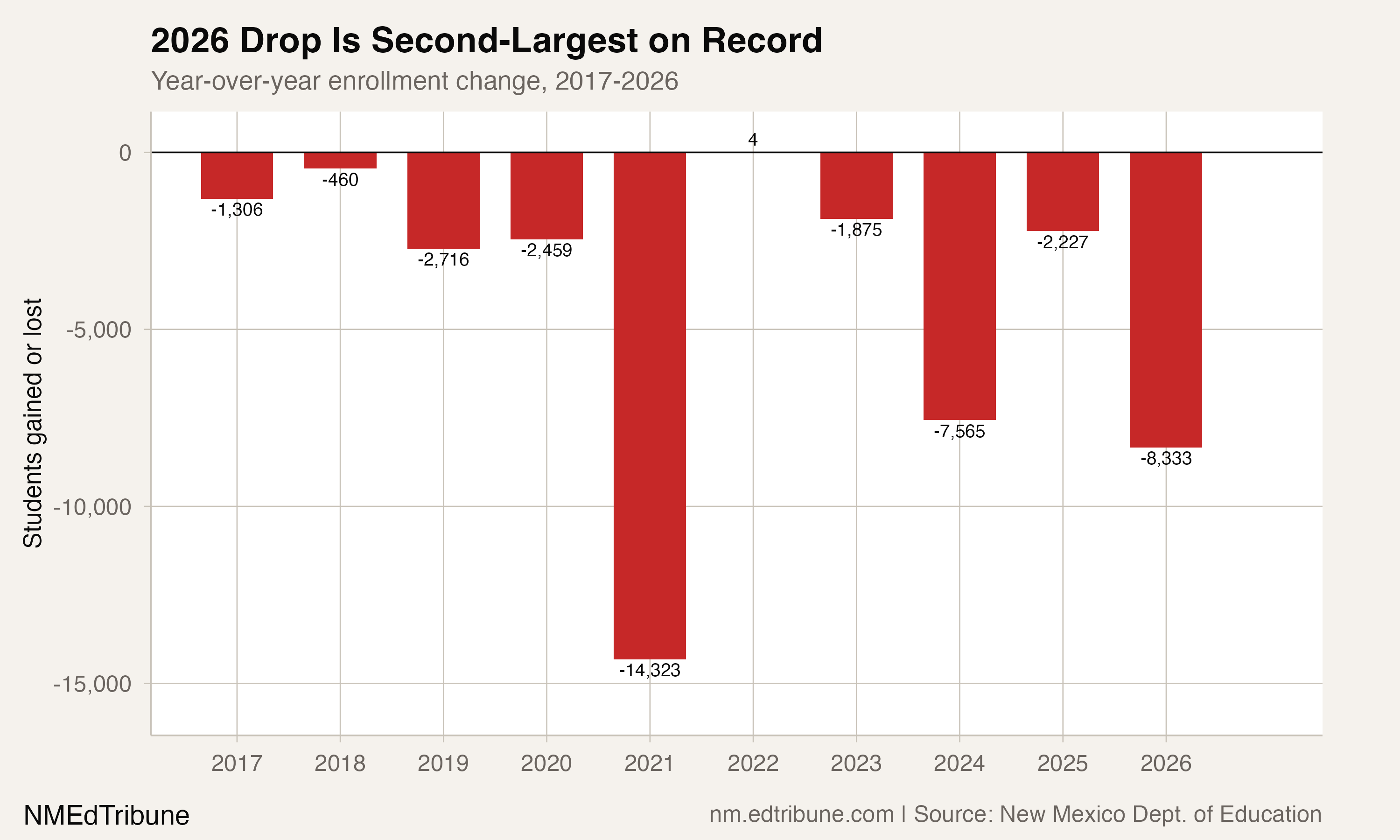
The loss is the second-largest single-year decline on record, behind only the pandemic crash of 2020-21, which erased 14,323 students in one year. But unlike the COVID drop, which had a clear external cause and prompted a partial rebound, the 2026 cliff arrived without a triggering event. It is the product of compounding structural forces that have now cost the state 41,260 students, a 12.1% decline, since enrollment peaked at 339,613 in 2015-16.
A year of false calm
The 2025 numbers had offered a misleading signal. After losing 5,581 students in 2023-24, the apparent deceleration to -4,211 in 2024-25 suggested New Mexico might settle into the slow bleed that characterized the pre-COVID era, when the state lost an average of 1,735 students per year. Instead, the 2026 data revealed a post-COVID enrollment regime that is running 2.3 times faster than the old normal: since 2021-22, New Mexico has lost an average of 3,999 students per year.
The four-year period from 2022-23 through 2025-26 accounts for 20,000 lost students, nearly half the state's total decline since 2016.
The Gallup distortion
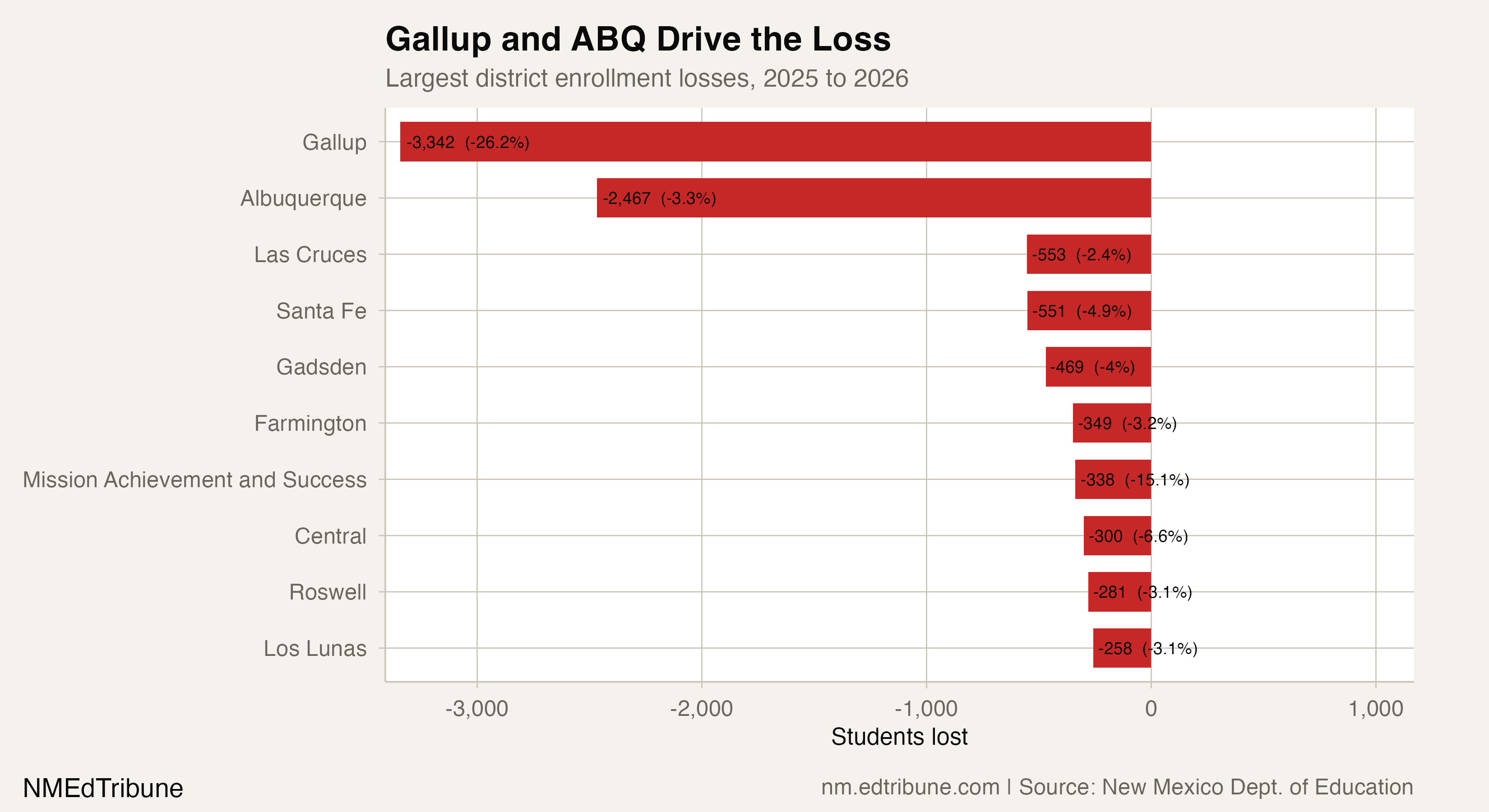
One district explains 40% of the statewide loss, and the story behind it is not about demographics. Gallup-McKinley County Schools↗ET lost 3,342 students in a single year, a 26.2% drop, after the district's board voted in May 2025 to terminate its contract with Stride, Inc. (formerly K12), a publicly traded virtual education provider. The cancellation displaced roughly 3,000 students statewide who had been enrolled in the district's online program.
Those students did not vanish from New Mexico's schools. Two small districts, Santa Rosa Consolidated and Chama Valley ISD, each absorbed approximately 1,500 of the affected students into their own virtual programs. The accounting is visible in the enrollment data: Santa Rosa jumped from 572 to 2,122 students, and Chama Valley from 280 to 1,866. Both are excluded from the district-level analysis here because their gains reflect student transfers between virtual providers, not organic growth.
The broader fallout has been substantial. Because New Mexico funds districts based on prior-year enrollment, Gallup-McKinley continued drawing state money for students it no longer served. The Public Education Department faced a $40 million budget shortfall because Gallup retained the funds while litigating against Stride, and the state simultaneously had to pay the receiving districts for the same students, prompting an emergency legislative response during the 2026 session. Governor Michelle Lujan Grisham signed Senate Bill 19 to give state officials additional time to determine the overpayment amount and develop a recovery plan.
Superintendent Mike Hyatt framed the decision to cut ties with Stride as protective:
"It was our students that were taken advantage of. They're the ones -- whether they know it or not -- that were harmed in this. And that just makes me sick inside that a company did this on our watch." -- NBC News, January 2026
Even without Gallup, the cliff is real
Strip Gallup's 3,342-student loss from the statewide total and New Mexico still lost 4,991 students, a figure that would rank as the state's third-largest annual decline after the COVID year and the 2024 drop of 5,581. The decline is broad. Ninety-eight districts lost students in 2025-26, while only 49 gained. The top five losers accounted for 60% of total district-level losses.
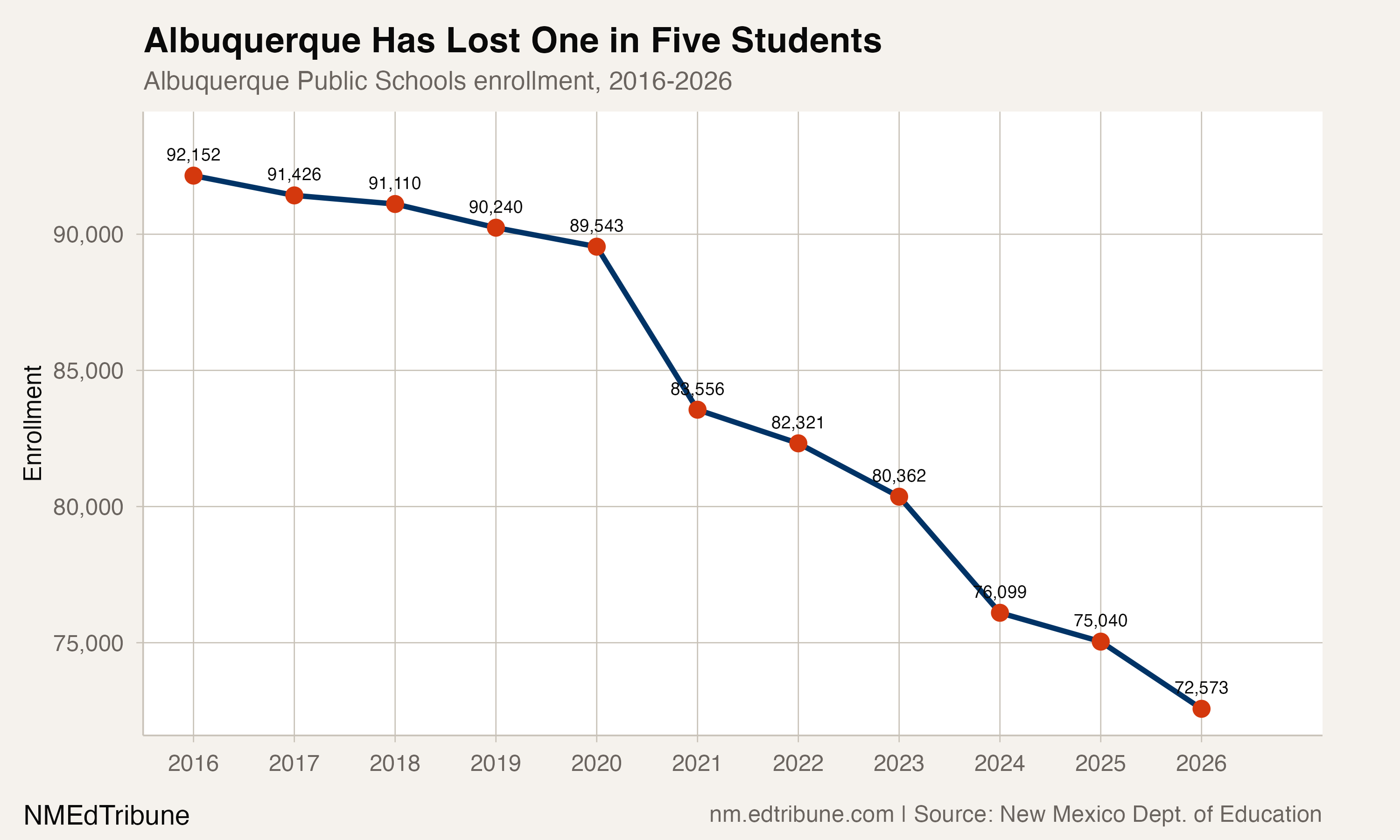
Albuquerque Public Schools↗ET lost 2,467 students, a 3.3% decline, extending a streak that has cost the district 19,579 students since 2016. That is a 21.2% decline over 11 years. APS now enrolls 72,573 students and accounts for 24.3% of the state's total enrollment, down from 27.1% a decade ago. Despite educating fewer students each year, the district's board approved a record $2.25 billion budget for 2025-26, a $104 million increase, pushing per-pupil spending to approximately $35,000.
The losses extend beyond Albuquerque. Las Cruces↗ET lost 553 students (-2.4%), Santa Fe↗ET lost 551 (-4.9%), Gadsden↗ET lost 469 (-4.0%), and Farmington↗ET lost 349 (-3.2%). Santa Fe's 4.9% single-year decline stands out as the sharpest percentage loss among the state's major districts.
Sixty-two of 154 districts, or 40.3%, hit all-time enrollment lows in 2025-26. Only 34.3% of districts have recovered to their pre-COVID enrollment levels.
Fewer children, fewer families
The structural driver underneath the year-to-year volatility is demographic. New Mexico's birth rate has been declining since 2008, and the state now has 16.4% fewer young children than it did a decade ago, a steeper drop than the national decline of 9.6%. Deaths exceeded births for the first time in 2020 and have continued to do so each year since.
Population projections from the University of New Mexico's Geospatial and Population Studies department forecast the state's youth population (ages 0-24) will fall to 550,000 by 2040, a 20% decline over two decades. The state's total population is expected to peak at 2.16 million around 2035 before beginning to contract, driven almost entirely by growth among residents age 65 and older.
Domestic migration has been negative since 2012, with international migration providing the only offset. Rural counties face the steepest projections: Mora, De Baca, and Hidalgo counties could lose more than 40% of their populations.
The new normal runs faster
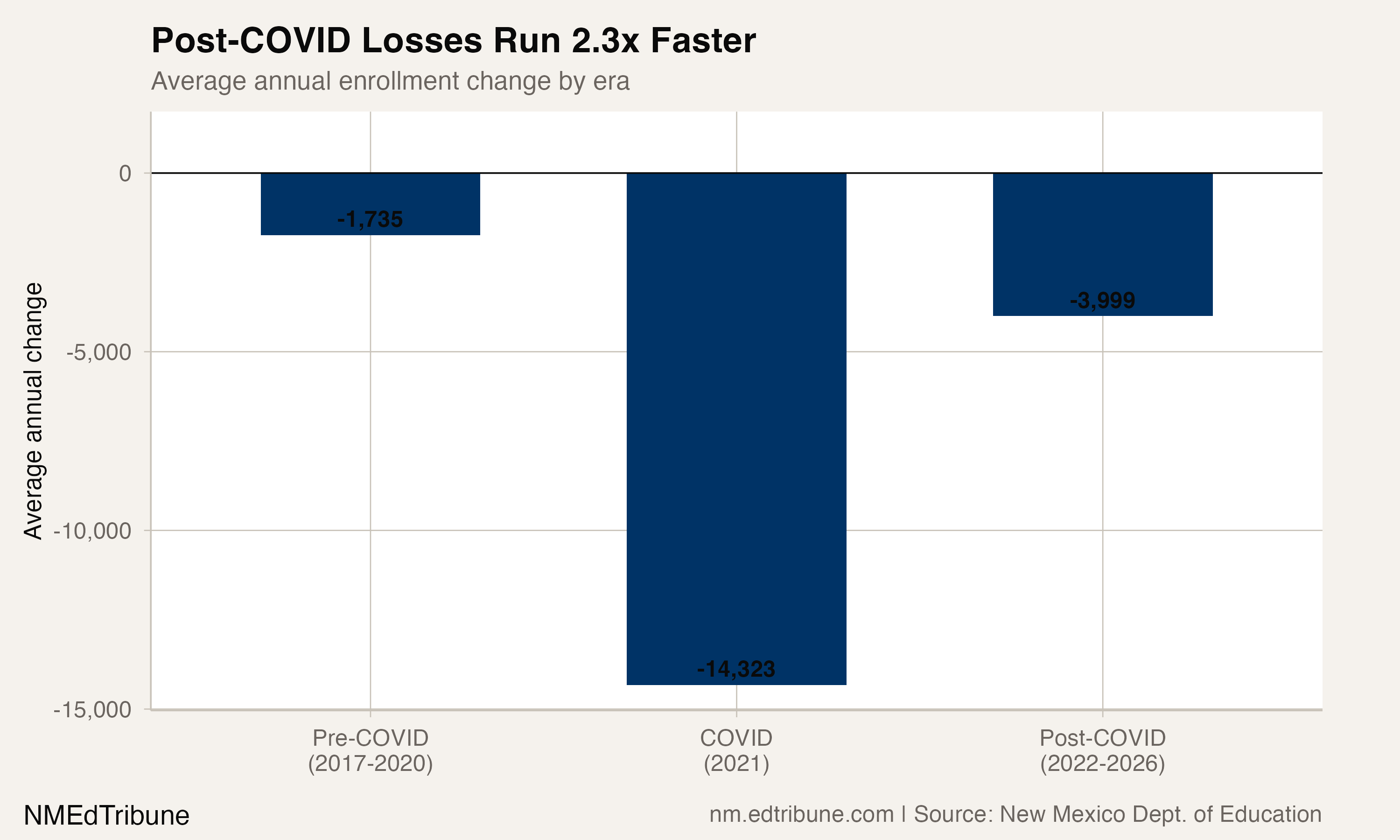
The pre-pandemic era now looks like a period of relative stability. From 2017 through 2020, New Mexico lost an average of 1,735 students per year. COVID compressed several years of decline into a single shock. But instead of recovering, the state settled into a post-COVID trajectory where annual losses average 3,999 students, more than double the old pace.
Part of this acceleration is compositional. As the enrollment base shrinks, each year's loss represents a larger share of a smaller total. A loss of 8,333 students from a base of 306,686 (2.7%) would have been only 2.5% from the 2016 base of 339,613. But the consistent direction matters more than the math: New Mexico has not posted a meaningful enrollment gain in any year since 2016. The single positive year, 2021-22, registered a gain of exactly four students.
State Senate President Pro Tempore Mimi Stewart captured the policy challenge in remarks on the Gallup virtual school controversy that apply equally to the broader enrollment picture:
"We have got to stop spending this much money on virtual schools when there's very little regulation." -- NBC News, January 2026
The legislature appropriated $4.76 billion to K-12 education for fiscal year 2025, a $580 million increase from the prior year and roughly 47% of the state's total budget. Per-pupil spending has risen by approximately $4,100 over the past five years even as the denominator continues to fall. Whether that spending can maintain service quality as enrollment declines below 300,000 is the fiscal question New Mexico will confront over the next decade.
The demographic projections offer no off-ramp. Births continue to fall. Deaths continue to exceed them. Domestic migration remains negative. Every kindergarten class that enters the system is smaller than the one before it. Districts that have already exhausted their enrollment buffers, the 62 now at all-time lows, will face consolidation decisions not in some theoretical future but within two to three budget cycles.
Detailed code that reproduces the analysis and figures in this article is available exclusively to EdTribune subscribers.
Discussion
Sign in to join the discussion.
Loading comments...