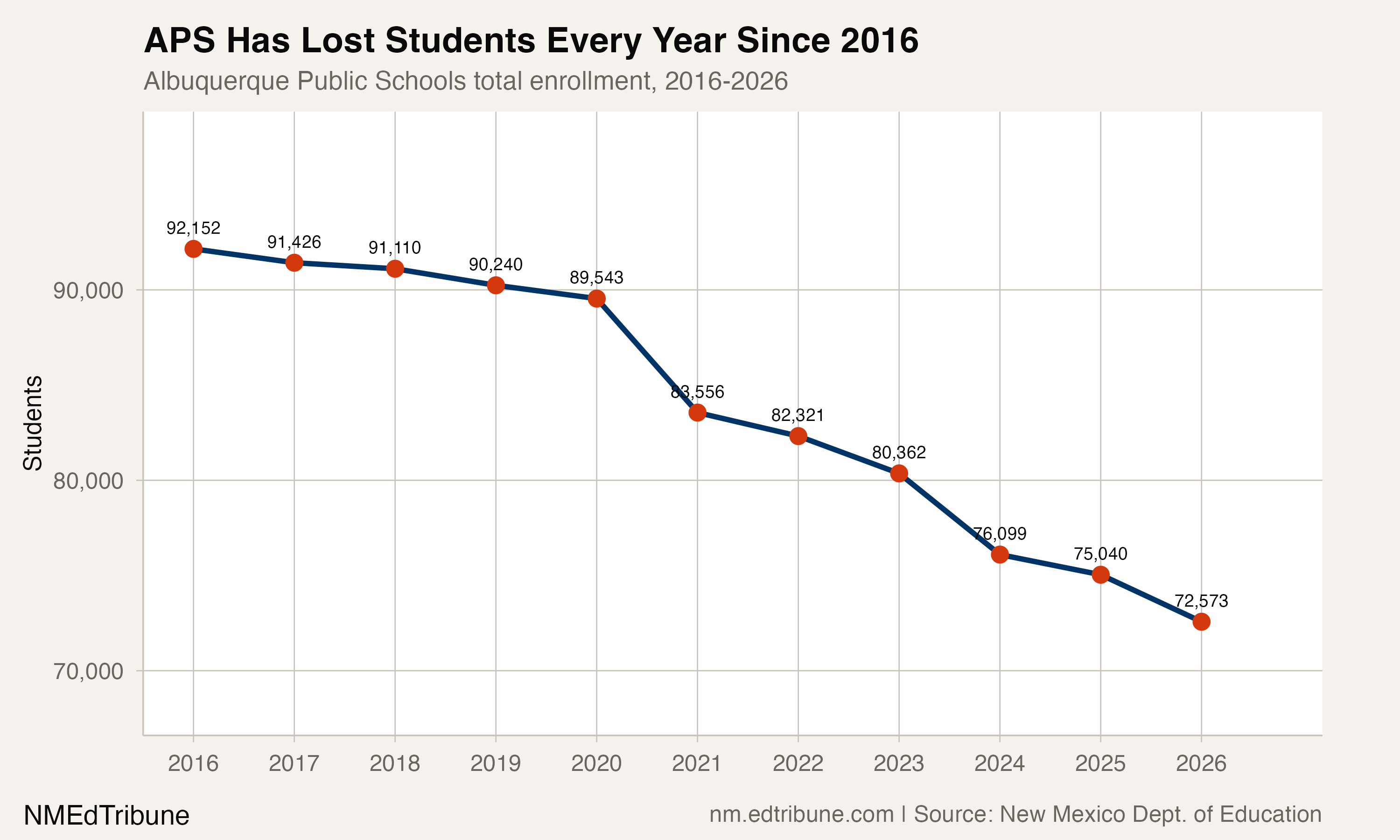
No district in New Mexico has gained students and lost them in the same breath quite like Albuquerque↗ET has avoided gaining them at all. Since 2016, APS enrollment has fallen every single year. Not once in a decade has the line ticked upward. The district enrolled 92,152 students in 2016. In 2025-26, that number was 72,573, a loss of 19,579 students, or 21.2%.
That is not just an APS problem. Those 19,579 missing students account for 47.5% of the entire state's enrollment decline over the same period, a remarkable concentration of loss in a single district.
The slow bleed, then the flood
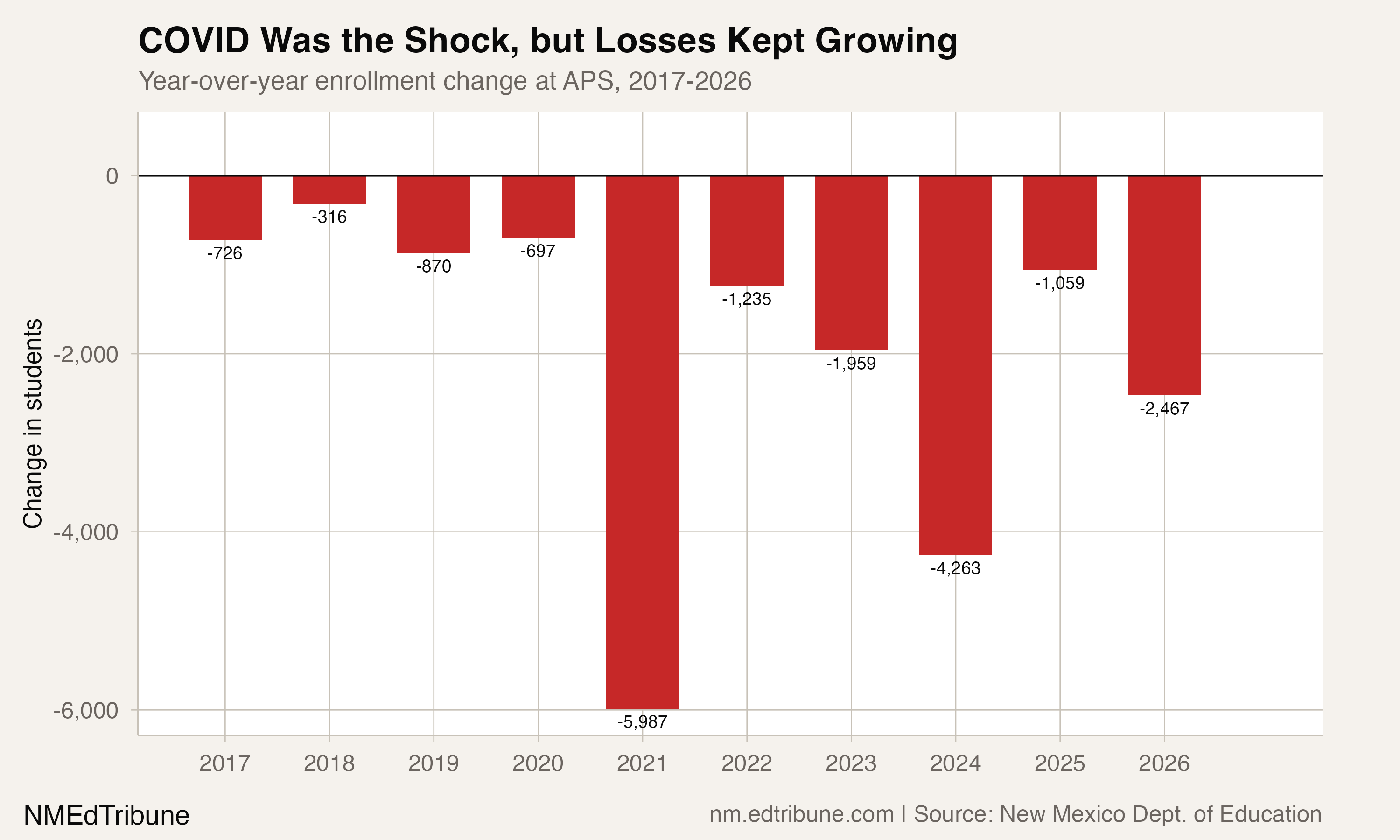
APS was already shrinking before the pandemic. From 2016 to 2020, the district lost about 650 students per year, a manageable erosion that could be absorbed through attrition and minor adjustments. COVID changed the math entirely. In 2021 alone, APS shed 5,987 students, a 6.7% single-year collapse.
The conventional expectation was that those students would return. They did not.
Since 2021, APS has lost an average of 2,197 students per year, more than triple the pre-pandemic rate. The five post-COVID years (2021-2026) produced 10,983 in losses. The worst single post-COVID year was 2024, when the district dropped 4,263 students, a 5.3% decline that exceeded the district's own projections by more than double, costing $2.5 million in state funding.
Outpacing the state
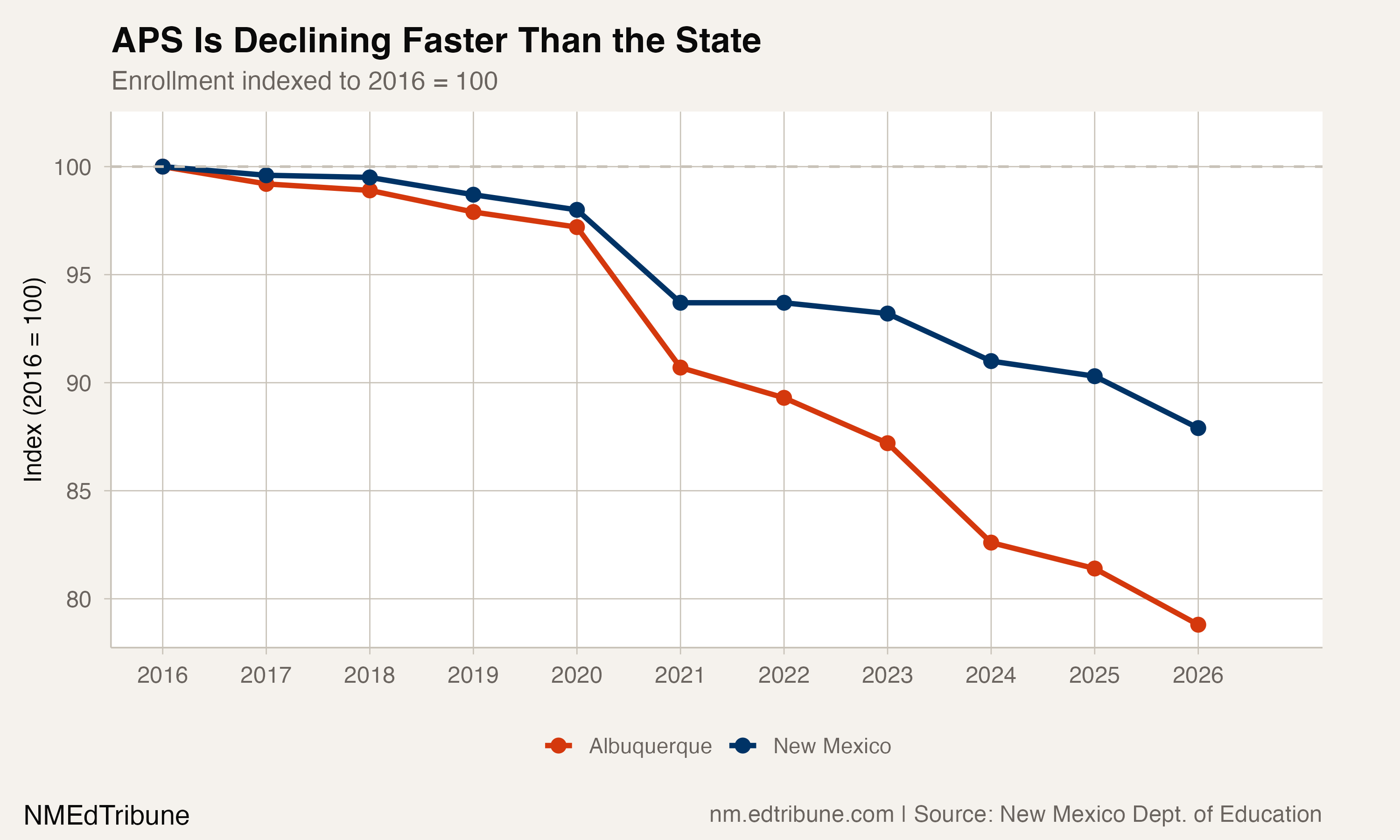
New Mexico as a whole lost 41,260 students from 2016 to 2026, a 12.1% decline. APS declined 21.2% over the same period, nearly twice the state rate. The divergence is visible when both trajectories are indexed to a common starting point: the state's line bends downward, but APS's line bends further and faster.
APS's share of statewide enrollment has slid from 27.1% to 24.3%. That 2.8 percentage-point shift represents a structural rebalancing. A district that once enrolled more than one in four New Mexico students now enrolls fewer than one in four.
Among New Mexico's 15 largest districts (those enrolling more than 5,000 students), only two avoided decline: Hobbs↗ET, which was essentially flat at +0.4%, and Carlsbad↗ET, which grew 12.5% on the strength of Permian Basin oil-economy migration. Every other large district shrank. But APS's 21.2% decline matches Gallup↗ET's 21.2% and trails only Central Consolidated at 33.5%.
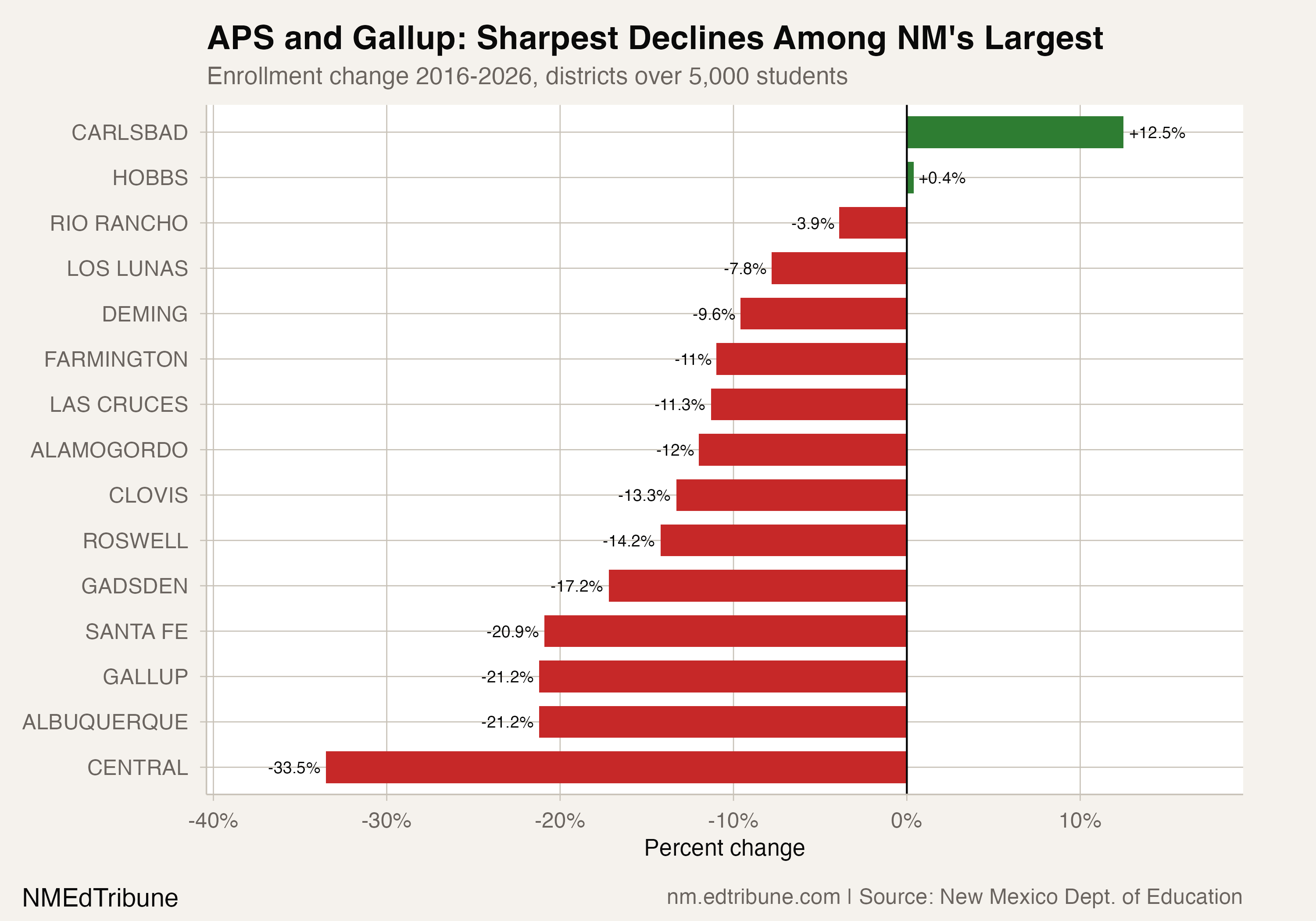
The distinction between APS and Gallup is scale. Gallup lost 2,522 students. APS lost nearly eight times as many.
Three forces pulling at once
No single explanation accounts for a 10-year decline of this magnitude.
The most likely driver is demographic contraction. New Mexico was one of only four states to lose population in 2025, and the underlying trend is bleak: deaths exceeded births by approximately 11,500 people statewide between 2020 and 2025. More than 10,500 residents left for other states in that same window. Jacqueline Miller, a demographer at the University of New Mexico's Geospatial and Population Studies Center, told KOB 4 that "our natural change is going to continue to be negative, which means the only way to have growth is through migration." International migration to New Mexico fell approximately 73% from 2024 to 2025 under tightened federal immigration enforcement.
Charter school expansion is pulling students too. Statewide charter enrollment grew from 13,534 students in 2019 to 21,734 in 2026, a 60.6% increase across 57 charter entities. The data cannot isolate how many charter students would otherwise be in APS specifically, but the timing is suggestive: APS's sharpest post-COVID declines coincided with the charter sector's fastest growth.
A harder-to-quantify pressure comes from the district itself. A state-mandated review of APS found that falling birth rates and increased charter enrollment are driving down APS enrollment, and that most APS elementary school classes are enrolled below statutory maximums, presenting opportunities for consolidation.
A district that is changing shape
The decline is not evenly distributed across the student body. From 2019 to 2026, every racial and ethnic group in APS shrank. White enrollment fell 30.8%, from 19,723 to 13,645. Black enrollment fell 37.0%, from 3,031 to 1,910. Hispanic enrollment, by far the district's largest group, fell 19.0%, from 59,735 to 48,397. Native American enrollment fell 21.8%, from 4,968 to 3,884.
Because Hispanic students are declining at a slightly lower rate than other groups, their share has remained essentially stable, at 66.2% in 2019 and 66.7% in 2026. White students' share fell from 21.9% to 18.8%. A caveat: New Mexico introduced a multiracial category in 2025, and some of the apparent decline in individual race groups reflects students reclassified as multiracial rather than actual departures.
Separately, the composition of services APS provides has shifted substantially. Special education enrollment rose from 15,963 to 18,282 over the same period, an increase of 2,319 students even as total enrollment fell by 17,667. The result: one in four APS students, 25.2%, now receives special education services, compared to 17.7% in 2019. The statewide average is 20.5%. English learner enrollment held roughly steady at about 14,600 to 15,500 students, but the share rose from 16.9% to 20.2% as the denominator shrank.
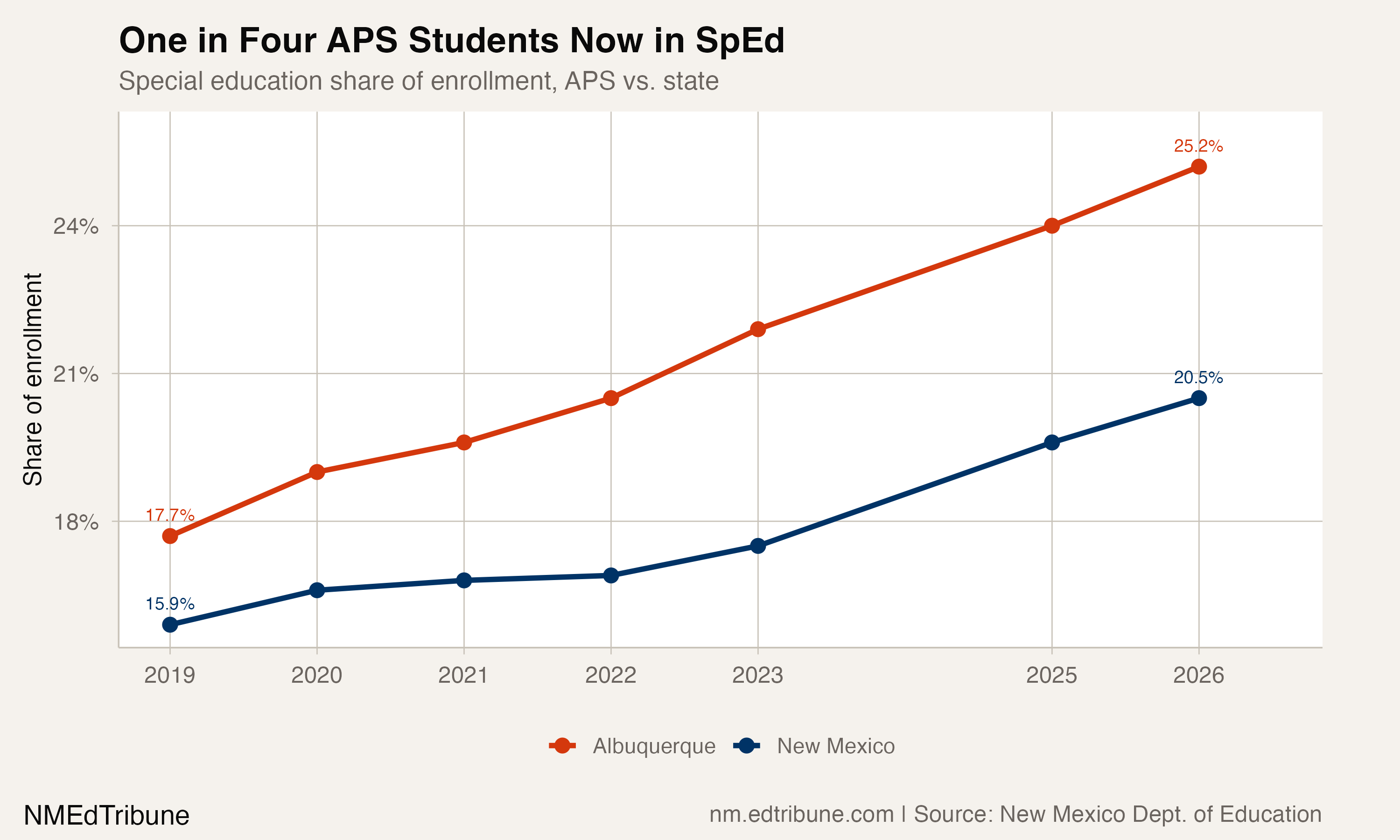
The instructional programs these students receive carry higher per-pupil costs. As the students leaving APS skew toward general education, the proportion of students entitled to specialized services rises, creating a structural mismatch between the funding model's assumptions and the district's actual obligations.
More money, fewer desks
APS adopted a $2.15 billion budget for 2024-2025 and is on track for $2.3 billion in 2025-2026. Per-pupil spending has climbed from roughly $15,574 in 2016 to an estimated $35,384 in the coming year. The budget has not contracted with enrollment. It has grown.
"We are currently identifying essential areas that require funding and exploring alternative funding sources for key initiatives." — APS CFO Rennette Apodaca, NM Education
Whether that per-pupil increase translates to better outcomes is an open question. Reporting from the Southwest Public Policy Institute notes that only 40% of APS high school students test proficient in reading and 26% in math. Per-pupil spending doubling while proficiency rates remain low is the kind of fact that fuels school choice arguments, and New Mexico's legislature will face intensifying pressure to expand alternatives as APS continues to shrink.
What to watch in 2027
APS's 10-year streak is tied with Taos↗ET and Socorro↗ET for the longest consecutive decline in the state. The difference is that APS is 34 times the size of Taos and 56 times the size of Socorro, which means the fiscal and operational consequences are visible across everything from bus routes to bond capacity.
The 2024 drop of 4,263 was the steepest post-COVID loss. In 2025 and 2026, losses moderated to 1,059 and 2,467 respectively. If that deceleration holds, APS may settle around 65,000 to 70,000 students. If it does not, the district hits 65,000 by 2028, at which point schools designed for 90,000 will be operating at less than three-quarters capacity. APS has already shuttered 22 schools since 2006. The consolidation math says more will follow. The buildings will still be there. The students will not.
Detailed code that reproduces the analysis and figures in this article is available exclusively to EdTribune subscribers.
Discussion
Sign in to join the discussion.
Loading comments...