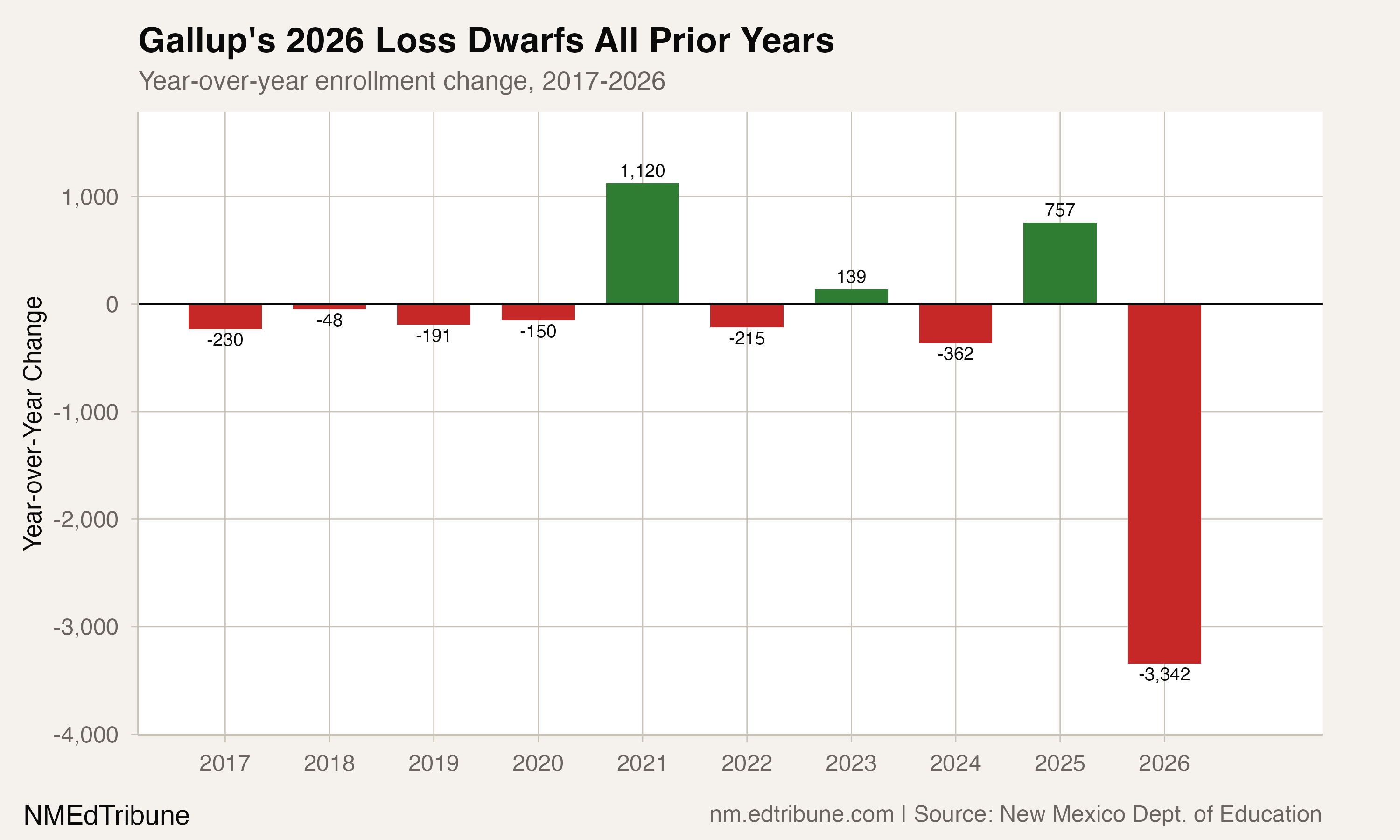
Gallup-McKinley County Schools↗ET reported 12,737 students in 2024-25. In 2025-26, it reported 9,395. The 3,342-student drop, a 26.2% loss in a single year, is the third-largest single-year district loss in New Mexico history, behind only Albuquerque↗ET's pandemic-year collapses. It accounts for 40.1% of the state's entire enrollment decline in 2025-26.
But most of those students were never in a Gallup-McKinley classroom. They were enrolled in a virtual school operated by Stride Inc. (formerly K12 Inc.) under a contract the district signed in June 2020. When the board terminated that contract in spring 2025, approximately 3,000 virtual students scattered to other districts. The enrollment crash is real in the data. Whether it reflects a real loss of students, or the correction of a five-year accounting distortion, is the harder question.
The Stride era: five years of phantom growth
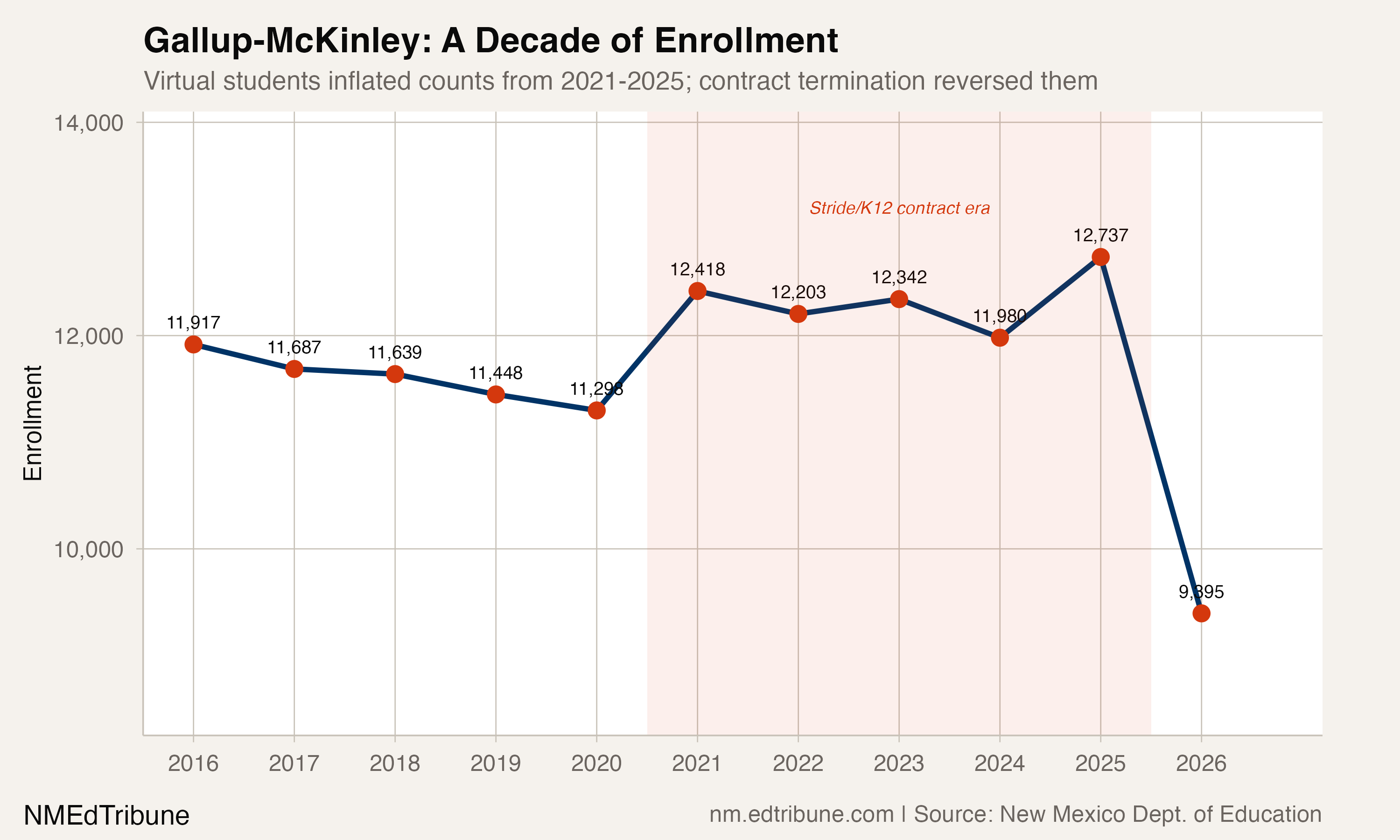
Before the Stride contract, Gallup-McKinley was a slowly declining district. From 2016 to 2020, enrollment fell from 11,917 to 11,298, a loss of about 150 students per year. The district ranked seventh in New Mexico by enrollment.
That trajectory reversed in 2020-21, when the district added 1,120 students in a single year, the only large gain in its recent history. The growth coincided with the first full year of the Stride/K12 virtual program, which signed up roughly 1,000 students from across New Mexico in its first year. By 2024-25, the virtual enrollment had grown to approximately 3,000.
The virtual students showed up in Gallup-McKinley's official count, boosting the district from seventh-largest to fourth-largest in the state. They also generated per-pupil funding. The district was not hiding this arrangement; it was operating under New Mexico's rules for virtual education, which had not been substantially overhauled since 2007.
The school-level data shows how the virtual students were distributed across campuses. Gallup Central Alternative, historically a small campus serving around 200 students, ballooned to 1,244 in 2024-25. Lincoln Elementary spiked from 243 to 1,094 in 2020-21 before falling back. Several middle schools showed enrollment increases from 2019 to 2025 that ran counter to statewide demographic trends.
The contract termination
In April 2025, the Gallup-McKinley board voted to end its Stride contract, effective June 30, 2025. The district cited severe academic and legal violations: graduation rates in the Stride-managed program had fallen from 55.8% in 2022 to 27.7% in 2024, math proficiency had dropped to 5.6%, and teachers were sometimes assigned more than 200 students, well above state limits.
"Our students deserve educational providers that prioritize their academic success, not corporate profit margins." — Chris Mortensen, School Board President, GMCS press release, May 2025
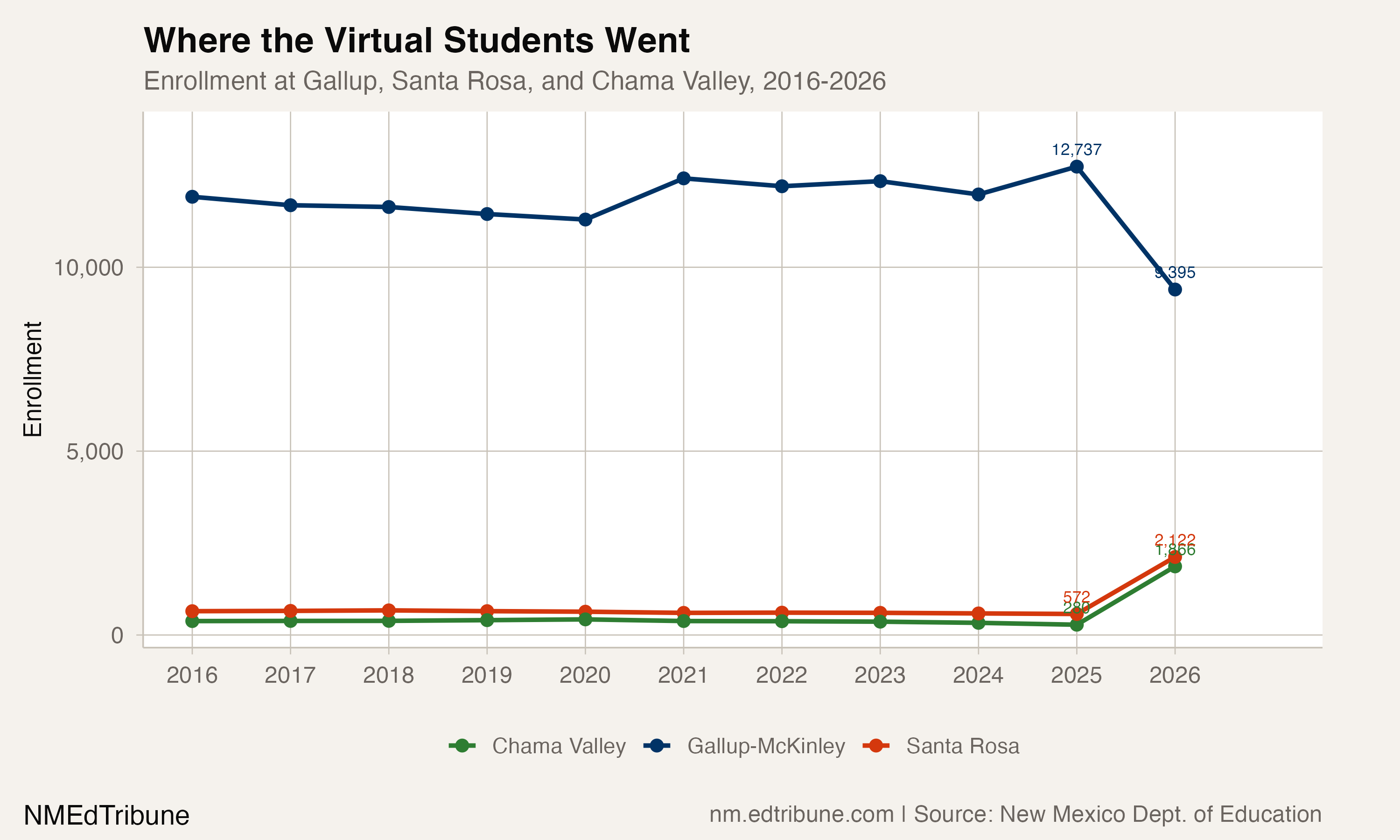
Stride responded with five lawsuits against the district. The company then secured contracts with Santa Rosa Consolidated Schools↗ET and Chama Valley Independent School District↗ET, each absorbing roughly 1,500 of the virtual students. The data confirms this: Santa Rosa's enrollment jumped from 572 to 2,122 (+1,550), and Chama Valley went from 280 to 1,866 (+1,586). The combined gain of 3,136 almost exactly matches Gallup's 3,342-student loss.
A $35 million statewide problem
Because New Mexico's State Equalization Guarantee is based on prior-year enrollment, Gallup was funded in 2025-26 for approximately 3,000 students it no longer served. At the same time, Santa Rosa and Chama Valley absorbed those students without corresponding funding. The result was a $35 million shortfall in the state funding formula, with the full double-payment scenario threatening a $75 million gap that would have forced cuts at schools statewide.
The legislature passed HB 253 to address the crisis, halting approximately $20 million each for Chama Valley and Santa Rosa and reducing Gallup-McKinley's allocation by $23 million. The bill also represents the state's first major overhaul of virtual education regulation since 2007.
In March 2026, the Gallup-McKinley board settled its dispute with Stride, reinstating a modified contract for K-12 tutoring services through June 2026 and withdrawing all complaints.
Every campus lost students
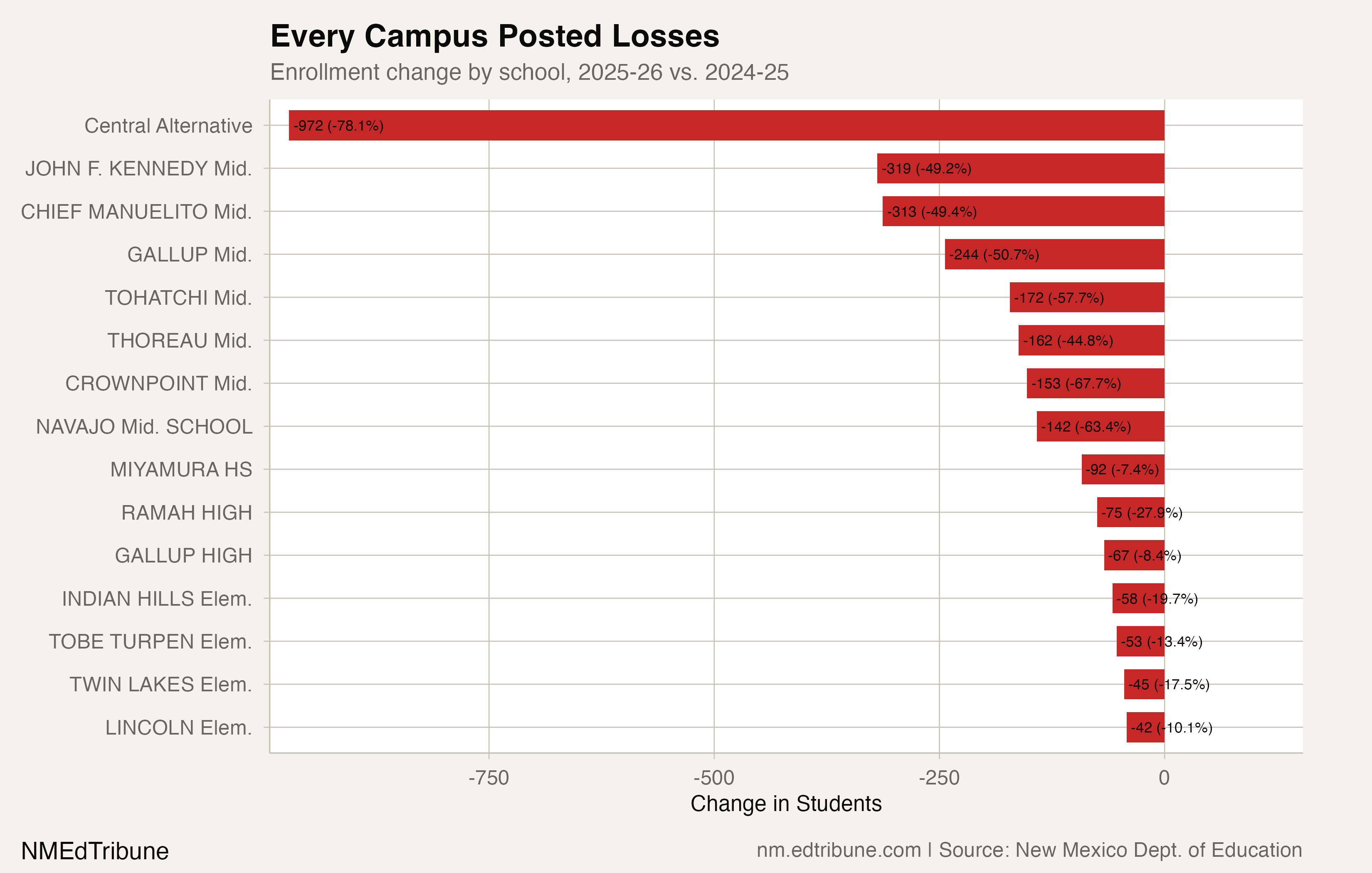
The virtual school termination does not fully explain the 2026 numbers. Even excluding Gallup Central Alternative entirely, the district's remaining campuses fell from 11,488 in 2024-25 to 9,122 in 2025-26, a loss of 2,366 students (20.6%). This suggests virtual students had been counted at campuses across the district, not just at Central Alternative.
The middle schools were hit hardest: combined enrollment across seven campuses fell from 2,873 to 1,368, a 52.4% collapse. Crownpoint Middle lost 67.7% of its students. Navajo Middle School lost 63.4%. Not a single one of the district's 32 campuses gained enrollment.
The real enrollment underneath
Strip away the virtual distortion, and Gallup-McKinley still faces a genuine enrollment decline. The district had 11,448 students in 2018-19, the last year before the Stride contract. It has 9,395 now. That is a loss of 2,053 students (17.9%) over seven years, a steeper trajectory than the state average and one that predates the virtual school controversy.
The demographic composition reveals the scope of the virtual inflation. In 2024-25, when virtual students swelled the count, Gallup's Native American share fell to 63.0%, the lowest on record for a district that historically serves an approximately 79% Native American student body. Non-Native enrollment nearly tripled: white students rose from 571 (2019) to 1,110 (2025), and Hispanic students from 1,591 to 2,740. In 2025-26, with the virtual students gone, the Native American share snapped back to 78.3%, and absolute non-Native enrollment fell by more than half.
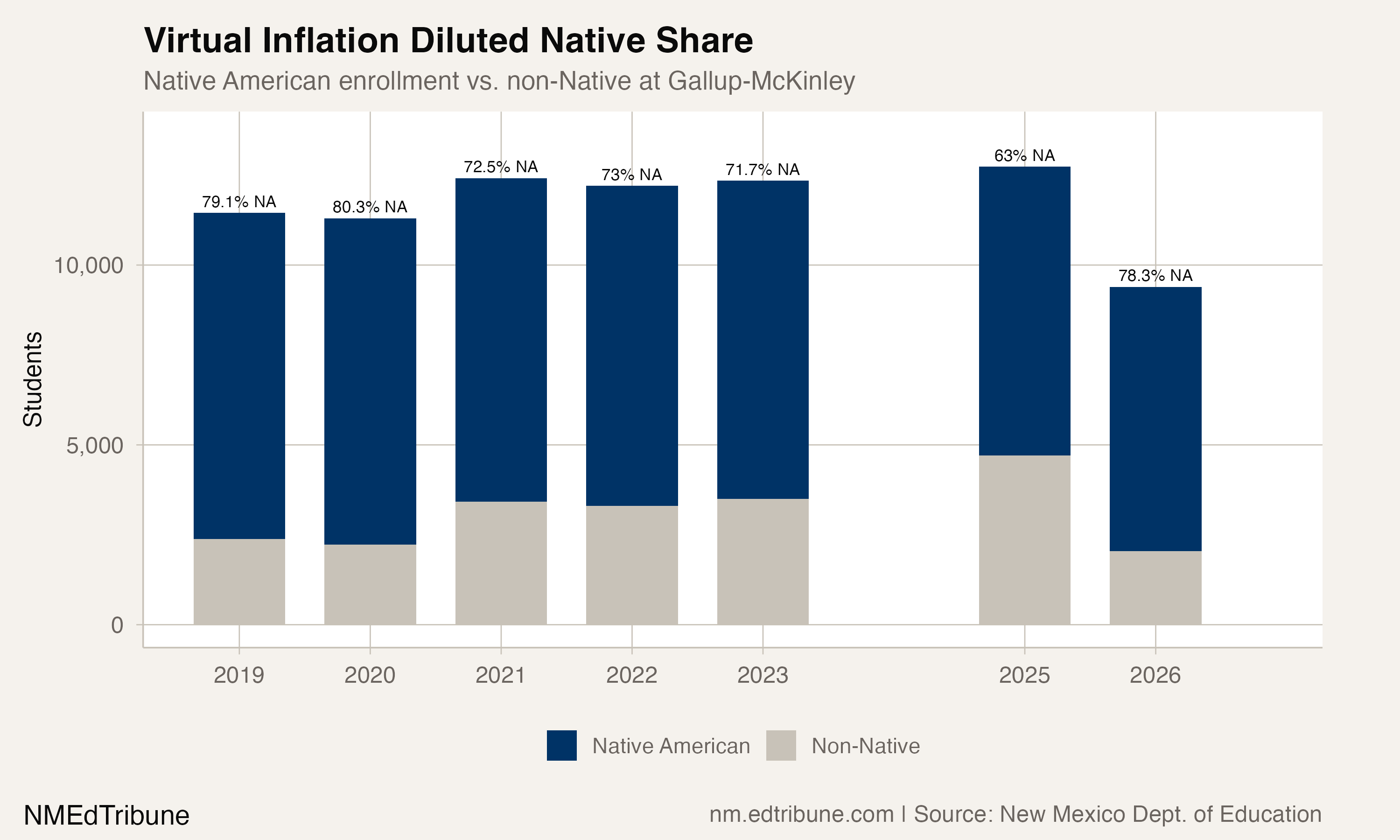
This pattern is consistent with a virtual program that enrolled students from across New Mexico, most of whom were not Native American, under the Gallup-McKinley umbrella. The district's actual Native American enrollment declined from 9,061 (2019) to 7,354 (2026), a loss of 1,707 students (18.8%). That loss, spread over seven years in a region where poverty rates are triple the national average and some students face two-hour bus rides to school, is the enrollment story that the virtual inflation obscured.
What families are left with
Gallup-McKinley now ranks eighth in New Mexico by enrollment, down from fourth a year ago. The district has reopened virtual options through new contractors, OpenEd and Graduation Alliance, following a competitive procurement process. Whether these programs will attract the same scale of enrollment remains to be seen.
The broader question is what five years of virtual inflation cost. Gallup-McKinley was funded as a 12,000-student district while its brick-and-mortar schools served closer to 9,000. A Navajo Nation Human Rights Commission report has spotlighted systemic inequities at the district, including treatment of Native American students and staff. As superintendent Mike Hyatt told NBC News: "It was our students that were taken advantage of. They're the ones that were harmed in this."
The 2026-27 count day will show whether the 9,395 figure represents a new floor for a district in genuine decline, or whether the departure of virtual students has further destabilized the physical schools that remain. For the 7,354 Native American students still enrolled, the answer will determine class sizes, bus routes, and whether schools in Crownpoint, Tohatchi, and Thoreau stay open.
Detailed code that reproduces the analysis and figures in this article is available exclusively to EdTribune subscribers.
Discussion
Sign in to join the discussion.
Loading comments...