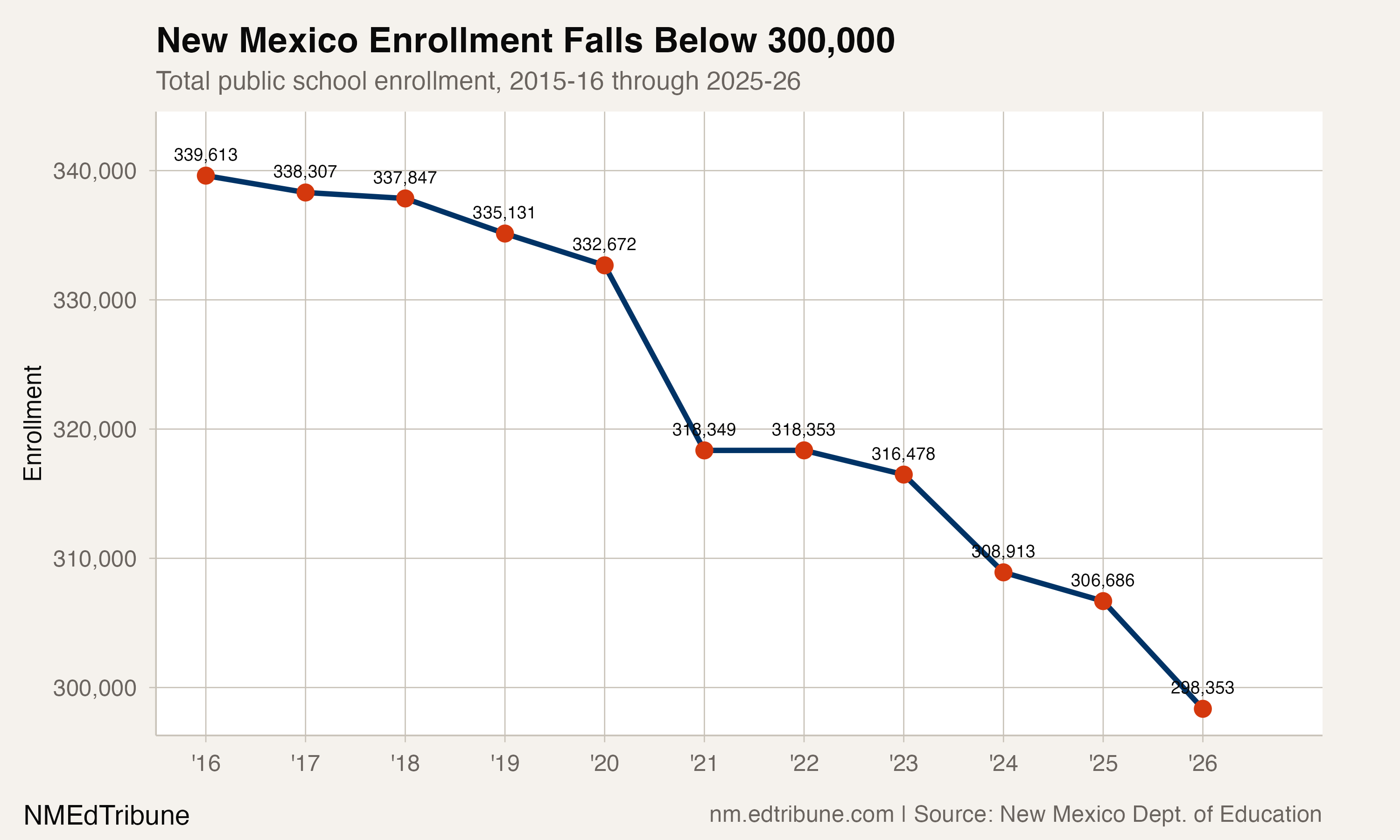
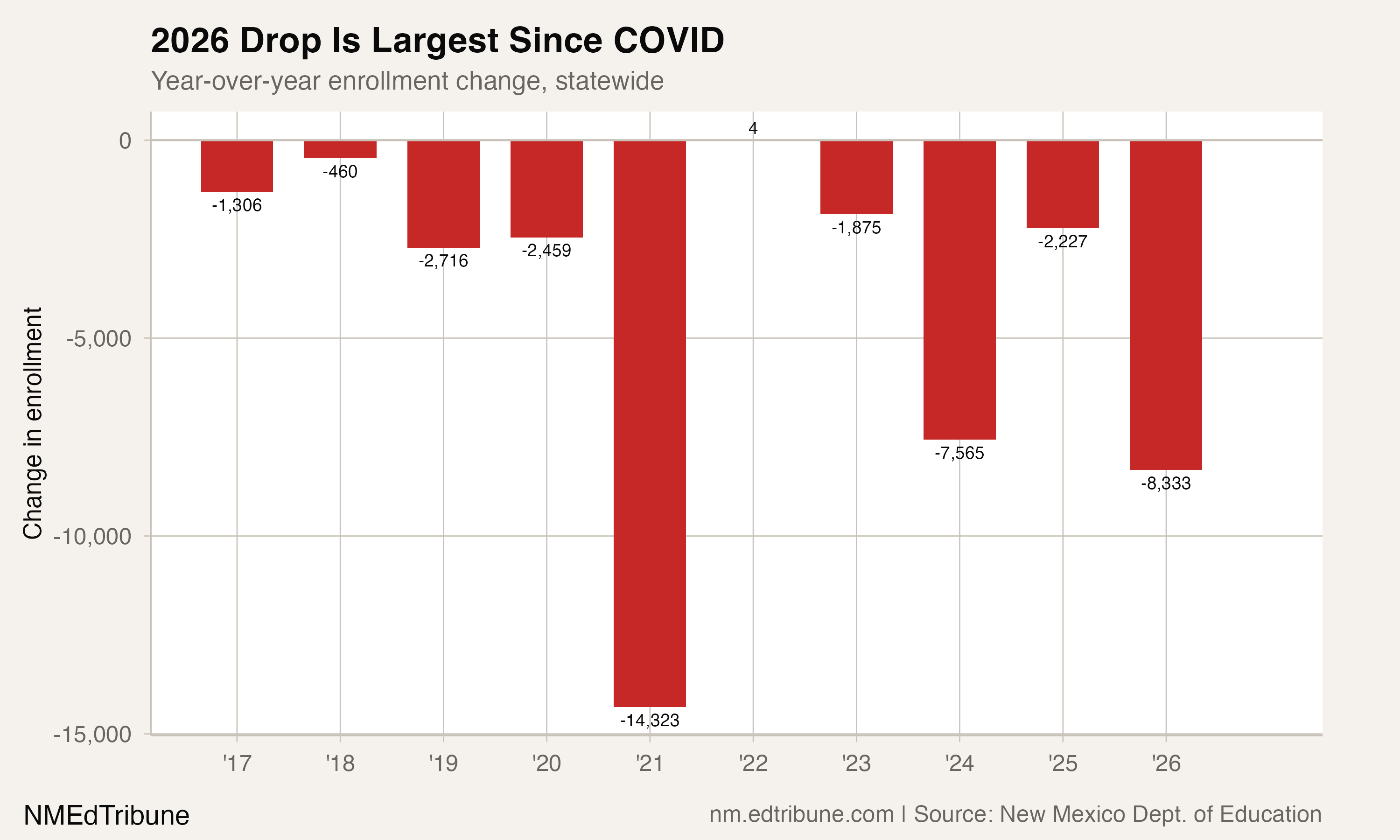
New Mexico's public schools enrolled 298,353 students in 2025-26, falling below 300,000 for the first time in the state's dataset. That 2.7% single-year drop, a loss of 8,333 students, is the largest outside the pandemic year that opened this decade of decline.
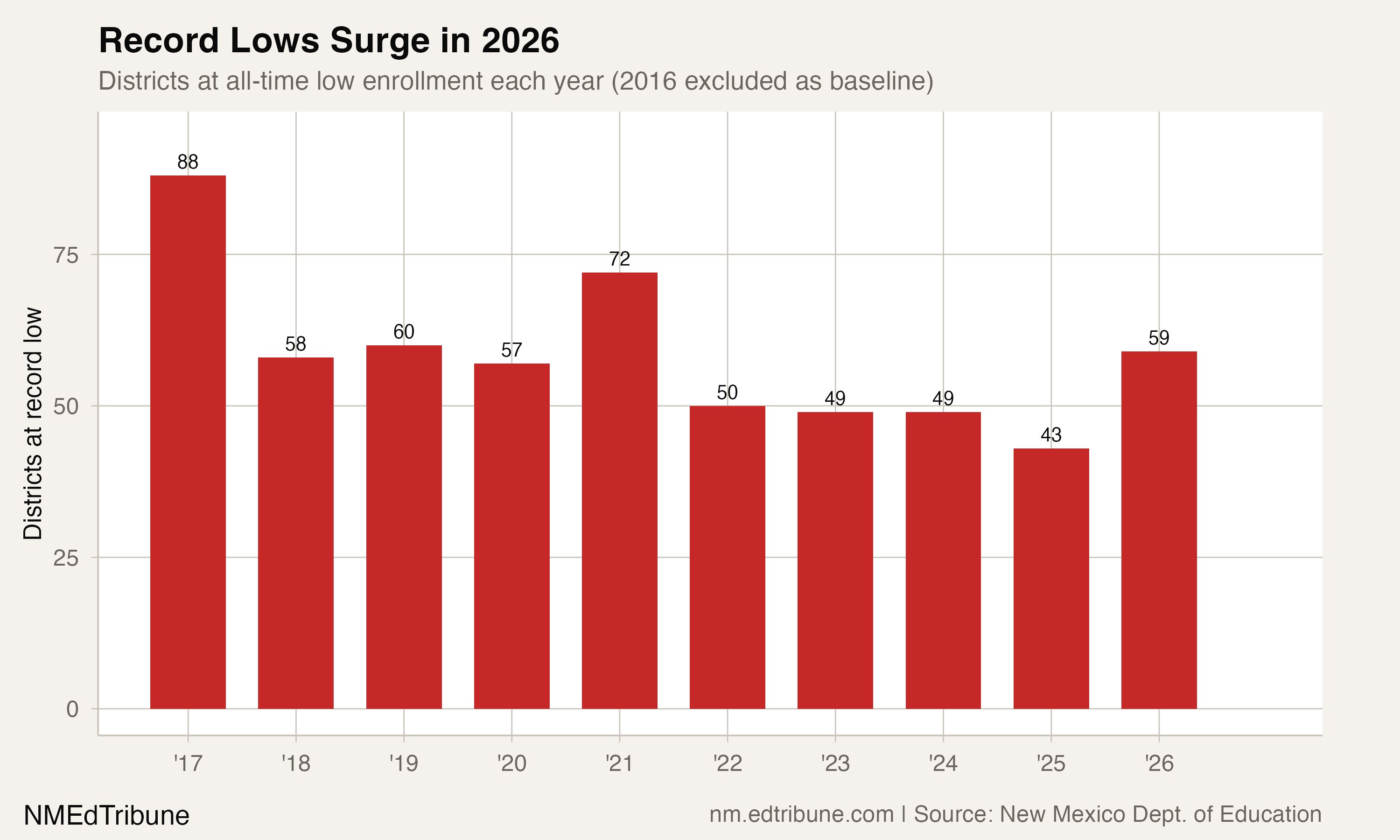
Fifty-nine districts are now at their lowest enrollment ever recorded in the state's dataset, which begins in 2015-16. That is 38.3% of all districts with multi-year data, and it includes nine of the state's 10 largest. The districts at record lows collectively enroll 78.7% of the state's students. Only Hobbs↗ET, the seventh-largest district at 10,002 students, avoided the list among the top 10.
Every major district, the same direction
Albuquerque↗ET has declined every year for a decade. Its 72,573 students in 2025-26 represent a loss of 19,579 from 2015-16, a 21.2% decline. The district now projects fewer than 65,000 students on its internal enrollment estimates, which use a different counting window than the state's 40-day figures.
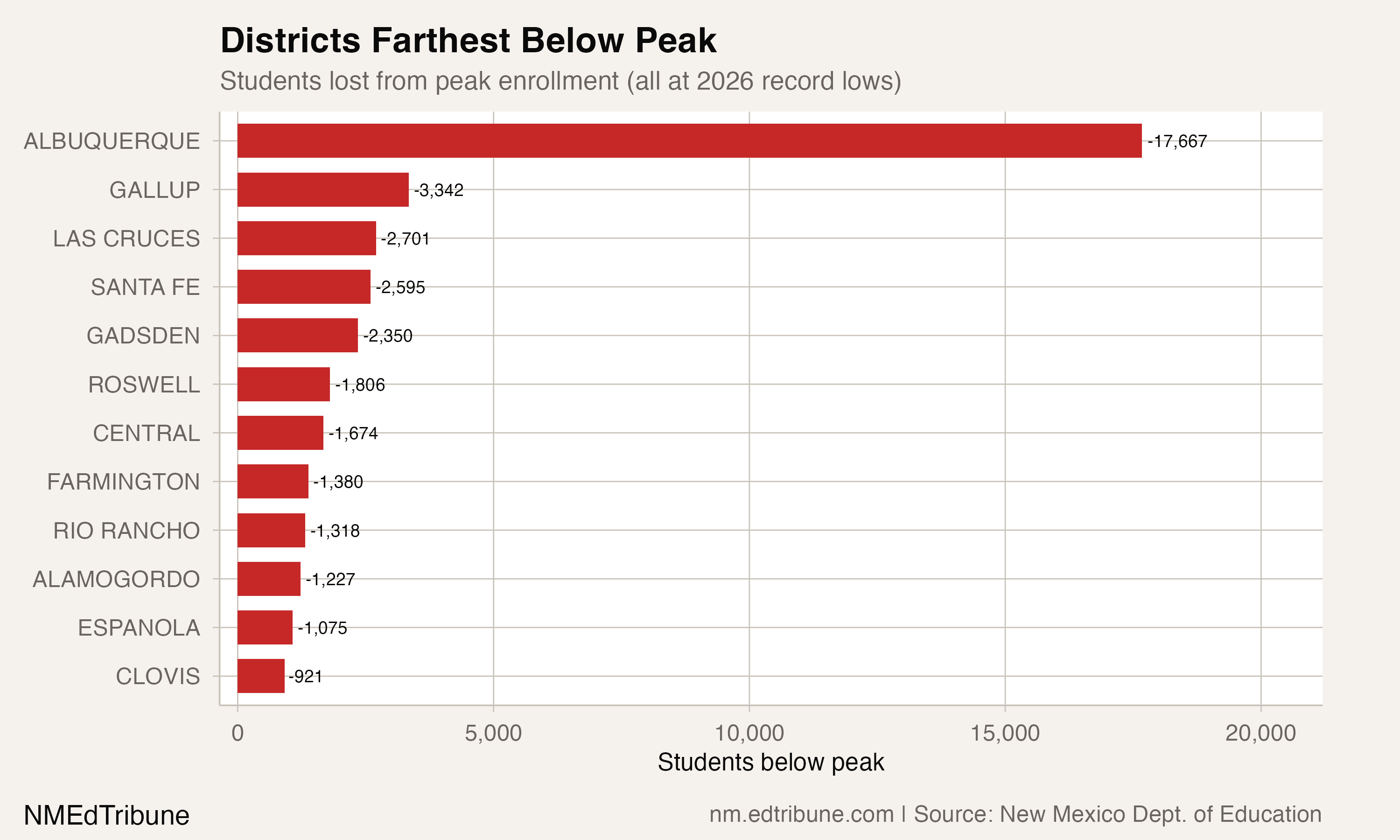
Las Cruces↗ET is down 2,701 from its 2018-19 peak, a 10.9% loss. Santa Fe↗ET has lost 2,595 students (19.6%) over the same span, declining every year since. Gadsden↗ET has shed 2,350 (17.3%), Roswell↗ET 1,806 (16.9%), and Farmington↗ET 1,380 (11.7%).
Three districts have declined every single year for a decade: Albuquerque, Socorro↗ET, and Taos↗ET. Santa Fe, Gadsden, and Pojoaque↗ET are on eight-year streaks. No traditional district of any size has been immune.
The Gallup disruption
The largest single-district collapse in 2025-26 belongs to Gallup↗ET, which lost 3,342 students in one year, a 26.2% drop from 12,737 to 9,395. This was not a gradual decline. Gallup-McKinley County Schools terminated its contract with virtual learning provider Stride Inc. in May 2025, displacing thousands of online students who had been enrolled through the district's Destinations Career Academy.
The state's Public Education Department later attributed a $35 million budget shortfall to the arrangement, because Gallup continued drawing state funding based on prior-year enrollment for students it no longer served. The state legislature passed an emergency bill to recoup the overpayment.
Without Gallup's virtual school collapse, the statewide drop would have been roughly 5,000, still larger than either the 1,875 loss in 2022-23 or the 4,211 loss in 2024-25. Gallup's situation illustrates how virtual enrollment, counted through a single district, can distort statewide figures in both directions.
The acceleration beneath the surface
Even setting aside the Gallup anomaly, the trend is worsening. The 2023-24 loss of 5,581 students had no such distortion, and it alone dwarfs the 1,300-to-2,700 annual declines that characterized the pre-pandemic years. The state lost 14,323 students in the COVID year of 2020-21, and enrollment has never recovered. New Mexico has declined in 10 of the 11 years in the dataset, with only 2021-22 showing a negligible gain of four students.
The record-low count has jumped. After holding in the range of 43 to 50 districts from 2022 through 2025, it jumped to 59 in 2026, the highest since the COVID year of 2020-21, when 72 districts hit lows.
The demographic undertow
The structural driver is demographic. University of New Mexico population projections estimate the state's 0-to-24 population will decline 20% over 20 years, reaching approximately 550,000 by 2040. Births have fallen steadily since 2008. Deaths now exceed births annually, a reversal that began in 2020 and has persisted. The state's total population peaked near 2.11 million and is projected to begin declining after 2035.
"Our population is experiencing a rapidly changing age structure... declining number of children and emerging adults." — UNM Geospatial and Population Studies, 2024
Domestic out-migration compounds the birth rate decline. New Mexico lost a net 6,000 residents to other states since 2020, partially offset by international migration of about 12,000.
The Rio Grande Foundation has characterized the enrollment decline as among the worst nationally, noting that only California and Hawaii face steeper projected declines. The foundation argues that state investments in universal pre-K and tuition-free college have not stemmed the outflow of young families.
Whether the decline is primarily birth-rate-driven or migration-driven, or some combination, is difficult to disentangle from enrollment data alone. Both mechanisms produce the same pattern: fewer children entering kindergarten, smaller cohorts moving through each grade.
Charters grew, then stalled
The charter sector has been the primary counterweight to traditional district losses. Charter enrollment grew from 13,534 in 2018-19 to 22,242 in 2024-25, nearly doubling its share from 4.0% to 7.3% of statewide enrollment. But in 2025-26, charter enrollment dipped for the first time, falling to 21,734, a loss of 508 students.
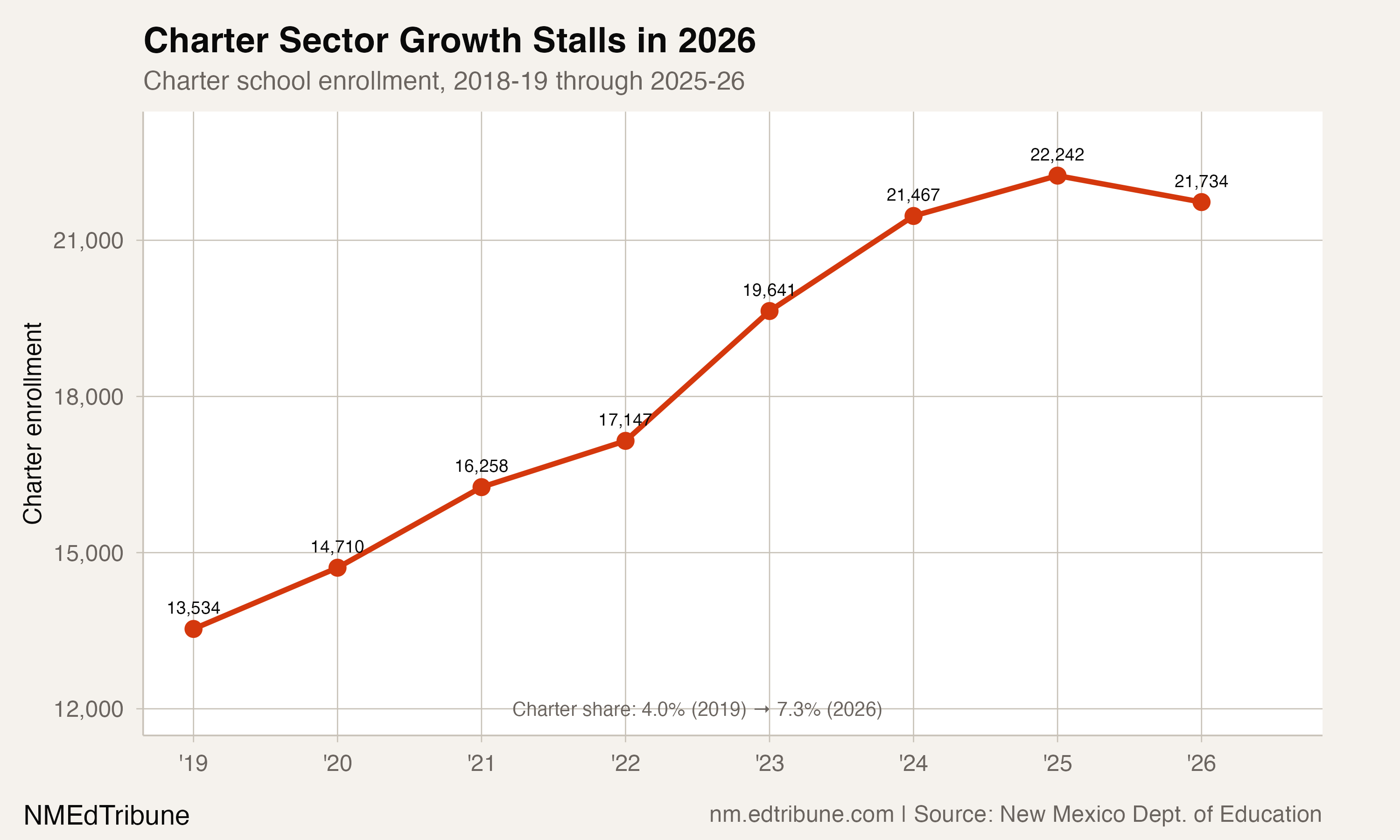
Among districts at all-time highs in 2026, 22 of 24 with multi-year data are charter schools. Among those at all-time lows, 50 of 59 are traditional districts. The sector divergence is unmistakable, but it is also reaching a ceiling. The total number of charter entities dropped from 58 to 57 in 2025-26, and several established charters lost students alongside their traditional counterparts.
The small-district squeeze
Of the 59 districts at record lows, 31 enroll fewer than 500 students. These micro-districts, scattered across rural New Mexico from the Sangre de Cristos to the Bootheel, face a compounding problem: each lost student represents a larger share of the budget, and there are fewer remaining programs to consolidate.
Espanola↗ET has lost 30.2% from its peak, falling from 3,555 to 2,480. Las Vegas City↗ET has lost 32.1%. Central↗ET Consolidated, serving a large Native American population in the Four Corners region, has shed 28.4%.
In percentage terms, the hardest-hit mid-sized districts have lost roughly a quarter to a third of their enrollment in seven years. These are not gradual shifts that can be managed through attrition. They represent the closure of grade-level sections, the consolidation of buildings, and the elimination of electives.
Only 17 traditional districts grew between 2018-19 and 2025-26, and most of those gains were modest. Loving↗ET and Tularosa each added 121 students over that span. No traditional district in the state added more than that.
What the next count will reveal
The 300,000 threshold New Mexico crossed in 2025-26 is symbolic, but the fiscal mechanics are not. State Equalization Guarantee funding follows enrollment counts. APS alone faces a $2.5 million SEG reduction from a single year's decline, even as the district approved its largest budget in history at $2.25 billion, driven by rising per-pupil costs.
The Yazzie/Martinez court order found the state was denying at-risk students their constitutional right to a sufficient education. The legislature has responded with $1.6 billion in additional recurring funding since the ruling, a 58% increase. Yet only 38% of students read at grade level. The 59 districts at their smallest ever recorded are being asked to do more with less, or more precisely, to do more with more money for fewer students, a formula that works until it does not.
Detailed code that reproduces the analysis and figures in this article is available exclusively to EdTribune subscribers.
Discussion
Sign in to join the discussion.
Loading comments...