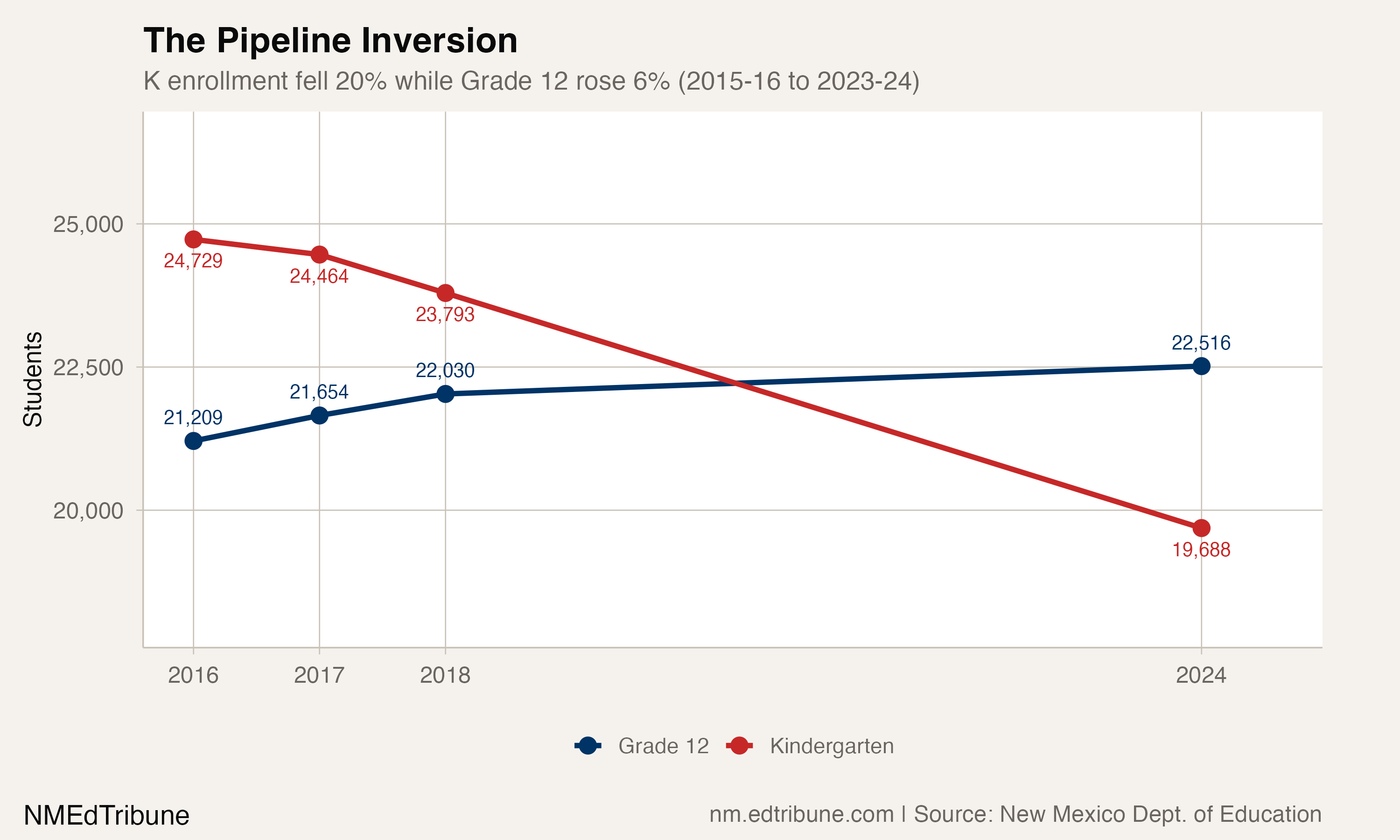
In 2015-16, New Mexico's public schools enrolled 3,520 more kindergartners than 12th-graders. That surplus meant the system was replenishing itself: more students entering at the bottom than exiting at the top. By 2023-24, the math had reversed. Grade 12 exceeded kindergarten by 2,828 students, a swing of more than 6,300 in annual pipeline pressure. The school system is now consuming itself faster than it can refill.
Kindergarten enrollment fell from 24,729 to 19,688 over that span, a 20.4% decline. Grade 12, meanwhile, rose 6.2%, from 21,209 to 22,516. The two lines crossed somewhere in the gap between 2018 and 2024, and every kindergarten class since has entered a system with more seniors leaving than five-year-olds arriving.
The bottom fell out first
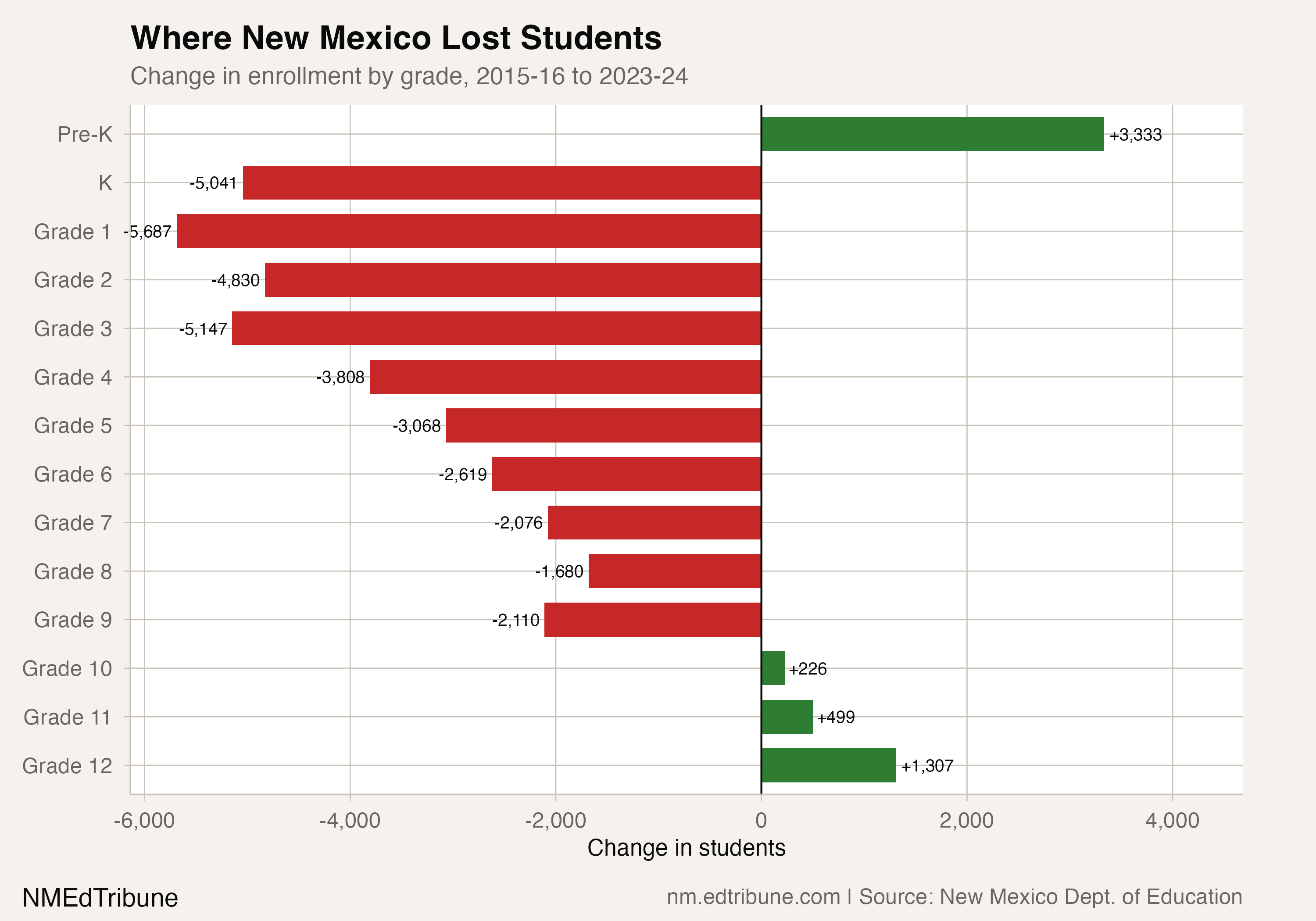
The damage is concentrated in the youngest grades. Elementary enrollment (K through 5th grade) fell 17.7%, a loss of 27,581 students. That accounts for 81% of the state's total K-12 decline of 34,034 over the period. Middle school (grades 6-8) lost 8.5%. High school lost 78 students, or 0.1%.
Grade 1 fell even harder than kindergarten: down 5,687 students, a 21.4% decline. Grades 2 and 3 followed closely, down 18.0% and 19.4%. The losses attenuate moving up the grade ladder. By 8th grade, the decline is 6.7%. By 10th grade, enrollment actually grew, if barely: up 226 students, or 0.9%.
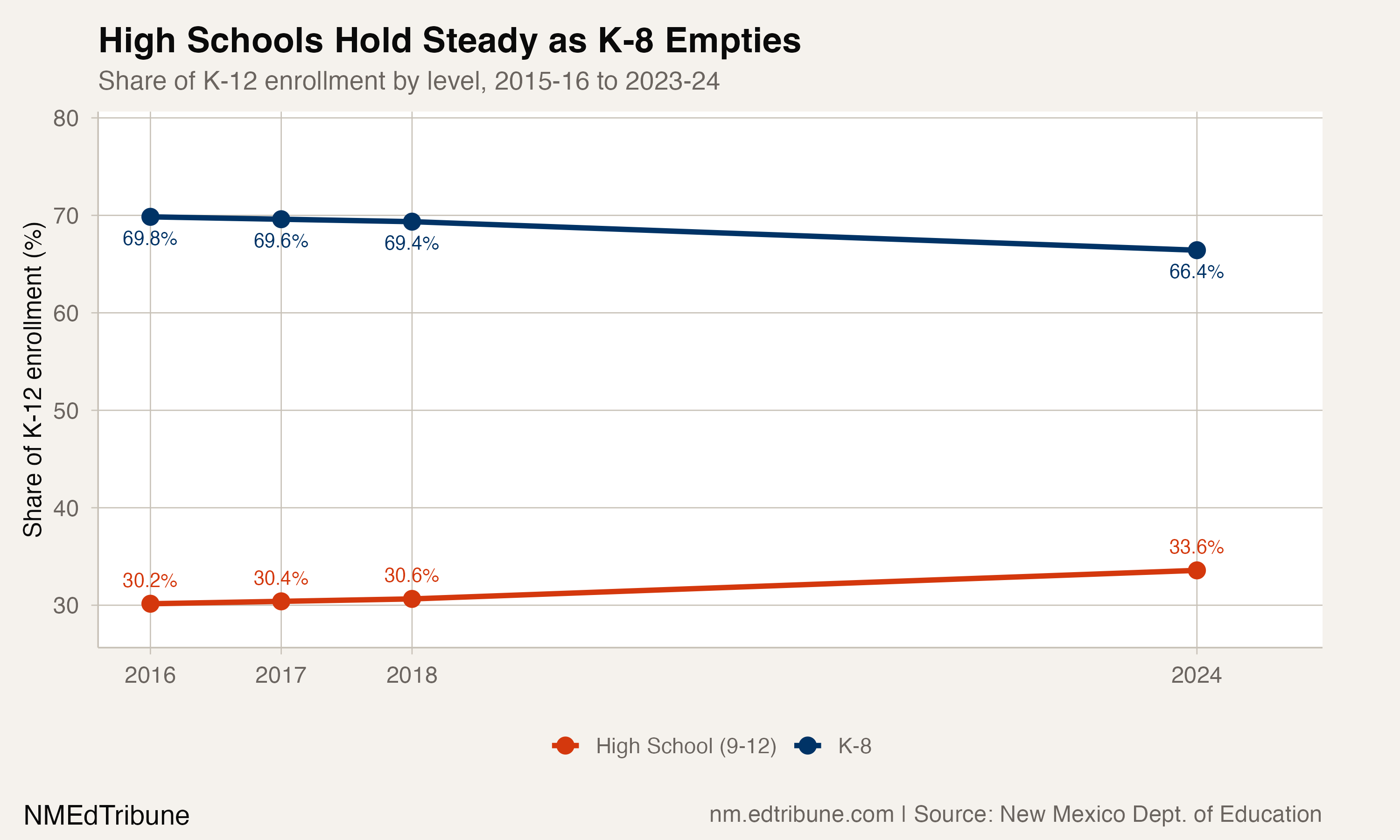
The structural result is visible in how the system's weight has shifted. In 2015-16, high school students (grades 9-12) accounted for 30.2% of K-12 enrollment. By 2023-24, that share had risen to 33.6%. The system is aging in place: the upper grades hold steady while the lower grades empty.
A birth decline that preceded COVID by years
The kindergarten collapse did not begin with the pandemic. New Mexico's births peaked at 30,475 in 2007 and have fallen nearly every year since, reaching 20,598 in 2023, a 32.4% decline over 16 years. The children entering kindergarten in 2023-24 were born in 2018 and 2019, when the state recorded roughly 22,900 births per year. The children who entered kindergarten in 2015-16 were born in 2010 and 2011, when births still exceeded 27,000.
The fertility rate tells the same story. New Mexico's total fertility rate dropped from 2,308 per 1,000 women of reproductive age in 2007 to 1,519 in 2023, a rate well below the replacement level of 2,100. The state's rate had historically exceeded the national average but fell below it in 2014 and has remained there since.
The decline was steepest among teens. The teen birth rate for 15- to 19-year-olds fell 59% between 2010 and 2020, from 53.1 to 21.8 per 1,000. Because New Mexico's teen birth rate was historically among the nation's highest, this category accounted for an outsized share of the total drop.
COVID did accelerate the broader enrollment decline, with the state losing 14,323 students in a single year (2020-21). But the kindergarten pipeline was already hollowing out. Between 2015-16 and 2017-18, kindergarten fell from 24,729 to 23,793, a decline of 936 students over two years, before grade-level data goes dark until 2023-24.
Albuquerque drives the statewide loss
Albuquerque↗ET Public Schools lost 1,932 kindergartners between 2015-16 and 2023-24, a 28.4% decline that is steeper than the state average. That single district accounts for 38.3% of the statewide K loss.
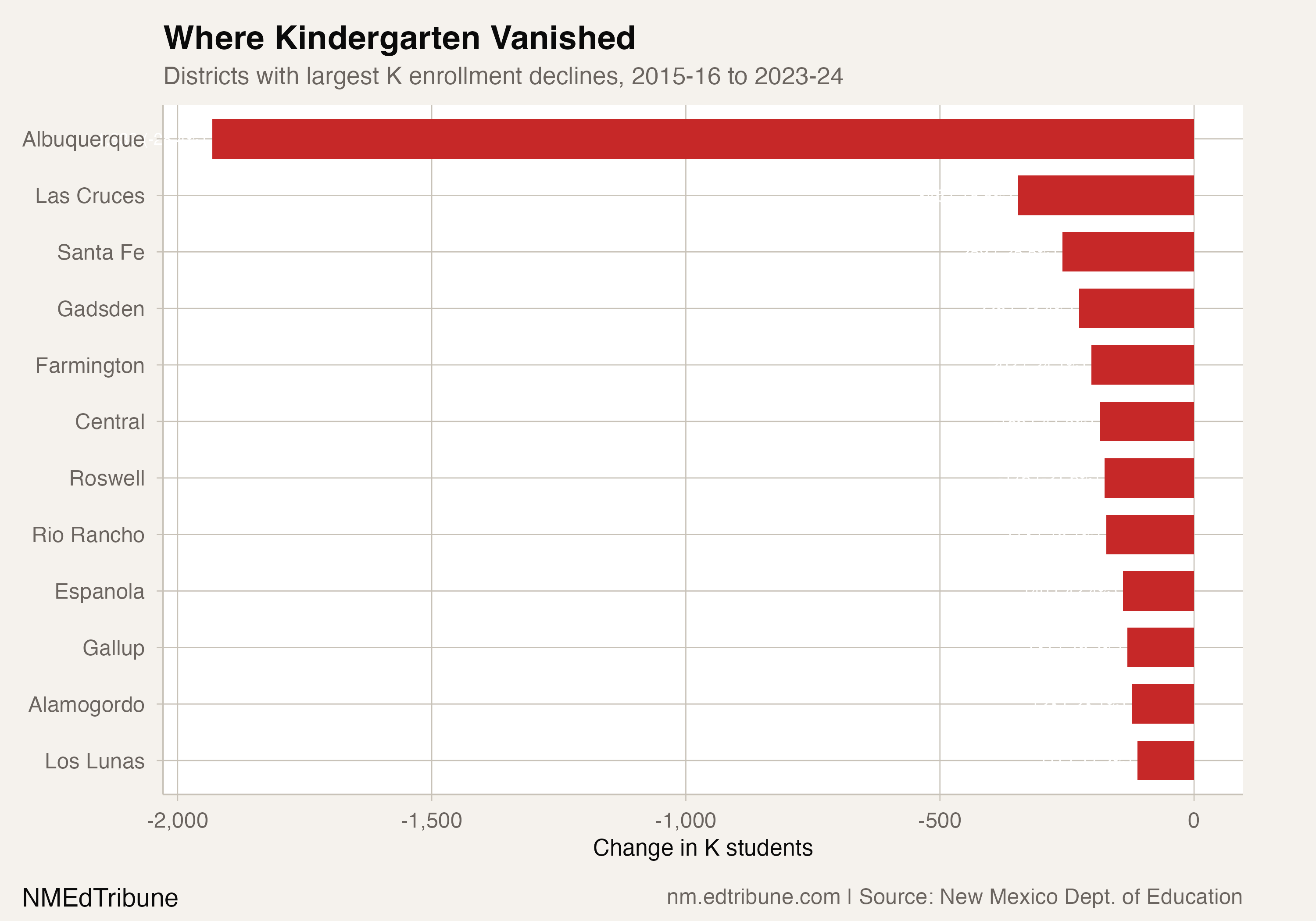
The losses run deep across every region. Las Cruces↗ET lost 346 kindergartners (-18.8%). Santa Fe↗ET lost 259 (-25.5%). Gadsden lost 226 (-23.4%). Farmington lost 202 (-24.1%). Espanola↗ET, the small northern district that has lost a third of its total enrollment since 2016, saw its kindergarten class drop from 330 to 190, a 42.4% decline.
Several smaller districts lost more than 40% of their kindergarten enrollment: Silver City (-43.9%), Bloomfield (-43.0%), Central (-41.5%). In districts this small, the losses translate to individual classrooms disappearing. Silver City went from 253 kindergartners to 142, a drop that likely means consolidating from multiple sections to one or two.
No large district escaped. Among the state's 10 largest K enrollment districts in 2015-16, every one posted a decline.
The 9th-grade influx masks the pipeline break
One feature of New Mexico's grade structure complicates a clean pipeline reading. In both 2015-16 and 2023-24, 9th-grade enrollment exceeded 8th grade by roughly 4,000 students: a 17.1% bump in 2016 and 16.5% in 2024. This likely reflects students entering public high schools from Bureau of Indian Education (BIE) schools, tribal schools, and private K-8 programs. New Mexico has approximately 7,400 students in BIE-funded schools, many of which serve only elementary and middle grades.
This influx is what keeps high school enrollment stable even as the lower grades thin. Without those roughly 4,000 additional 9th-graders entering from outside the public K-8 system each year, high school enrollment would show meaningful decline too. It also means the pipeline problem is, in some sense, larger than it appears: the public K-8 system is shrinking by more than the high school numbers suggest, because an external source of students partially compensates at the 9th-grade transition.
Pre-K grew while K shrank
One counterintuitive bright spot: pre-K enrollment rose 41.0%, from 8,123 to 11,456, over the same period kindergarten fell 20.4%. The divergence reflects New Mexico's aggressive investment in early childhood education. The state created a dedicated funding stream from the Land Grant Permanent Fund in 2022, and by the 2022-23 school year, 45% of four-year-olds were enrolled in a pre-K program, up from 1% in 2002.
"New Mexico did something remarkable." — Steve Barnett, founder, National Institute for Early Education Research, April 2024
Barnett was referring to the constitutional amendment that guarantees funding for early childhood programs, not to the enrollment trend specifically. But the pre-K expansion creates an irony: the state is reaching more children earlier than ever, yet fewer of them exist. The 3,333-student pre-K gain reflects expanded access to existing children, not a growing population. Those same children show up in the kindergarten numbers a year later, where they join a shrinking cohort.
What the pipeline predicts
The kindergarten-to-12th-grade gap will persist for at least a decade. The children who will enter kindergarten in 2030 have already been born, and their cohort is smaller than the one currently in 5th grade.
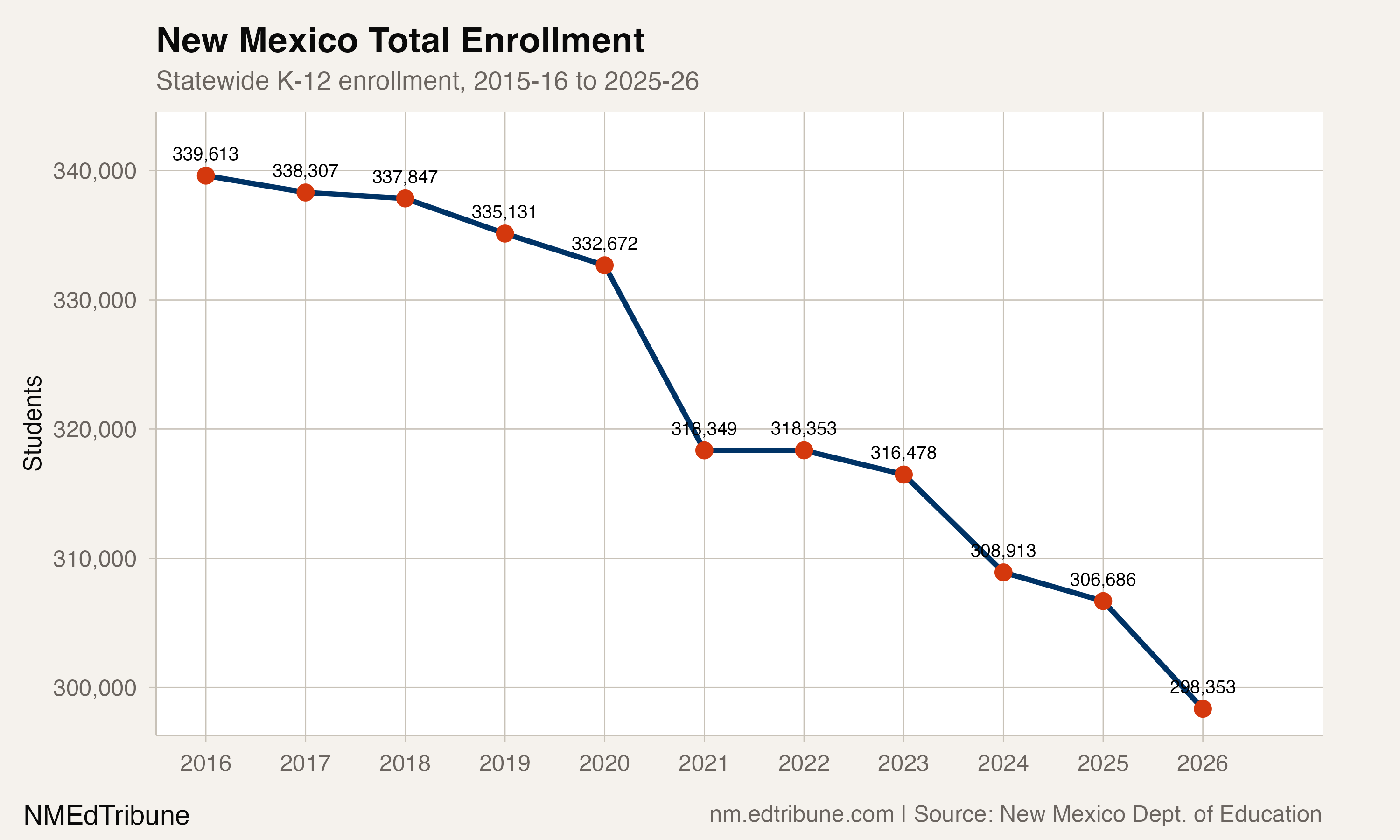
New Mexico's total enrollment has fallen from 339,613 in 2015-16 to 298,353 in 2025-26, a loss of 41,260 students (12.1%). The pipeline inversion guarantees that this decline will continue even if migration and retention hold steady, because the system loses more seniors each spring than it gains kindergartners each fall.
The fiscal consequences are direct. New Mexico's public school funding formula allocates dollars based on membership counts. Districts with membership over 8,000 that lost at least 10% of enrollment between fiscal years 2025 and 2026 are now allowed to average their membership across two years for funding purposes, a legislative buffer that acknowledges the scale of decline but does not reverse it. For a district like Albuquerque, which has lost 19,579 total students since 2015-16, averaging across two years smooths the curve but does not change its direction.
A district that lost 40% of its kindergartners eight years ago will, within the next four to five years, see that same-sized hole in its 4th- and 5th-grade classrooms. The wave is moving upward through the system, one grade per year, and it has not yet reached the grades where staffing and facilities were built for larger cohorts. Silver City went from 253 kindergartners to 142. Those 142 will be Silver City's 5th-grade class in 2029. The building will not have gotten smaller by then.
A note on the data: Grade-level enrollment is only available from NM PED for 2015-16 through 2017-18 and for 2023-24 (80-Day count). The years 2018-19 through 2022-23 and 2024-25 through 2025-26 report only statewide totals without grade breakdowns. The kindergarten and grade 12 figures cited in this article are from the bookend years with grade-level data, not interpolated estimates.
Detailed code that reproduces the analysis and figures in this article is available exclusively to EdTribune subscribers.
Discussion
Sign in to join the discussion.
Loading comments...