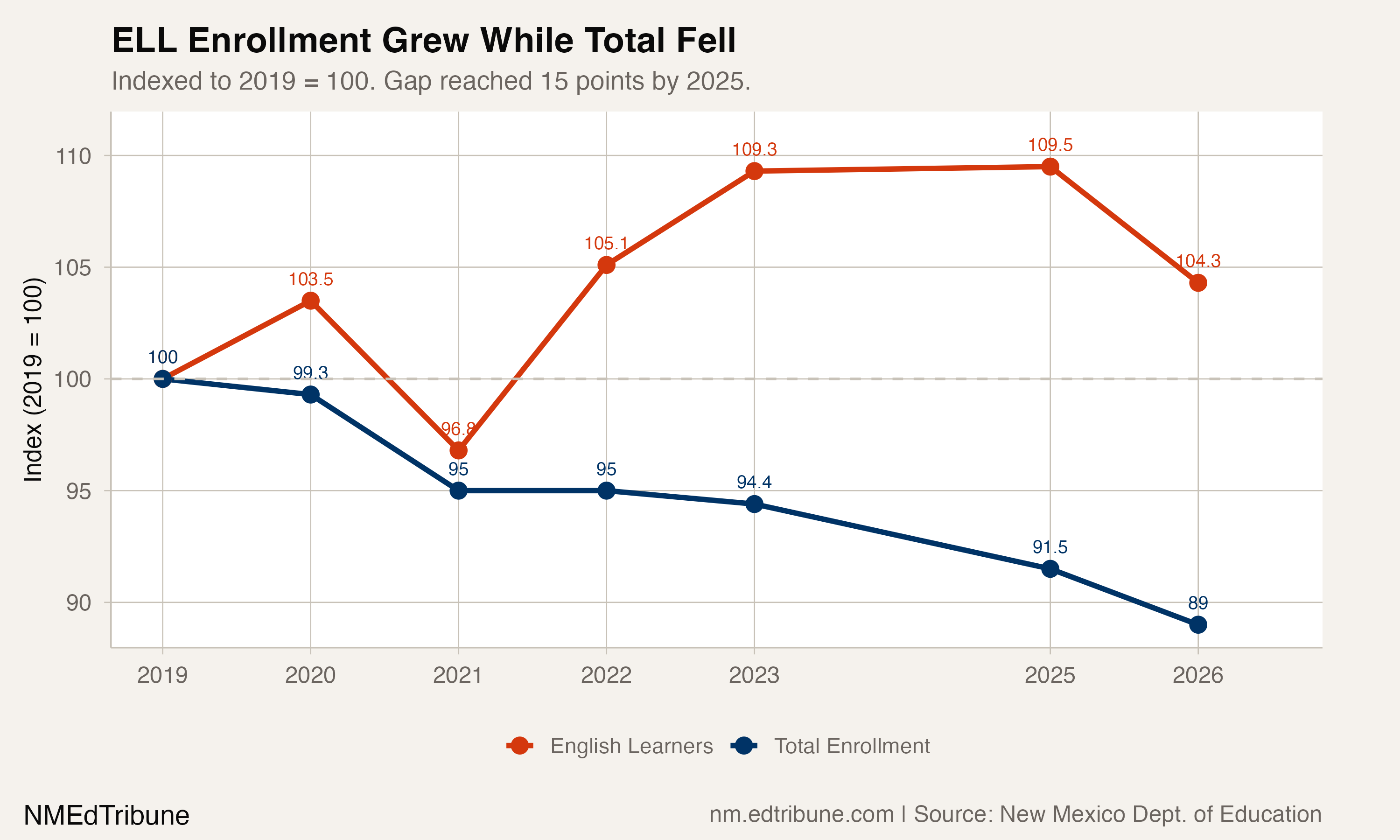
New Mexico lost 36,778 students between 2019 and 2026, an 11% decline that touched nearly every district in the state. English learner enrollment moved in the opposite direction. The state counted 53,149 ELL students in 2025-26, up 2,197 from 50,952 seven years earlier. That 4.3% gain against an 11% total loss produced a 15.3 percentage point divergence: the students learning English grew while the system around them shrank.
The gap is not abstract. It means 33 districts now have English learner shares above 20%. It means Hatch Valley↗ET, a small district on the southern border, enrolls more ELL students than non-ELL. It means Carlsbad↗ET, deep in Permian Basin oil country, saw its ELL population more than double in six years. And it means New Mexico's $4.4 billion K-12 system faces a structural mismatch: declining headcounts that reduce per-pupil funding and rising service demands that increase per-pupil costs.
The divergence in numbers
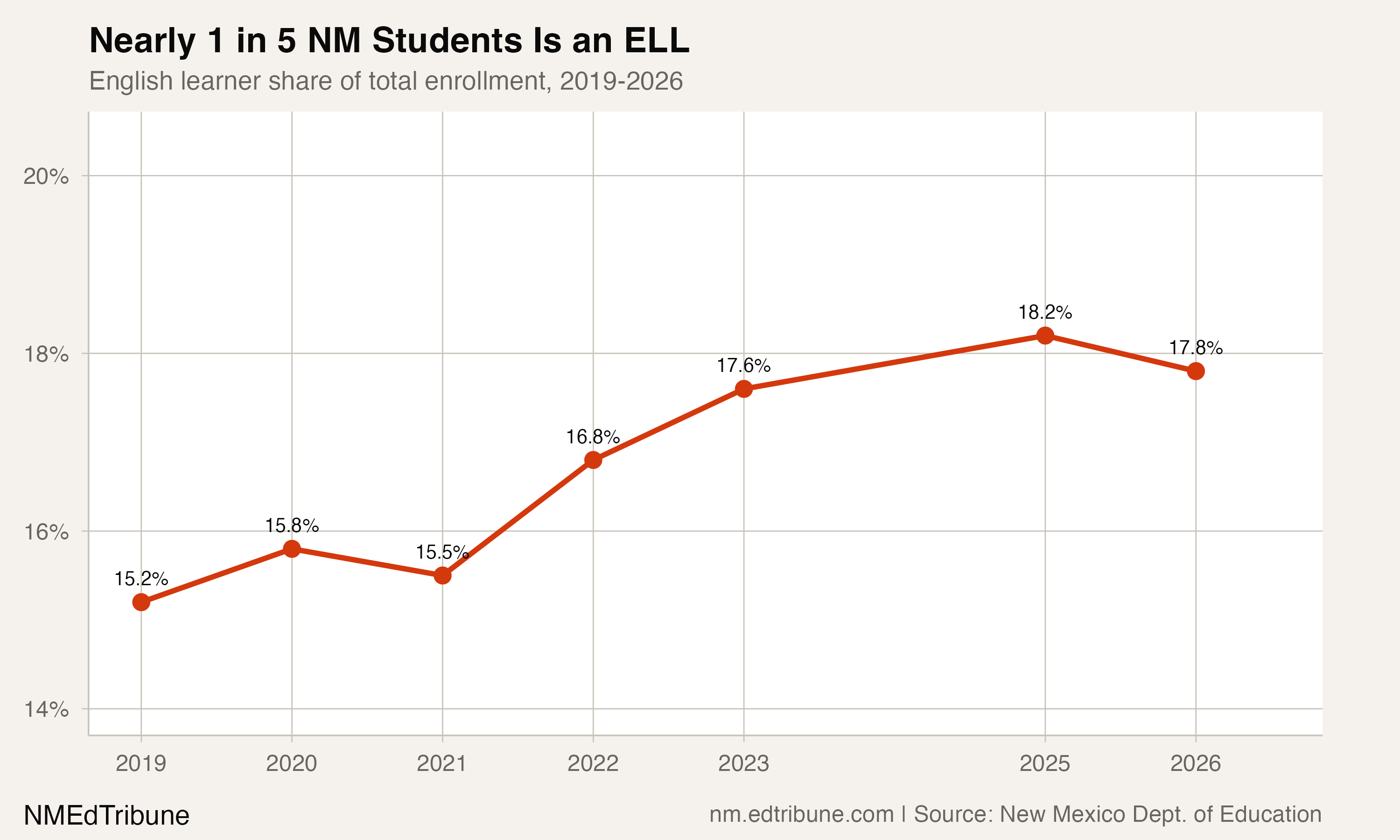
Between 2019 and 2026, non-ELL enrollment fell by 38,975 students, a 13.7% decline. ELL enrollment added 2,197 students. The effect on share was steady: English learners rose from 15.2% of total enrollment in 2019 to a peak of 18.2% in 2024-25, before dipping slightly to 17.8% in 2025-26.
That trajectory puts New Mexico well above the national average. Nationally, about 10.6% of public school students were English learners as of fall 2021, the most recent federal figure. New Mexico's 17.8% rate is nearly double that.
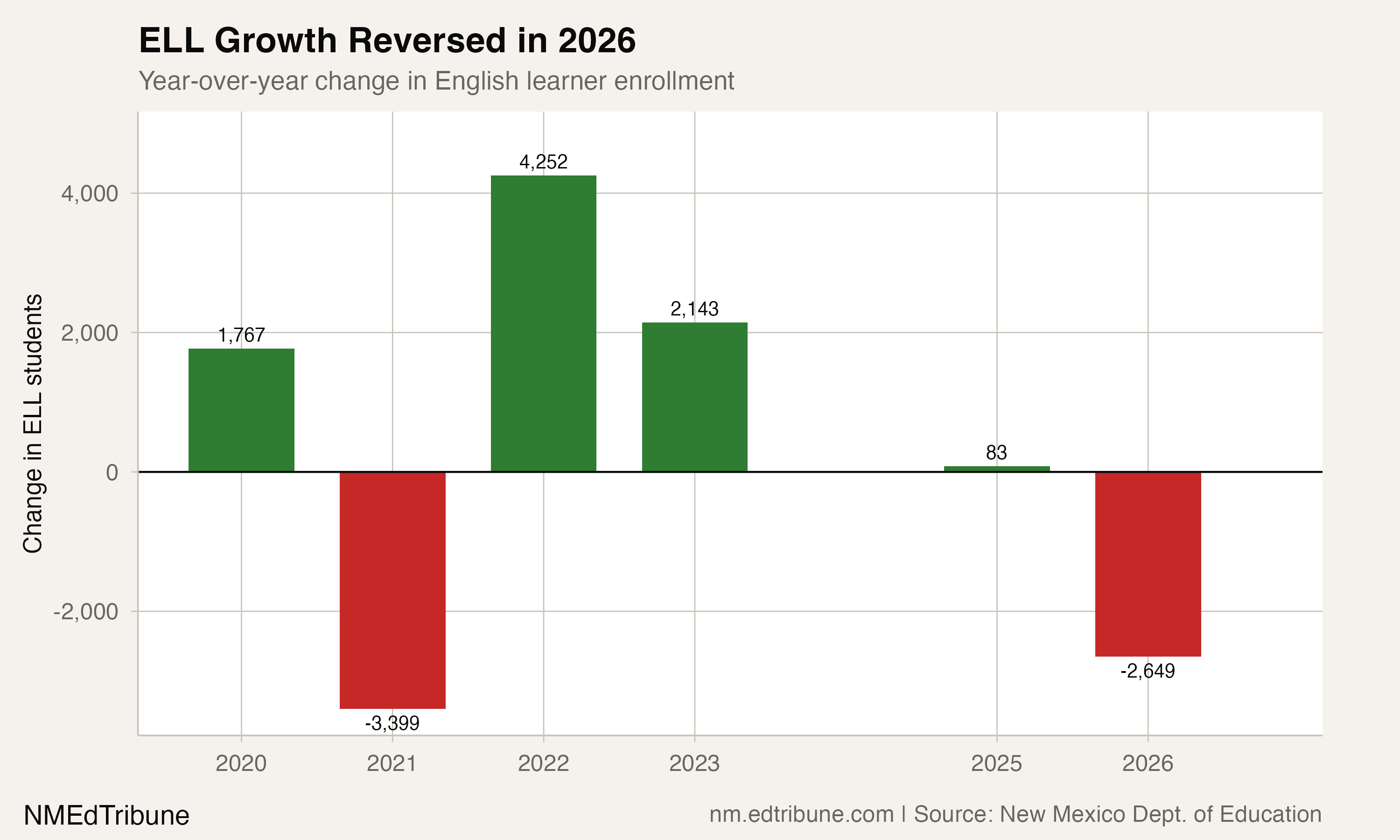
The year-over-year pattern reveals two distinct phases. From 2021 through 2023, ELL enrollment surged, adding 4,252 students in 2022 alone, a post-COVID rebound that exceeded the pre-pandemic baseline. Growth then plateaued: the 2025 count of 55,798 was only 83 students above 2023. In 2026, the trend reversed. ELL enrollment fell by 2,649 students, a 4.7% drop, the largest single-year decline in the dataset.
Where the growth is coming from
ELL enrollment can rise for two distinct reasons: new students arriving who speak a language other than English, or existing students being identified as English learners through screening. The data cannot distinguish between the two, but geographic patterns offer clues.
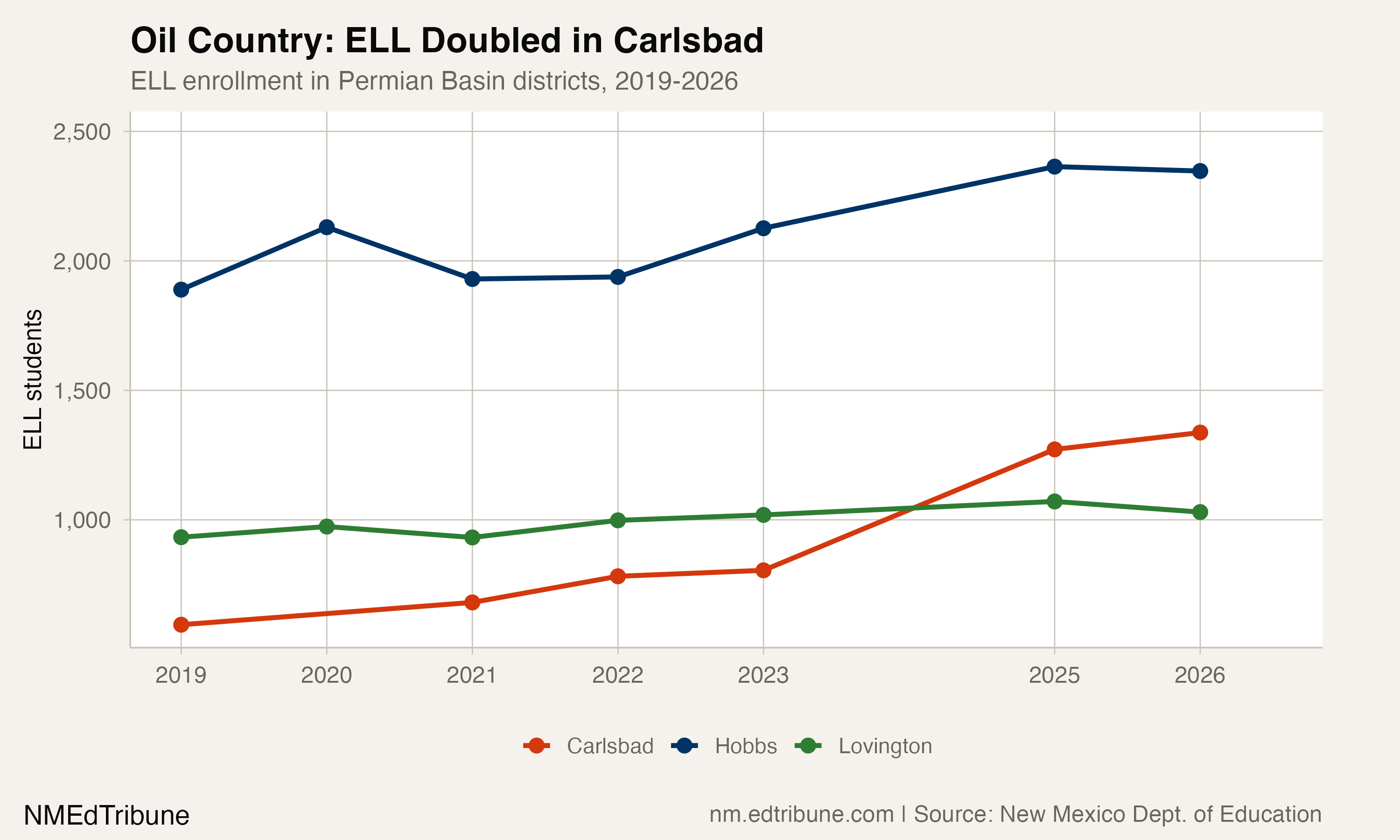
The strongest ELL growth is concentrated in southeastern New Mexico's Permian Basin, where oil and gas extraction has drawn thousands of immigrant workers and their families. Carlsbad↗ET went from 595 ELL students in 2019 (7.4% of enrollment) to 1,337 in 2026 (17.8%), a 125% increase. Hobbs↗ET grew from 1,889 to 2,347, a 24% gain that pushed its ELL share to 23.5%. Lovington↗ET rose from 933 to 1,030, reaching 31.2%.
This pattern is consistent with arrival-driven growth. The Permian Basin has experienced sustained labor migration, particularly from Mexico and Central America, as oil production expanded. In Lea County, where Hobbs and Lovington are located, Hispanics and Latinos now account for as much as 70% of the population, compared with 40% two decades ago.
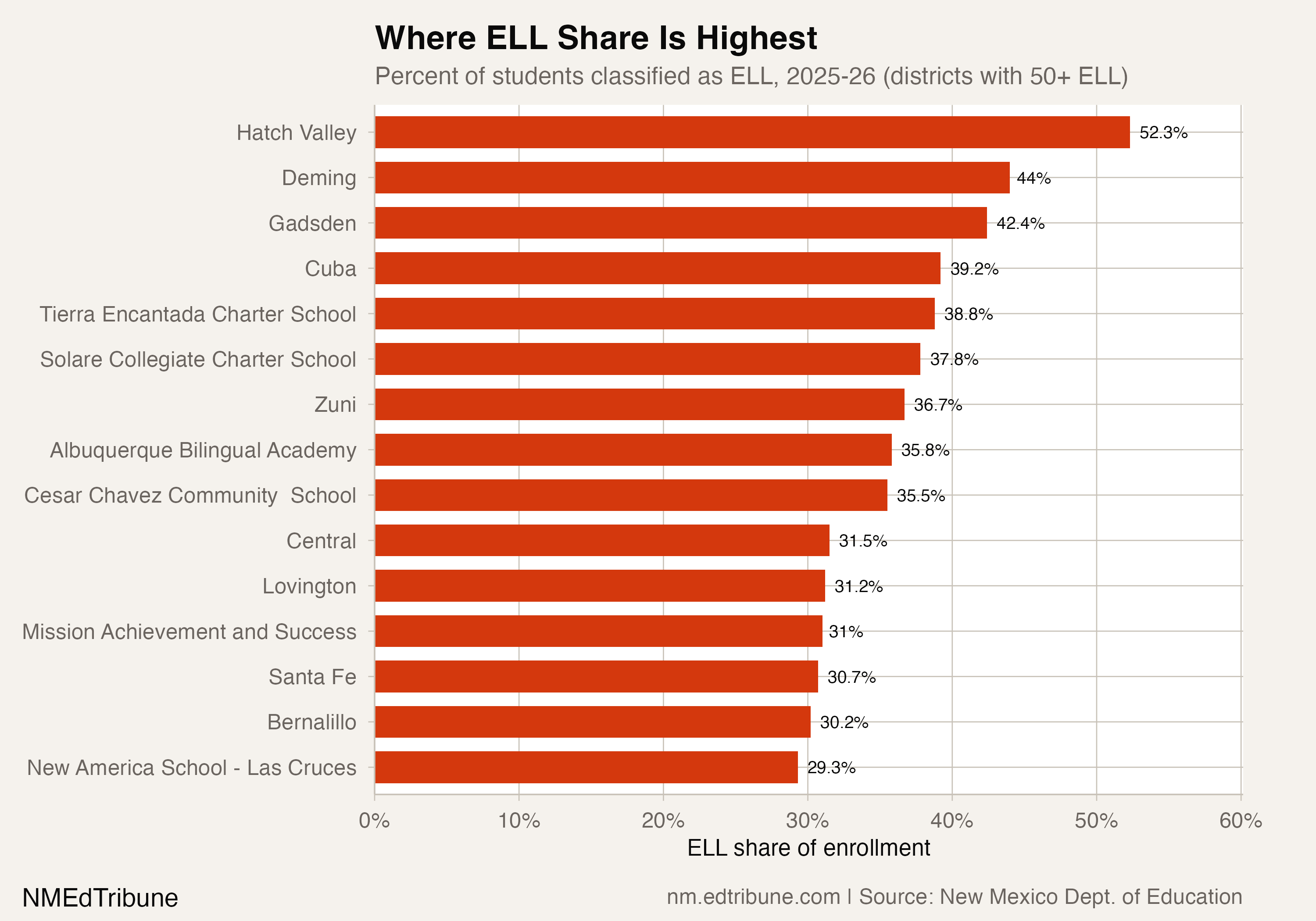
The border region tells a different story. Gadsden↗ET, Deming↗ET, and Hatch Valley↗ET have always had high ELL concentrations, reflecting longstanding cross-border communities. Hatch Valley's share rose from 43.5% to 52.3%, but its absolute ELL count grew by just 25 students. The share increase is largely a denominator effect: total enrollment fell while ELL enrollment held steady.
Improved identification may also be at work. The 2018 Yazzie/Martinez ruling found that New Mexico had failed to meet its obligations to English learners under the Bilingual Multicultural Education Act and federal civil rights requirements. The court ordered the state to address these failures, and subsequent reforms expanded screening and identification efforts. Districts that had previously under-identified ELL students may have begun counting them more systematically, inflating apparent growth.
Both forces are probably at work. Oil country growth is primarily arrival-driven. The statewide share increase, particularly in districts without obvious immigration drivers, likely reflects expanded screening.
The funding equation
New Mexico's legislature recognized the structural tension in 2025. HB 63, signed into law that year, creates a standalone English Learner Program Unit in the state's funding formula. Previously, ELL students were bundled into the broader "at-risk" funding category, diluting resources among multiple populations with different needs.
"By having it as its own category, I feel that this will help to ensure that we're being equitable." — Michael Rodriguez, executive director of Dual Language Education of New Mexico, quoted in the Los Alamos Daily Post
The new formula uses a three-year average ELL rate multiplied by a 0.33 factor to generate additional program units. For districts like Hatch Valley and Deming, where more than four in ten students are English learners, the standalone multiplier could deliver meaningful new revenue. For districts like Rio Rancho↗ET, where ELL share is 5.8%, the impact will be smaller.
But funding is only half the constraint. The state faces a bilingual teacher retention problem. A Legislative Finance Committee program evaluation found 4,055 teachers in New Mexico hold bilingual endorsements, but only about 20% actually teach in bilingual programs. The gap is not supply but willingness: bilingual-endorsed teachers report being asked to translate materials and interpret at meetings without additional compensation, creating a disincentive to work in the programs that need them most.
Where concentration is highest
Thirty-three districts had ELL shares above 20% in 2025-26. The geography splits into three clusters.
The border corridor, from Gadsden (42.4%) through Deming (44.0%) to Hatch Valley (52.3%), has maintained high ELL shares for decades. These are communities where Spanish is the predominant home language and cross-border enrollment is common.
The Permian Basin, including Hobbs (23.5%), Lovington (31.2%), and Carlsbad (17.8%), represents the fastest growth. Carlsbad's ELL share was 7.4% in 2019. It has more than doubled.
Albuquerque↗ET anchors the system. With 14,624 ELL students, it accounts for 27.5% of the state's entire ELL population. Its ELL share crossed 20% in 2024-25 and held at 20.2% in 2025-26. One in five APS students is an English learner.
The 2026 reversal
The 2,649-student ELL decline in 2026 broke a four-year growth streak and deserves scrutiny. Albuquerque alone lost 841 ELL students, accounting for nearly a third of the statewide drop. Gallup↗ET lost 477. Gadsden lost 355. Las Cruces↗ET lost 315.
Several explanations are plausible. Reclassification: students who reached proficiency thresholds on the ACCESS assessment exited ELL status, and the exit cohort exceeded the entry cohort for the first time since the pandemic. Immigration enforcement: increased federal enforcement activity in 2025-26 may have deterred enrollment among immigrant families. Total enrollment decline: a shrinking denominator means fewer new kindergartners entering the pipeline, including fewer who qualify as ELL.
The data cannot isolate a single cause. What it does show is that ELL growth in New Mexico is not a one-way escalator. The 2021 COVID dip and the 2026 reversal both demonstrate that external forces, from pandemic disruption to federal policy, can shift the trajectory sharply in a single year.
A system built for decline, serving growth
New Mexico's education system is shrinking. Total enrollment has fallen nearly every year since 2019 and now sits at 298,353, its lowest point in the data. The state lost 36,778 students in seven years. Within that contraction, English learner enrollment grew by 2,197, special education enrollment grew by 7,779 (to 20.5% of all students), and the instructional programs these students receive carry higher per-pupil costs than general education.
The budget pressure is direct. Declining headcounts reduce total funding. Rising shares of students in specialized programs increase average costs. HB 63 begins to address the ELL piece, but whether new formula units translate into bilingual classrooms, trained teachers, and effective programming depends on districts' ability to recruit and retain bilingual educators, something the state has struggled with for years.
Hatch Valley now has more English learners than non-English learners. Carlsbad's ELL population more than doubled in six years. In Hobbs, nearly one in four students is learning English. These are not districts that can wait for policy to catch up. They need bilingual teachers now, in buildings that are losing general education students, in a state where 80% of bilingual-endorsed teachers do not teach in bilingual programs. The 53,149 English learners enrolled in 2025-26 are not going anywhere. The system around them keeps shrinking.
Detailed code that reproduces the analysis and figures in this article is available exclusively to EdTribune subscribers.
Discussion
Sign in to join the discussion.
Loading comments...