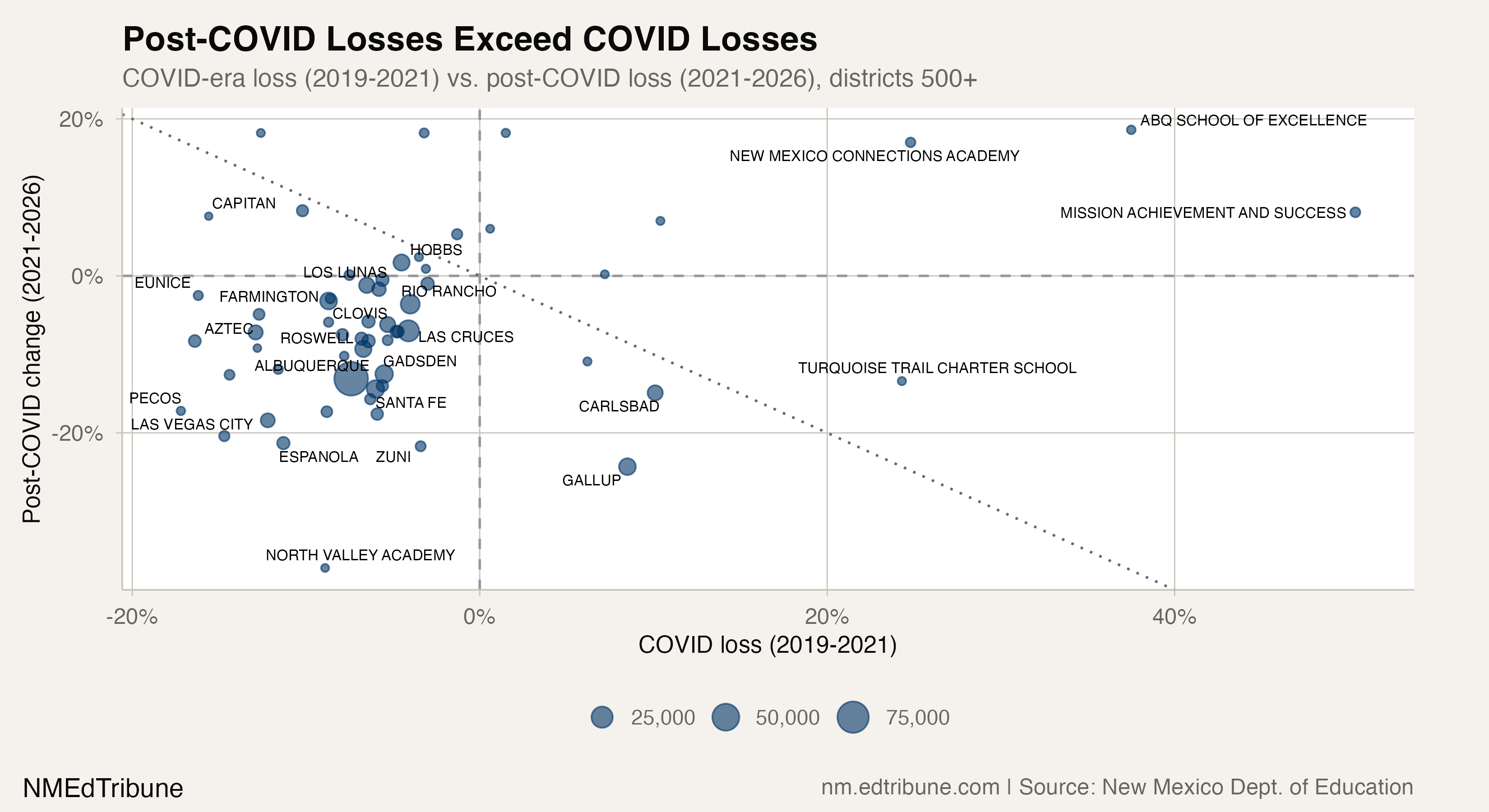
The pandemic was supposed to be a temporary shock. Albuquerque↗ET lost 6,684 students between 2019 and 2021, an extraordinary loss for any two-year period. But the five years since have been worse: APS shed another 10,983 students after schools fully reopened, bringing the district to 72,573, a 19.6% decline from its 2019 enrollment. The COVID crater, it turns out, was just the first drop on a much longer fall.
New Mexico enrolled 298,353 students in 2025-26, down 36,778 from its 2019 total of 335,131. That is an 11.0% decline in seven years. The state has not recovered a single net student since the pandemic. It has lost more.
The gap that kept growing
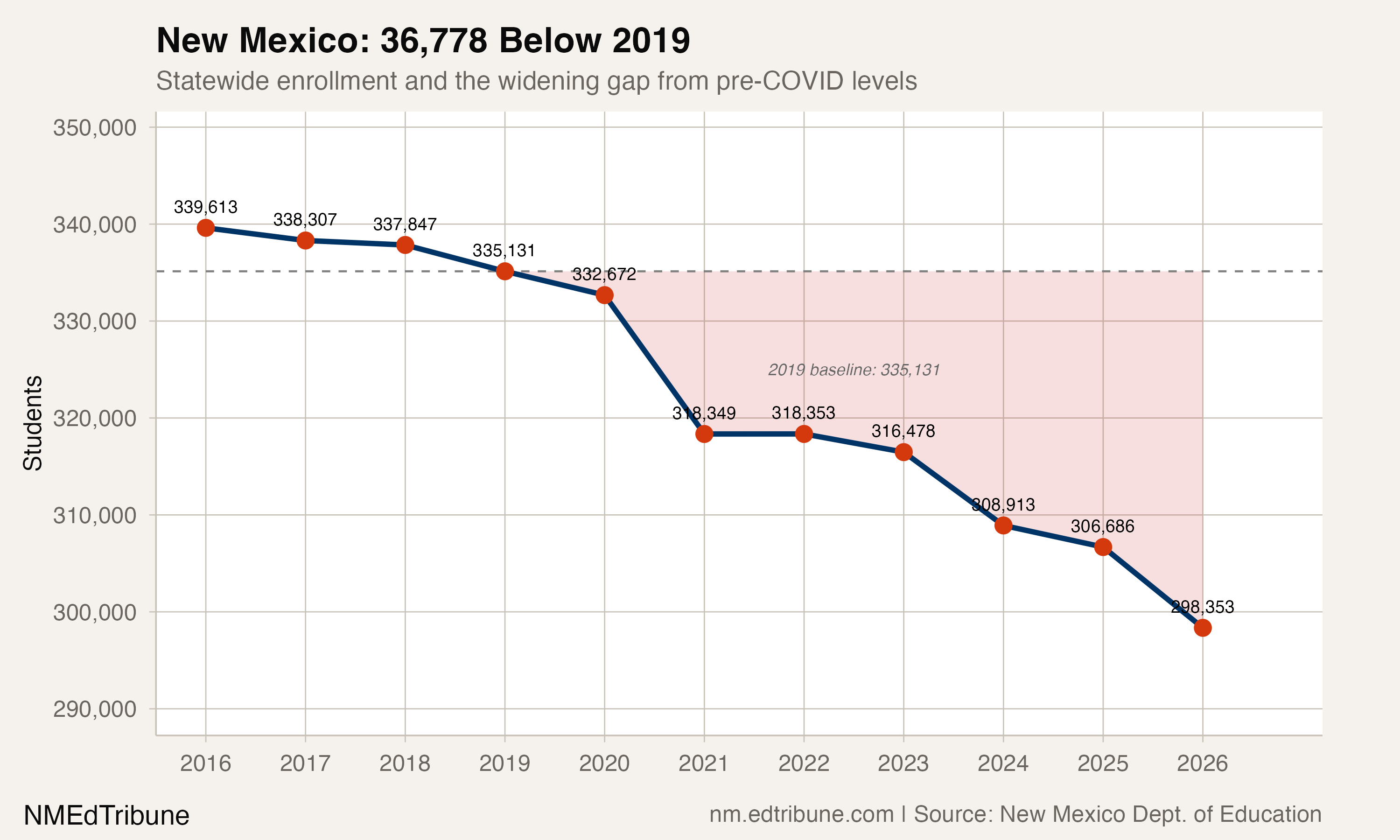
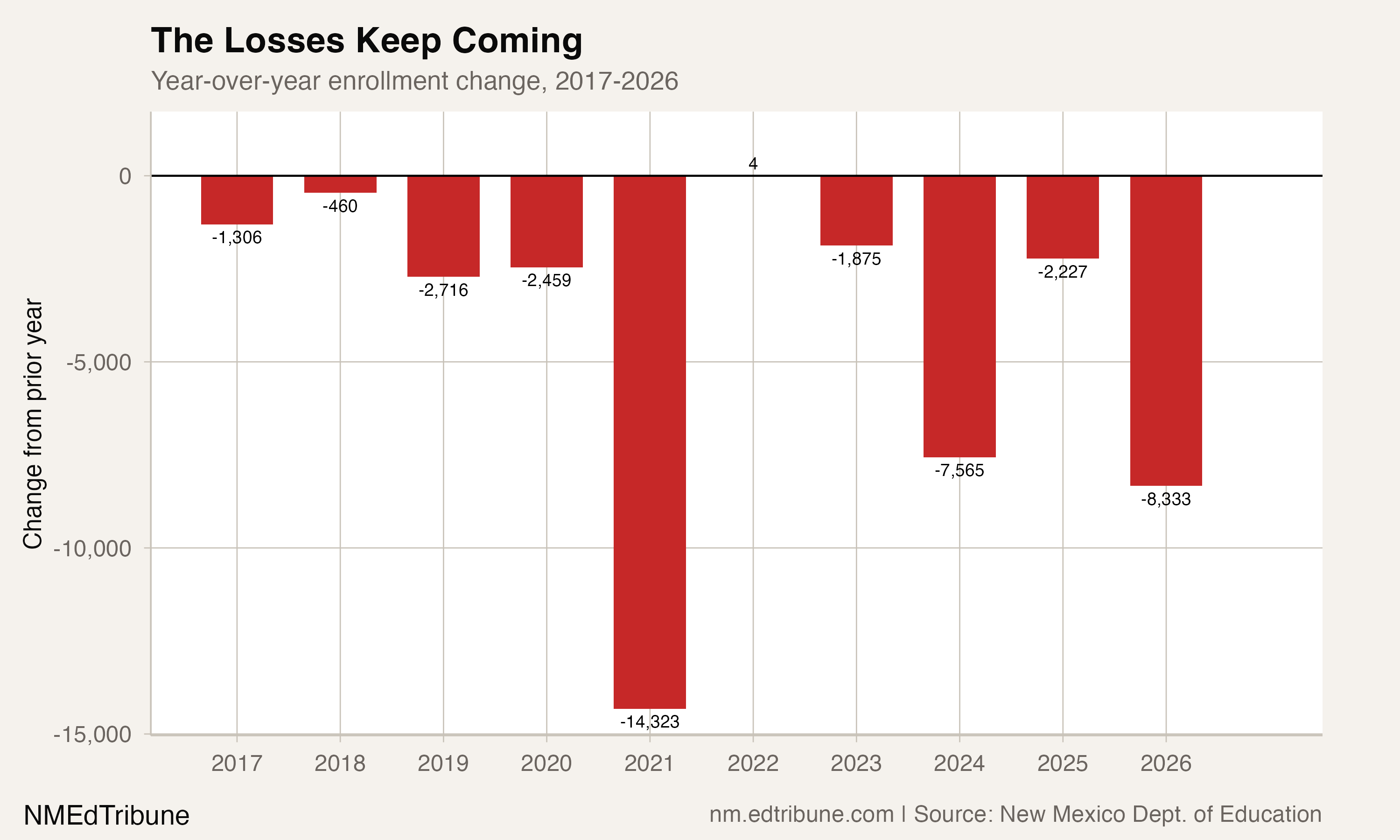
The state was already declining before COVID. Between 2016 and 2019, New Mexico lost 4,482 students, about 1,500 per year. Then the pandemic hit, and enrollment fell by 14,323 in a single year (2020-21), the largest one-year drop in the dataset.
What followed was not recovery. In 2021-22, the state added four students statewide. Four. Then the losses resumed: 1,875 in 2022-23, 5,581 in 2023-24, 4,211 in 2024-25, and 8,333 in 2025-26. The post-COVID losses (19,996 students since 2021) now exceed the pandemic-era losses (16,782 students from 2019 to 2021) by 19%.
Only 43 of 136 districts (31.6%) have returned to their 2019 enrollment levels. That rate has declined steadily: in 2020, 51.1% of districts were above their 2019 mark. By 2023, it was 34.8%. By 2026, it fell to 31.6%. Each year, a few more districts slip below their pre-COVID line and do not come back.
The weight falls on a few shoulders
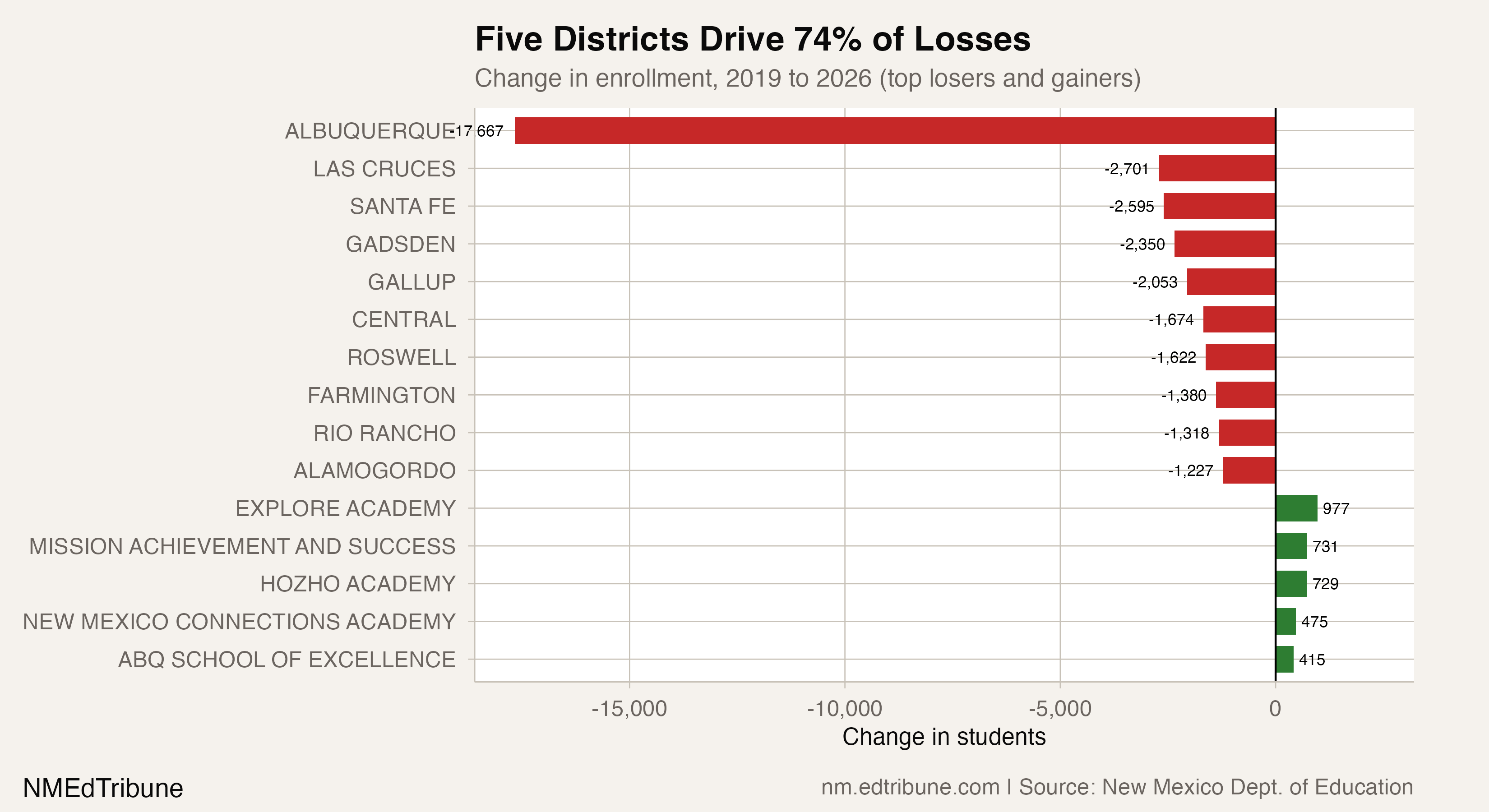
Statewide losses are concentrated to a degree that is unusual even among declining states. Five districts account for 74.4% of the total gap: Albuquerque (-17,667), Las Cruces↗ET (-2,701), Santa Fe↗ET (-2,595), Gadsden↗ET (-2,350), and Gallup↗ET (-2,053). APS alone accounts for 48.0% of the state's entire loss.
APS's trajectory has no inflection point. The district enrolled 90,240 students in 2019, and has declined every year since: 89,543, then 83,556, 82,321, 80,362, 76,870, 75,040, and now 72,573. At its current pace, APS will enroll fewer than 65,000 students within three years of a district that held 92,152 a decade ago. City Desk ABQ reported in 2024 that the enrollment variance in 2023-24 resulted in a $2.5 million reduction in State Equalization Guarantee revenue from the state.
The size gradient is severe. Not a single district enrolling more than 2,000 students in 2019 has recovered to its pre-COVID level. Zero of nine large districts (10,000+). Zero of 20 mid-size districts (2,000-10,000). Recovery is limited to smaller entities: 36.7% of districts between 500 and 2,000 students, and 40.0% of districts under 500.
Where the students went
For most districts, COVID was not the cause. It was the accelerant. The post-pandemic period has been worse than the pandemic itself for 49 of 134 districts (excluding Santa Rosa and Chama Valley, which show counting methodology changes).
The New Mexico Legislative Finance Committee identified the underlying mechanics in a 2021 policy spotlight: the state's birth rate fell 19% between 2010 and 2019, producing 16.4% fewer young children than a decade prior. That translates to roughly 5,900 fewer births per year flowing into the school system. At the same time, the working-age population declined 2% while the over-65 population grew 38%. New Mexico's 2.8% total population growth from 2010 to 2020 was driven almost entirely by aging, not by families.
"Our population is aging, which contributes to lower fertility in the state overall and school enrollment has declined in large part because our child population has declined." -- Jacqueline Miller, UNM Geospatial and Population Studies, KSFR, Sept. 2022
The LFC report found that 43% of families whose students disenrolled during the 2020-21 school year cited moving out of state as the reason. New Mexico took one of the nation's most aggressive approaches to COVID-19 school closures, ordering schools closed on March 16, 2020 and not authorizing full-time in-person return until April 2021, more than a year later. During that period, LFC staff heard "numerous anecdotal accounts of parents moving out of state to enroll their children in neighboring state schools." The LFC estimated only 55% of students who disenrolled during 2021 were likely to return.
The remaining disenrollment breaks down among homeschooling (17.4%), re-enrollment in a private or charter school (14.4%), and students dropped for non-attendance (12.0%), according to the NM Public Education Department survey cited in the LFC report.
The charter divide
Charter schools occupy a separate universe in the recovery data. Among charters, 23 of 43 (53.5%) have recovered to 2019 levels. Among traditional districts, only 18 of 91 (19.8%) have.
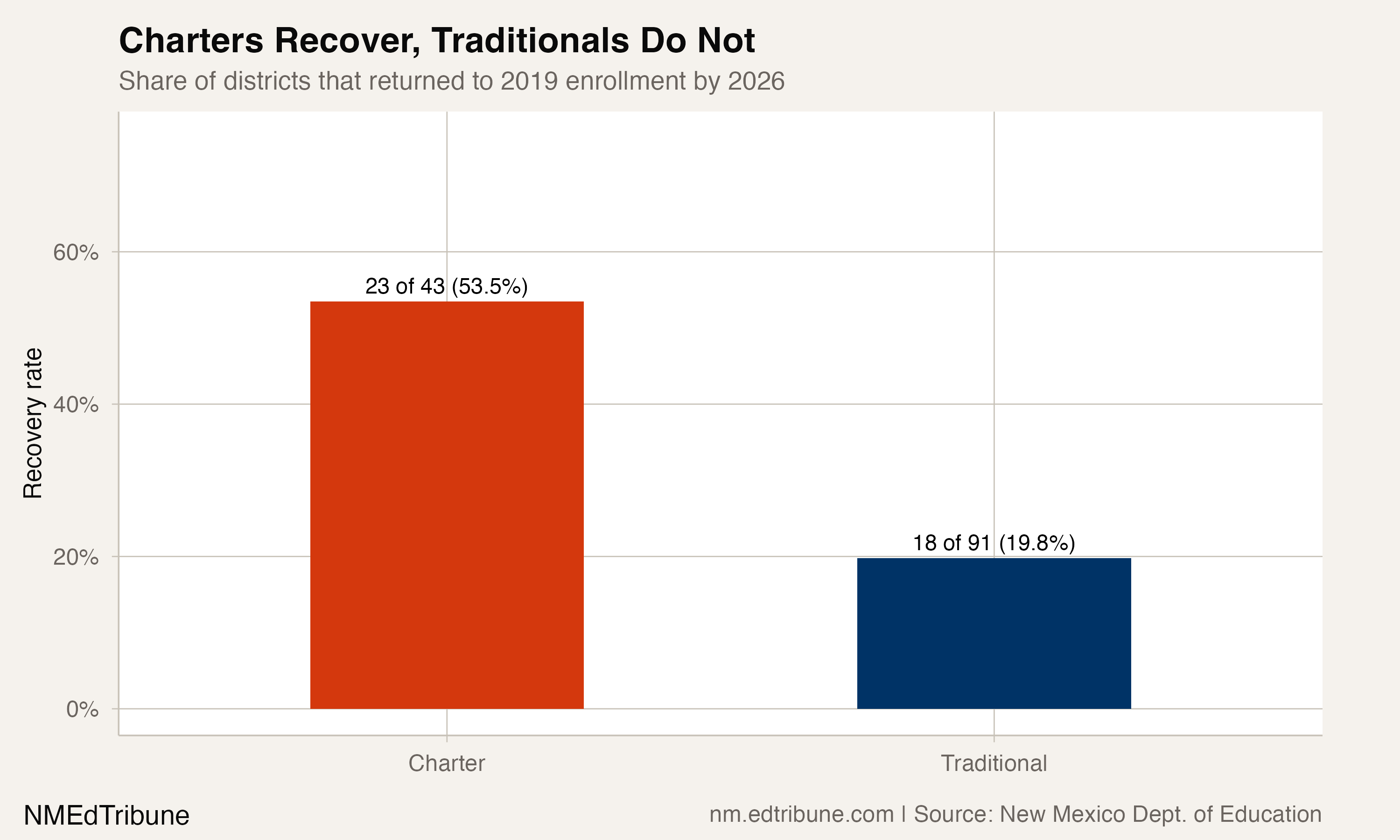
The gap goes beyond recovery rates. The traditional sector lost 47,277 students between 2019 and 2026; the charter sector gained 3,172. Explore Academy↗ET grew from 441 to 1,418 students. Mission Achievement and Success↗ET went from 1,167 to 1,898. Hozho Academy↗ET expanded from 123 to 852. These are not districts recovering lost ground. They are schools that grew through the pandemic and kept growing.
Part of the charter recovery advantage reflects size: most charters are small enough to fall into the categories where recovery is more common. But sector identity matters beyond size. Traditional districts under 500 students recovered at 40.0%, while charters of all sizes recovered at 53.5%.
That growth does not offset the traditional losses. Charter enrollment statewide totals 15,753, less than one-fifth of the 47,277 lost by traditional districts. The charter sector is growing, but it is absorbing a fraction of the students leaving, not replacing them. Most of the decline reflects students who left the state's public system entirely.
Espanola↗ET and the rural collapse
The percentage declines in smaller districts are more severe than the headline numbers from Albuquerque. Espanola lost 30.2% of its enrollment since 2019, falling from 3,555 to 2,480. Central↗ET Consolidated dropped 28.4%, from 5,893 to 4,219. Las Vegas City↗ET declined 32.1%, from 1,512 to 1,026. These are districts where losing 500 students means losing an entire elementary school's worth of enrollment and the staffing allocation that comes with it.
Gallup presents a special case. The district actually gained students during the pandemic (from 11,448 in 2019 to 12,418 in 2021), one of the few large districts to do so. But in 2025-26, Gallup dropped to 9,395, a loss of 3,023 from its 2021 level. The 2026 figure represents a restructuring event that warrants further investigation.
Farmington↗ET lost 1,380 students (11.7%), and Rio Rancho↗ET lost 1,318 (7.5%), suggesting that the decline extends beyond the urban core and the poorest rural districts into the state's suburban and mid-size communities.
The bottom is not in sight
New Mexico's public school enrollment has not reached bottom. The state's birth rate, already 19% below its 2010 level, continued to decline after the pandemic. The LFC projected in 2021 that the number of high school graduates would fall 22% by 2037. The 0-to-14 age group is projected to shrink by 10.2% between 2020 and 2040, according to UNM Geospatial and Population Studies projections cited in the LFC report.
The 2025-26 loss of 8,333 students is the second-largest single-year decline in the dataset, behind only the pandemic year of 2020-21. If the state loses students at even half that pace, enrollment will fall below 280,000 within four years, a level not seen since the early 2000s.
The budget hit is direct. At approximately $11,000 per pupil in state funding, the 36,778-student gap since 2019 represents over $400 million in annual revenue that no longer flows to district budgets. APS CFO Renette Apodaca told NM Education that the district is "currently identifying essential areas that require funding and exploring alternative funding sources for key initiatives." Despite enrollment falling by more than 20,000 since 2016, APS approved a budget of almost $2.2 billion for 2024-25, its largest ever. That budget assumed a 2% enrollment decline. The actual decline was 3.3%. Every percentage point of miss costs roughly $2.5 million in state formula funding that has already been spent.
Detailed code that reproduces the analysis and figures in this article is available exclusively to EdTribune subscribers.
Discussion
Sign in to join the discussion.
Loading comments...